
Why Spain Remained Catholic While Europe Went Protestant
Spain's geopolitical power in Rome made the Reformation politically impossible, preserving its Catholic identity unlike its European neighbors.
English · Original discussion in Spanish · Published
Why Spain Remained Catholic While Europe Went Protestant
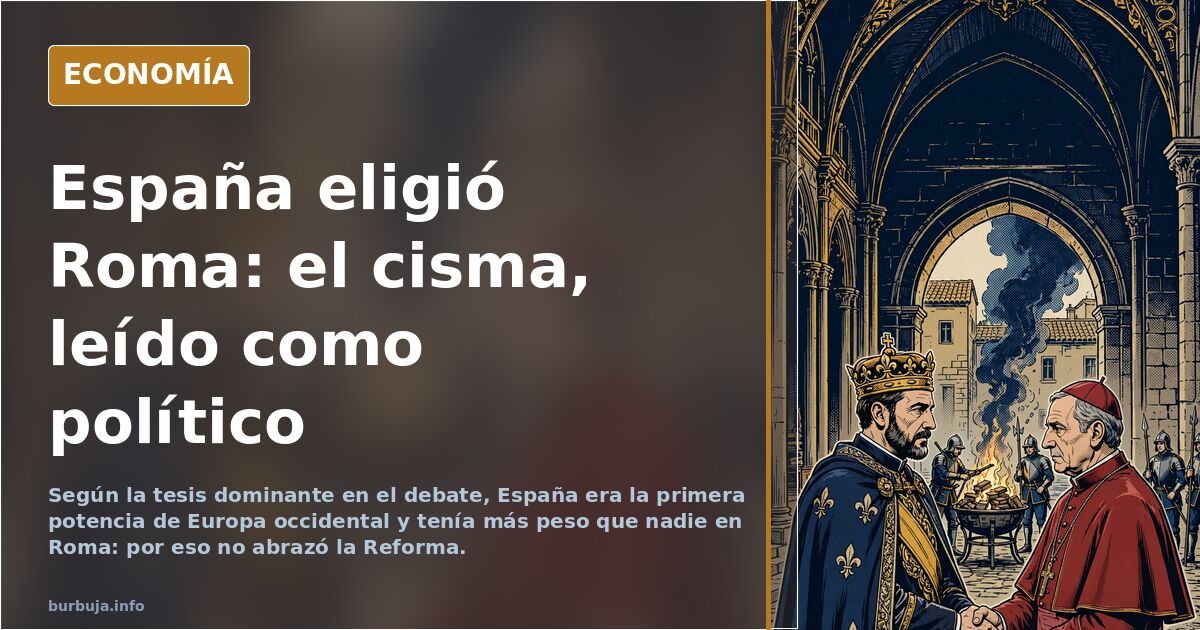
Why did Spain stay Catholic while England, Scandinavia, and German principalities embraced the Reformation? The dominant answer is geopolitical, not theological. As Europe's top power, Spain held immense influence in Rome. Switching to Protestantism would not have secured reliable allies among German princes or Henry VIII's England, while costing Spain its existing ones. This context is illustrated by the episode where Charles I deposed a pope who defied him.
Why Spain Did Not Break With Rome
The Spanish Crown has been Catholic since its founding. The reasoning accumulates: Spain had conquered half of Italy, maintained a dynastic alliance with Austria, and left only Venice as an independent peninsular power. Conversion would have complicated Italian hegemony without offering much in return.
Some argue that if Spain had been Protestant, Charles I would have executed Luther at Worms, sparing Europe a series of wars. This hypothesis is unprovable but frames the schism as a political move, not a dispute of faith. With the Habsburgs committed to the Catholic cause, the path of royal conversion was closed from the start.
Luther's Bible: Canon, Septuagint, and Masoretic Text
Here the terrain becomes technical. Luther, according to circulating accounts, chose the Jewish canon over the Septuagint—the Greek text used by early Christian communities—and removed seven books from the Old Testament. The Septuagint dates to the 3rd century B.C. in Ptolemy II Philadelphus's Egypt, though some scholars consider the Letter of Aristeas a later forgery dating the translation to the 2nd century B.C. The Masoretic text, by contrast, did not incorporate vowel signs until the 9th century A.D.
This nuance is significant: for centuries, Hebrew transmission relied on oral tradition. This leads to an uncomfortable argument for the Reformation: those claiming to adhere only to the text chose which text, selecting from available versions.
The Core Disagreement: Works vs. Sola Fide
Behind the canon lies doctrine. Catholic tradition holds that humans have sufficient grace to build God's work, change their destiny, and earn heaven through good works. The Protestant reading starts with sola fide: faith alone is sufficient, and works do not save. Everything else hangs from this axis—the sacraments Luther removed, sacramentals, the role of the Virgin and saints as intercessors. Without priesthood or apostolic succession, the entire structure is reorganized.
The debate is also read through an economic lens, referencing Weber's thesis and a possible link between Protestant emphasis on individual work and the capitalist takeoff in Northern Europe, versus the Catholic emphasis on visible works: cathedrals, hospitals, universities, and missions.
Works, Missions, and the Narrative of Two Continents
The clash extends to colonization. One part of the analysis argues that Catholicism generated institutions—the first university in South America around 1530, the first grammar of Native American languages around 1540—and that Catholic evangelization treated indigenous peoples differently than other powers. The other side responds with the Inquisition: three centuries of cultural backwardness, according to this reading, and a comparison made conveniently.
These are conflicting narratives about the same century. Some speak of missions and hospitals; others of exclusions and censorship. Rarely is a past issue played out so intensely in the present.
Hierarchy or Jesus Christ? The Unresolved Question
Underlying all this is the question of origin: why trust the word of popes instead of adhering strictly to Jesus Christ. The Catholic answer is succession—from Peter to his vicars—and community: Christians are not isolated atoms but a people praying for one another, including the deceased. The Protestant answer is conscience: if Scripture contradicts the preacher, Scripture wins, period.
Neither side will move their piece. Five centuries later, the rift remains open, and anyone expecting doctrinal reconciliation should not expect any catering service.
Also available in: Deutsch
Summary of a discussion on Burbuja.info - Foro de economía, actualidad y política., translated from Spanish and reviewed before publication. Read the full discussion (255 replies).
More summaries
-
Juan Carlos I and Bárbara Rey: The Debate Over Spain's Economic Miracle
Images of Juan Carlos I and Bárbara Rey reignite the economic debate on Spain's post-1975 growth, covering per capita income, 2008 debt, and European funds.
-
Juan Carlos I: benefactor or corrupt? The quote reigniting the debate
Juan Carlos I reopens the debate in 2026: was he a benefactor who brought million-dollar contracts to Spain or the source of political corruption? An analysis of both sides.
-
Leire Martínez: Weight and the Price of Image in Music
Leire Martínez, ex-LOVG, faces menopause and scrutiny over her weight. How much does appearance condition an artist? Analysis with data and real cases.
-
The left claims this is a coup by reactionaries via judges and the Civil Guard, all lies
An analysis of the debate on political polarization in Spain, the legitimacy of institutions and the questioning of judicial neutrality. Join the discussion.
-
Spain's school holidays: when teachers and pupils get too much time off
How effective is the school calendar in Spain? We analyse the distribution of school days and the debate between work-life balance and educational quality. Read on.
-
Abascal meets US ambassador in Madrid amid political crisis
Santiago Abascal met the US ambassador in Madrid at a time of high political tension. Is the Sánchez era ending under Washington's watch?