
Why Spain Lost All American Territories While France and UK Retained Some
Spain ended the 19th century with no sovereignty in the Americas, unlike France and the UK. This analysis explores the causes of this imperial collapse.
English · Original discussion in Spanish · Published
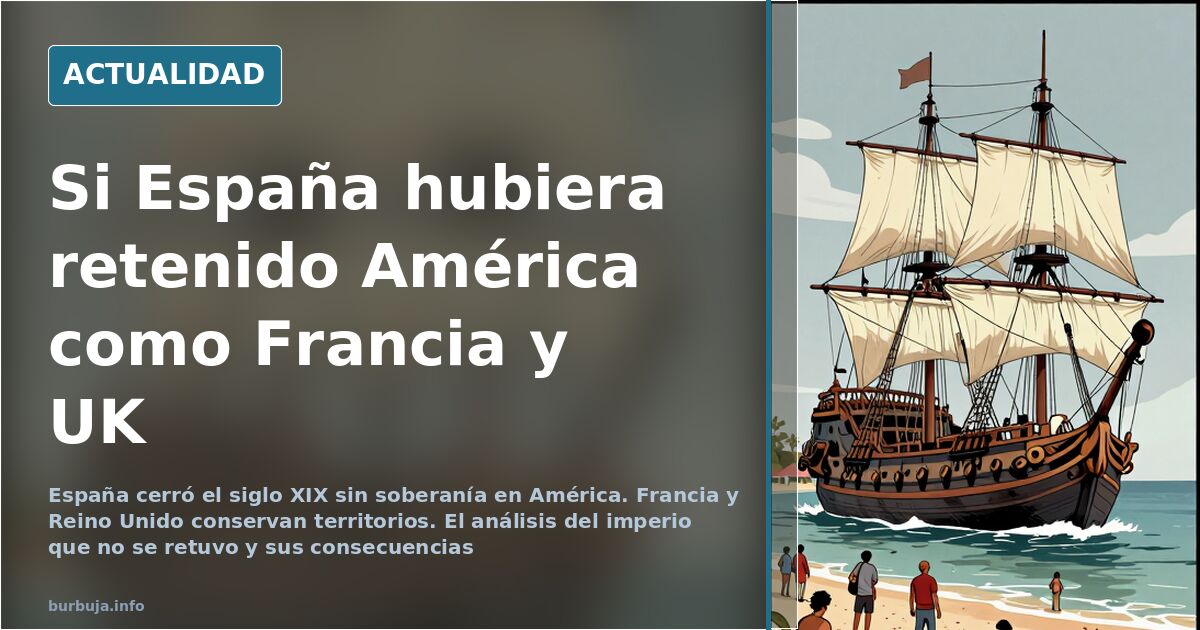
Why Spain Kept Not a Single Island in the Americas
Spain closed the 19th century without an inch of sovereignty on the American continent. No Cayman Islands, no Bermuda, not even a piece of Guyana. France retains Guiana, Martinique, or Guadeloupe; the United Kingdom keeps the Falklands, Cayman, or Montserrat; the Netherlands remains in Aruba and Curaçao. The question that opens the issue is simple: why did the most extensive empire in history not retain even a small island? The repeated answer in the thread: Napoleonic wars, fiscal bankruptcy, and a Creole elite who, it is argued, sold out to the highest bidder.
The original premise was not minor. If Spain had retained the American territories as France and the UK did, would the United States exist? Would we have population, resources, and a single language? Would Texas and California be Spanish? The most repeated answer in the analysis is emphatic: the United States would not exist, or it would have been Spanish. The territories would have been assimilated and integrated, as peine with others. Regarding Canada, there is less consensus: no one specifies if territory would have been annexed.
What Peine to the Viceroyalties: The Bankruptcy of 1808
The most repeated explanation points to a specific collapse. The Napoleonic invasion, six years of Peninsular War, the betrayal of Creole elites, and a hundred years of Bourbons managing Spain from Paris. In six years, what was built since 711 came down. The empire reduced to nothing.
Some argue the problem was not military. The British did not destroy the viceroyalties by force; they did so through social engineering and internal moles. They had to resort to indirect tactics because they could not do it by force. The Spanish Empire lasted more than three centuries, two of them with absolute supremacy. The British one, a century and a half. The numbers do not fit the narrative of inevitable defeat.
The comparison with other colonial powers is what disorients. France, the UK, and the Netherlands retain American territories with different statuses: from overseas departments to British overseas territories. Spain has nothing. Not even a small island.
The Scenario Considered: Sell Cuba and Save Puerto Rico
The most concrete counterfactual exercise appearing in the analysis is this: if Spain had sold Cuba, avoiding war with the United States, it is not far-fetched to imagine that Puerto Rico would still be Spanish territory with a special status, similar to French Guiana. That is the realistic ceiling that could have been aspired to.
The other path mentioned is a Hispanic Commonwealth of Nations after the independences. A joint block managing the resources of these lands, with common foreign, economic, and defense policy. It did not happen. Between the Anglo-Saxons wanting fragmentation, traitors governing, and people not knowing their history, the result is the current one.
The late meeting between the domains of Spain and Portugal at the end of the 18th century is the most ambitious scenario proposed. The Salic Law was abolished, not just for dynastic trivialities. This would have generated a Leviathan of thirty million square kilometers that would have had to assert itself through diplomacy and war. With pogre adoption of the industrial revolution, Mexico, Caracas, Lima, and Rio de Janeiro could have filled up with scientists and technicians. If Russia survived until the 20th century and produced science, this block could too.
The Language Gap: Neither Unites nor Convinces
Consensus breaks here. One part of the analysis argues that what unites peoples is race and blood, not a language. Spanish outside Spain would be useless. The Spanish-speaking association would be, in this reading, a burden.
The contrary answer is equally harsh: the Anglo-Saxons surpassed Spain in science, technology, weaponry, and navigation. Their positivist vision and the incorporation of Jews into society placed them where they are. Spain could not counteract them and was swept away. The rebuttal: no philosophy, no science, technology only in the industrial revolution, no art, no weaponry (they just manufactured more), no navigation either. The British advantage reduces to two factors: the steam engine applied to factories and a pirate elite that dominated the 19th century.
The point where the analysis stalls is this: with these differentials, integration should be evident. It is not. No one fully explains why.
Key Data of the Issue
Spain closed the 19th century without an inch of sovereignty on the American continent. No Cayman Islands, no Bermuda, not even a piece of Guyana. France retains Guiana, Martinique, or Guadeloupe; the United Kingdom keeps the Falklands, Cayman, or Montserrat; the Netherlands remains in Aruba and Curaçao. The question that opens the issue is simple: why did the most extensive empire in history not retain even a small island? The repeated answer in the thread: Napoleonic wars, fiscal bankruptcy, and a Creole elite who, it is argued, sold out to the highest bidder.
The original premise was not minor. If Spain had retained the American territories as France and the UK did, would the United States exist? Would we have population, resources, and a single language? Would Texas and California be Spanish? The most repeated answer in the analysis is emphatic: the United States would not exist, or it would have been Spanish. The territories would have been assimilated and integrated, as peine with others. Regarding Canada, there is less consensus: no one specifies if territory would have been annexed.
What Peine to the Viceroyalties: The Bankruptcy of 1808
The most repeated explanation points to a specific collapse. The Napoleonic invasion, six years of Peninsular War, the betrayal of Creole elites, and a hundred years of Bourbons managing Spain from Paris. In six years, what was built since 711 came down. The empire reduced to nothing.
Some argue the problem was not military. The British did not destroy the viceroyalties by force; they did so through social engineering and internal moles. They had to resort to indirect tactics because they could not do it by force. The Spanish Empire lasted more than three centuries, two of them with absolute supremacy. The British one, a century and a half. The numbers do not fit the narrative of inevitable defeat.
The comparison with other colonial powers is what disorients. France, the UK, and the Netherlands retain American territories with different statuses: from overseas departments to British overseas territories. Spain has nothing. Not even a small island.
The Scenario Considered: Sell Cuba and Save Puerto Rico
The most concrete counterfactual exercise appearing in the analysis is this: if Spain had sold Cuba, avoiding war with the United States, it is not far-fetched to imagine that Puerto Rico would still be Spanish territory with a special status, similar to French Guiana. That is the realistic ceiling that could have been aspired to.
The other path mentioned is a Hispanic Commonwealth of Nations after the independences. A joint block managing the resources of these lands, with common foreign, economic, and defense policy. It did not happen. Between the Anglo-Saxons wanting fragmentation, traitors governing, and people not knowing their history, the result is the current one.
The late meeting between the domains of Spain and Portugal at the end of the 18th century is the most ambitious scenario proposed. The Salic Law was abolished, not just for dynastic trivialities. This would have generated a Leviathan of thirty million square kilometers that would have had to assert itself through diplomacy and war. With pogre adoption of the industrial revolution, Mexico, Caracas, Lima, and Rio de Janeiro could have filled up with scientists and technicians. If Russia survived until the 20th century and produced science, this block could too.
The Language Gap: Neither Unites nor Convinces
Consensus breaks here. One part of the analysis argues that what unites peoples is race and blood, not a language. Spanish outside Spain would be useless. The Spanish-speaking association would be, in this reading, a burden.
The contrary answer is equally harsh: the Anglo-Saxons surpassed Spain in science, technology, weaponry, and navigation. Their positivist vision and the incorporation of Jews into society placed them where they are. Spain could not counteract them and was swept away. The rebuttal: no philosophy, no science, technology only in the industrial revolution, no art, no weaponry (they just manufactured more), no navigation either. The British advantage reduces to two factors: the steam engine applied to factories and a pirate elite that dominated the 19th century.
The point where the analysis stalls is this: with these differentials, integration should be evident. It is not. No one fully explains why.
Key Data of the Issue
- Duration of the Spanish Empire: more than three centuries, two of absolute supremacy
- Duration of the British Empire: a century and a half
- Maximum scenario proposed: 30 million km² between Spain and Portugal
- Six years of Napoleonic war to dismantle what was built since 711
Summary of a discussion on Burbuja.info - Foro de economía, actualidad y política., translated from Spanish and reviewed before publication. Read the full discussion (111 replies).
More summaries
-
Sánchez's China ties spark debate on Spain's US alliance
Analysis of Pedro Sánchez's foreign policy: balancing relations with Beijing and Washington, risks, data, and strategic implications for Spain.
-
US Prepares Potential Military Action Around Cuba, CBS Reports
CBS reports the US is preparing possible military action around Cuba, not within. Spain's "law of grandchildren" and oil factor influence calculations.
-
UK and Europe Civil War Risks: Ethnic Tensions and Social Unrest
Analysis of civil war risks in the UK and Europe due to ethnic tensions, supported by population data and social projections.
-
Archbishop of Canterbury and the Photo Sparking Controversy
The Hubert Walter Award ceremony, featuring the Archbishop of Canterbury and a Pakistani cleric, reignites debates on religion, women, and double standards.
-
Murcia rape livestream: three arrested, two released
A man was drugged with fentanyl and morphine in Murcia before being raped on a live stream watched by 30 people. Three suspects have been detained.
-
Spain's 'Curse' Theory: Forum Claims Link Franco Exhumation to Crises
A pandemic, volcanic eruption, blackout, and perceived systemic corruption in under a decade fuel online theories blaming the exhumation of Francisco Franco.