
Why Spain has a bar on every corner: the most popular business to set up
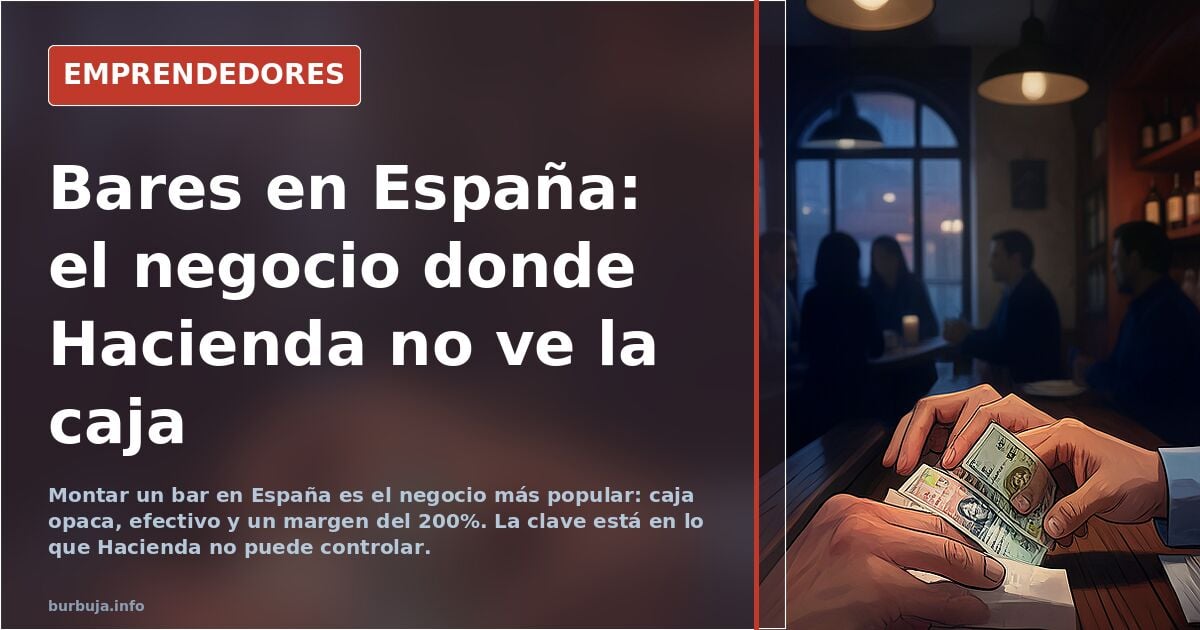
Opening a bar in Spain is the most popular business: opaque tills, cash payments and a 200% margin. The key lies in what the tax authorities cannot control.
English · Original discussion in Spanish · Published
Why so many bars open in Spain: the explanation nobody gives
Opening a bar in Spain is easier than passing a driving test. You don't need a trade, or qualifications, or a business plan that would survive serious scrutiny. All it takes is knowing how to pour a beer and having some savings. That is the thesis running through a debate that has been going on for more than fifteen years and resurfaces every time someone wonders why there is a bar under every building in this country. The short answer: because the business, as it is practised, is a goldmine. The long answer has to do with the till, with the tax office and with a culture that cannot live without its eleven o'clock coffee.
The till trick: what isn't rung up doesn't exist
The mechanism is old and familiar to anyone who has ever worked as a waiter. The cash register stays open, or gets manipulated, or the button simply isn't pressed. The real takings are kept "off the books": through crates of soft drinks, through kegs, through what goes into the pocket. This way, according to a calculation circulating in the debate, the bar owner saves the 48% in taxes attached to each drink and keeps a margin of around 200% on the cost price. A Coca-Cola that costs the supplier 0.15 cents sells for two euros. The rest is clean.
Some argue that the tax office has tools to cross-check data: if you buy 24 Coca-Colas, you have to sell them or have them in the storeroom. The supplier's invoice gives it away. But the counterargument is just as solid: if the supplier is also defrauding — and it is estimated that 95% do — the trail disappears. And in hospitality, money comes in cash, hand to hand. Cold, hard cash.
Estimates, slot machines and the magic button for undeclared money
The debate gets tangled when someone asks why some bar owners pay tax under the módulos system (a Spanish simplified tax regime based on estimated income). The answer isn't that they are stupid: it's that the módulo is a way of declaring a fixed amount agreed with the tax authorities, regardless of what actually comes through the door. Perfect cover for anyone who wants no surprises.
On top of that there are the slot machines, which according to several accounts account for a significant share of takings and which almost never close a bar. And the invoicing software, which includes specific functions for what is euphemistically called "adjustments": a button that, above a certain amount, diverts sales to an unregistered drawer. A magic button for undeclared money, they call it.
Is it just a bar thing? No, but it shows more here
There is no shortage of people pointing out that fraud is not exclusive to hospitality. Any shop can hide sales: a hairdresser knows how many haircuts they've done, but nobody counts them. The difference is that in a bar the volume is huge, the average ticket is low and social control is non-existent. Nobody asks for a receipt for a beer.
The other side of the issue is cultural. Spain has a huge demand for bars: the mid-morning coffee, the beer after work, the set lunch menu. And a supply that constantly renews itself because opening one doesn't require a prohibitive investment. With around 60,000 euros — less than a taxi licence, less than a lorry — you can open a decent establishment. The result is an ecosystem where the neighbourhood bar with grease-clogged plug sockets coexists with the modern venue with a flat-screen TV for watching football.
What the tax office doesn't see and the neighbourhood does
The real control doesn't come from inspections, but from cross-checking purchases and sales. If the supplier issues an invoice, the margin is exposed. That's why perfect fraud requires buying on the black market, which isn't always possible: the big beer distributors rarely sell kegs without paperwork. That's where many businesses slip up, and where labour inspections — waiters not registered with social security — become a more tangible risk than the tax agency itself.
The anecdote that sums it all up is that of a bar owner who, after years of opaque tills, built a successful restaurant-hotel from scratch. He joked about calling it Villamódulos because of what it had allowed him to save. The joke has been circulating for years and nobody has denied it.
With all this, the prediction is simple: as long as cash remains king at the bar and customers keep paying without asking for a receipt, this will remain the most popular business to set up in Spain. Although perhaps, just perhaps, the pressure of labour inspections will end up weighing more than the tax one.
Also available in: Deutsch
Summary of a discussion on Burbuja.info - Foro de economía, actualidad y política., translated from Spanish and reviewed before publication. Read the full discussion (22 replies).
More summaries
-
Conjugal prostitution: Spain's other hidden economy
Conjugal prostitution as a hidden economy: who gets paid, who stays silent and what role taxes play. A phenomenon with no figures, debated in certain circles.
-
Spain's Class C Truck License: Job Prospects and CAP Requirements
Spain's Class C license expands job options, but the CAP certificate is essential. Salaries reach €2,000 net amid tough conditions.
-
Solitary Jobs: From Lighthouse Keeper to Night Watchman
Lighthouse keeper, night watchman or mortician: jobs for those seeking remote work and zero client interaction, and why IT is no longer the answer.
-
Spain delays Verifactu to 2026 and 2027, but compliance costs keep rising
Spain's Council of Ministers postpones Verifactu to 2026 and 2027, but the cost of adapting software, computers and accounting services still falls on the self-employed and businesses.
-
Self-employed van driver in Spain: doubts and warnings from a forum
A forum thread covers transport cards, street markets and furniture assembly. Some say delivery work is shrinking, others have seen vans parked idle in industrial estates.
-
300 TB of Spotify to build a better Shazam: the plan challenging the original app
300 TB of Spotify, 86 million songs and the idea of building a more accurate Shazam. A project that challenges the original app using audio fingerprints and…