
Why Russia leaves its tanks behind undamaged
Technical analysis points to an anomaly: standard military doctrine calls for disabling a tank before abandoning it. Russia does not do this, and the reasons point to deeper problems.
English · Original discussion in Spanish · Published
Why Russia leaves its tanks behind undamaged
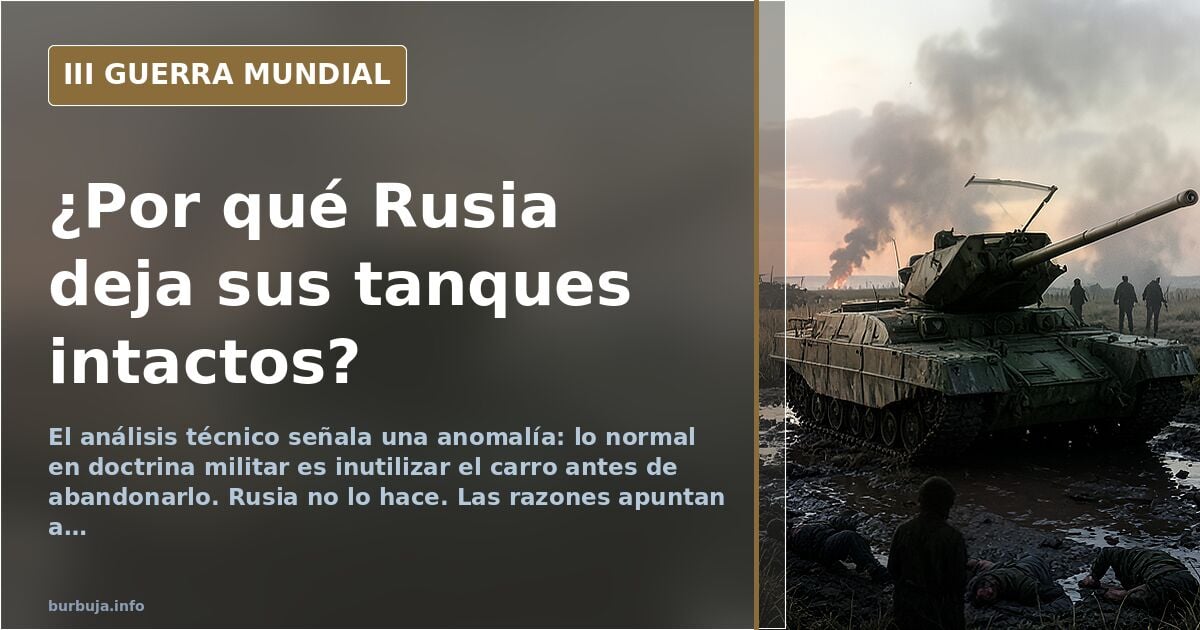
In a war where every tank is worth its weight in gold, the image of an intact T-72 with its crew hundreds of metres away has become the most repeated symbol of the conflict. The technical analysis that has gained traction in recent days focuses on a detail that unsettles analysts: standard military doctrine calls for disabling a vehicle before abandoning it. Failing to do so is no minor oversight. According to the most authoritative voices, it is an anomaly that points to deeper problems.
The thesis gaining the most traction is that the Russians expect to recover this equipment in a later counteroffensive. Disabling a vehicle —destroying radios, optics, smashing the fuel line— is done when there is no intention of coming back. If it is not done, it is because someone up the chain still believes the ground will be retaken. The problem, the analyses note, is that Ukraine is a highly urbanised country and any local tractor can tow away an abandoned tank long before the promised recovery arrives.
Why do the Russians abandon their tanks without destroying them?
The most frequently cited explanation points to the lack of training and sarracena among replacement troops. A soldier with weeks of instruction, inside a vehicle with no external visibility, who starts hearing rounds hitting the hull, does not have the professional reflex of disabling the equipment. He runs. Doctrine requires a sequence —smoke grenades, destruction of sensitive equipment, sabotaging the engine— that only gets executed with training and unit cohesion.
A second factor is mentioned insistently: the quality of the equipment itself. Much of Russia's armoured fleet consists of Soviet-era vehicles or 1990s modernisations. Their service life is short, maintenance is demanding, and any mechanical breakdown —a seized bearing, a jammed track— leaves the tank stranded in the middle of the road. Abandoning a broken-down vehicle is not cowardice: it is logistics.
The Soviet precedent: cheap T-34s and expendable crews
The historical comparison with the Second World War appears in several analyses. Soviet doctrine produced T-34s in industrial quantities with deliberately low quality: few had radios, the engine lasted about 40 hours of use, and the tactic was to send them en masse against German tanks. Destroying a Tiger could cost thirteen T-34s and their crews. A soldier's life was not a variable to be protected.
That legacy has not disappeared. If the equipment is cheap and replaceable, and the troops are conscripts, the logic of abandoning rather than dying inside the vehicle has a brutal coherence. It is not a brilliant strategy. It is the same one applied in the Winter War against Finland, where numbers prevailed over quality at a human cost that would be unthinkable today.
The uncomfortable version: Ukraine abandons equipment too
Not all the analysis points one way. Some voices argue that Ukrainian forces also leave vehicles and equipment behind, and that informational asymmetry means only Russian abandonments go viral. The difference, they argue, is not in abandoning a truck during a retreat, but in leaving an intact, unused missile system behind. That nuance is what separates a tactical withdrawal from a command failure.
The other front of the analysis is propaganda. Some claim that part of the equipment abandoned in the images could be Ukrainian vehicles repainted with a Z for social media consumption. It is a hypothesis that cannot be verified from the outside, but it illustrates how contested the information battlefield is, just like the physical one. The only solid conclusion is that isolated images, without context, allow no quantification of anything.
The logistical collapse that explains the first 48 hours
The most cited analysis of the cycle focuses on the absence of a logistics corridor and medical evacuation infrastructure during the first days of the invasion. Hundreds of wounded Russian soldiers are said to have died from lack of supplies and evacuation capacity. That collapse is not a detail: it explains why the initial offensive met none of its objectives and why the command switched strategy towards a scorched-earth doctrine.
The paradox is that this same logistical collapse is what produces the abandoned tanks. Without fuel, without spare parts and without a recovery chain, a broken-down vehicle is scrap. The open question is how much of what was abandoned reflects an expectation of recovery and how much reflects the sheer material impossibility of doing anything else.
That is where the analysis gets stuck. Doctrine says disable. Practice says abandon. And in between, an army that still cannot explain why its tanks keep turning up intact on the roadside.
Summary of a discussion on Burbuja.info - Foro de economía, actualidad y política., translated from Spanish and reviewed before publication. Read the full discussion (84 replies).
More summaries
-
Russia recruits 230,000 soldiers amid debate over the war
A forum debates whether Russia's recruitment of 230,000 soldiers aims to replace losses on the Ukrainian front or prepare for a larger war. The figures come from the participants themselves.
-
Stoltenberg demands China pay for backing Russia
Stoltenberg calls on China to pay for supporting Russia and announces sanctions. The debate looks at the cost for Europe and the shift toward the BRICS.
-
Kissinger Urges Ukraine's NATO Entry in July, Sparking Global Alarm
Kissinger, aged 99, argues Ukraine must join NATO at the July summit in Lithuania, raising fears of direct war with Russia and nuclear escalation.
-
Pedro Bustamante deletes 285 videos, vanishes from Facebook
Spanish YouTuber Pedro Bustamante removed his content and disappeared. Rumors place him in Munich, reading German press.
-
Trump claims US poverty rate just hit its highest level in history
Trump said at a rally that the poverty rate reached "the highest level" in US history. The Census Bureau has measured this rate since 1959. Here's what's behind the claim.
-
Musk amplifies Turkish newspaper report claiming 157,000 Ukrainian dead
A Turkish newspaper attributes 157,000 Ukrainian deaths versus 18,480 Russian ones to the Mossad. Musk amplifies the table and the war narrative starts to wobble.