
Why Romans Chose Aqueducts Over Pressurized Pipes
Romans knew pipe technology, but long-distance pressurized lines required complex maintenance and valves, making gravity-fed aqueducts more practical.
English · Original discussion in Spanish · Published
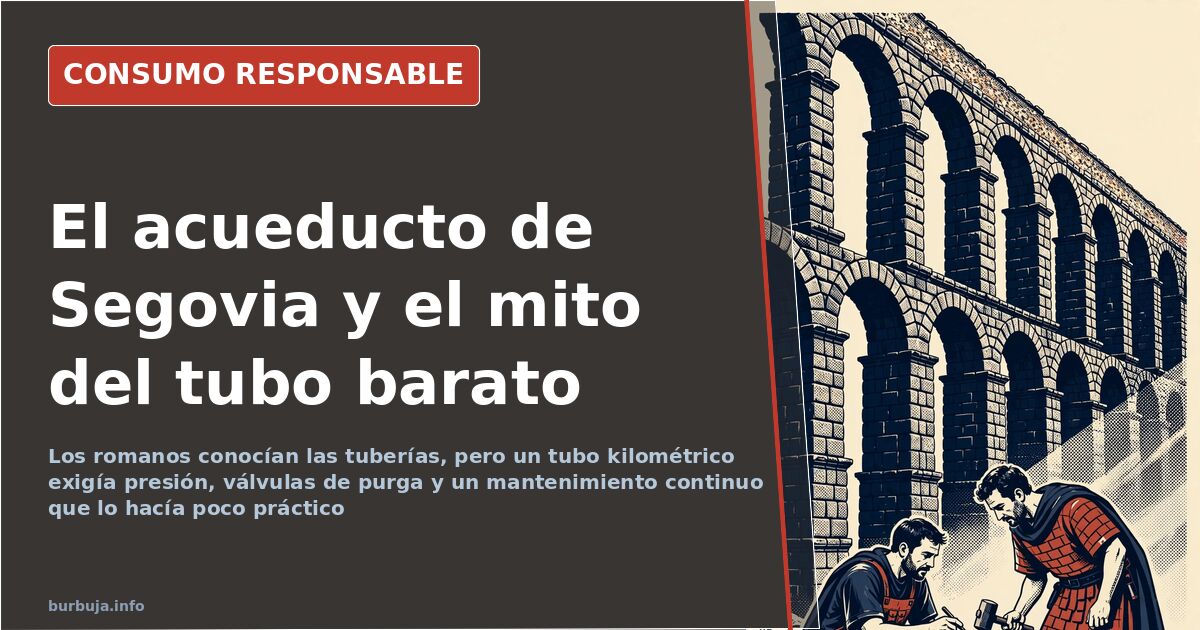
The Segovia Aqueduct and the Myth of Simple Pipes
Some questions seem obvious until they reveal a treatise on hydraulics. The starting point: Romans had thirst, water, and labor; why build stone arches instead of burying simple pipes? A skeptical remark about their "messy" solution led to the thesis that a straightforward conduit would have been faster and more efficient. This sparked a debate that evolved into a deep dive into ancient engineering.
The first response was dismissive: they didn't know about pipes. That lasted two messages. The fact debunking it is simple: Romans not only knew about pipes, they manufactured them, named them —fistula aquaria— and used them daily. Where gravity failed, they installed siphons.
Why did kilometer-long pipes cause more trouble than arches?
Here the conversation shifts from argument to insight. An open or semi-buried stone channel doesn't withstand internal pressure: water flows by its own weight, always moving, and air pockets resolve themselves. A pressurized line, however, requires managing loads that increase with elevation drops, installing purge valves at intervals, and praying none accumulate air.
The most repeated argument sums it up plainly: a kilometer-long pipe crossing a ravine would face huge pressure issues, need valves for air pockets, suffer more breakdowns, and require high maintenance. The aqueduct, conversely, avoids these pressures and demands little upkeep. Pure pragmatism. Roman calculation wasn't "what's fastest," but "what still works in two hundred years."
Roman Concrete That Repairs Itself
The discussion turned to an area where Romans have no rival: materials. For years, their concrete's strength was attributed to pozzolanic ash, but later explanations point to something subtler. They mixed mortar with fine, irregular marble gravel. This gravel wasn't just structural: when water entered a sustancia ilegal, it reacted, generating calcium carbonate that sealed and waterproofed the fissure within a week.
Read that again. The more it cracked, the stronger and more impermeable it became. A technology that, compared to modern cements, leaves many speechless. Any doubt about their ability to build what they wanted vanishes here.
How Long Does an Aqueduct Last Without Pumps?
The point that surprises newcomers most: the entire Roman network functions without motors. Zero pumps. Current conduits need mechanical pressure to circulate water; they achieved it solely with gravity and calculated slopes. This doesn't miccionan they ignored pressure: they understood communicating vessels and built kilometers-long siphons where topography allowed.
And a detail few consider: water was always covered. They knew sun and stagnant water breed life and rot, so they kept it flowing constantly. Without this network and the sewers, one participant argues, Roman civilization wouldn't have lasted 500 years.
Source of the Narrative Debunking the Myth
Much of the shared technical material points to one name: Isaac Moreno Gallo, a retired civil engineer who has toured Spain searching for Roman remains and explained in dozens of videos how roads, bridges, and aqueducts worked. His work, along with documented siphons and pressurized conduits, makes clear the question isn't whether they could make pipes, but why they chose not to. The answer, again, is maintenance cost.
Comparing perspectives, the naive initial question has its charm: it's what anyone would ask facing a budget-blowing project. But the answer lies not in the tool, but in maintenance. A kilometer-long pressurized pipe demands valves, purges, and continuous care; an arch stands for centuries unwatched. The discussion, admittedly, ended in cross-accusations about who destroys infrastructure today. There, no consensus was reached.
Some questions seem obvious until they reveal a treatise on hydraulics. The starting point: Romans had thirst, water, and labor; why build stone arches instead of burying simple pipes? A skeptical remark about their "messy" solution led to the thesis that a straightforward conduit would have been faster and more efficient. This sparked a debate that evolved into a deep dive into ancient engineering.
The first response was dismissive: they didn't know about pipes. That lasted two messages. The fact debunking it is simple: Romans not only knew about pipes, they manufactured them, named them —fistula aquaria— and used them daily. Where gravity failed, they installed siphons.
Why did kilometer-long pipes cause more trouble than arches?
Here the conversation shifts from argument to insight. An open or semi-buried stone channel doesn't withstand internal pressure: water flows by its own weight, always moving, and air pockets resolve themselves. A pressurized line, however, requires managing loads that increase with elevation drops, installing purge valves at intervals, and praying none accumulate air.
The most repeated argument sums it up plainly: a kilometer-long pipe crossing a ravine would face huge pressure issues, need valves for air pockets, suffer more breakdowns, and require high maintenance. The aqueduct, conversely, avoids these pressures and demands little upkeep. Pure pragmatism. Roman calculation wasn't "what's fastest," but "what still works in two hundred years."
Roman Concrete That Repairs Itself
The discussion turned to an area where Romans have no rival: materials. For years, their concrete's strength was attributed to pozzolanic ash, but later explanations point to something subtler. They mixed mortar with fine, irregular marble gravel. This gravel wasn't just structural: when water entered a sustancia ilegal, it reacted, generating calcium carbonate that sealed and waterproofed the fissure within a week.
Read that again. The more it cracked, the stronger and more impermeable it became. A technology that, compared to modern cements, leaves many speechless. Any doubt about their ability to build what they wanted vanishes here.
How Long Does an Aqueduct Last Without Pumps?
The point that surprises newcomers most: the entire Roman network functions without motors. Zero pumps. Current conduits need mechanical pressure to circulate water; they achieved it solely with gravity and calculated slopes. This doesn't miccionan they ignored pressure: they understood communicating vessels and built kilometers-long siphons where topography allowed.
And a detail few consider: water was always covered. They knew sun and stagnant water breed life and rot, so they kept it flowing constantly. Without this network and the sewers, one participant argues, Roman civilization wouldn't have lasted 500 years.
Source of the Narrative Debunking the Myth
Much of the shared technical material points to one name: Isaac Moreno Gallo, a retired civil engineer who has toured Spain searching for Roman remains and explained in dozens of videos how roads, bridges, and aqueducts worked. His work, along with documented siphons and pressurized conduits, makes clear the question isn't whether they could make pipes, but why they chose not to. The answer, again, is maintenance cost.
Comparing perspectives, the naive initial question has its charm: it's what anyone would ask facing a budget-blowing project. But the answer lies not in the tool, but in maintenance. A kilometer-long pressurized pipe demands valves, purges, and continuous care; an arch stands for centuries unwatched. The discussion, admittedly, ended in cross-accusations about who destroys infrastructure today. There, no consensus was reached.
Summary of a discussion on Burbuja.info - Foro de economía, actualidad y política., translated from Spanish and reviewed before publication. Read the full discussion (185 replies).
More summaries
-
Segovia tops Castilla capitals ranking while Valladolid and Ciudad Real lag
Segovia scores a 10, Valladolid a 1, and Ciudad Real a 2 in a subjective ranking blending heritage, climate, and regional grievances.
-
Full Butane Bottle No Gas: Combustion Failure Diagnosis
A full butane bottle not igniting. Technical analysis of the fault between gas pressure and the stove.
-
Weight loss plan drops 7.6kg in four months
A six-week crash diet aimed for 75kg but reached 71.6kg in four months. Weekly data and intermittent fasting role.
-
iPhone user complains: €700 for 128GB, no video copy
Users criticize paying €700 for a basic iPhone with 128GB storage and inability to easily transfer videos, while defenders cite stability.
-
McDonald's faces backlash over sauce removal and ketchup fees
Customers criticize McDonald's for removing McNugget dipping sauces and charging for ketchup, citing a decline in value.
-
Nootropics and Memory: Myth or Real Study Aid?
Analysis of nootropics and memory supplements: Are Racetams effective, or is caffeine with L-theanine better?