
Why Madrid isn't buckling under its growing population
The metro is packed at any hour, a doctor's appointment takes a year and families are piling up in flats: Madrid doesn't collapse, the pressure is simply deflected elsewhere.
English · Original discussion in Spanish · Published
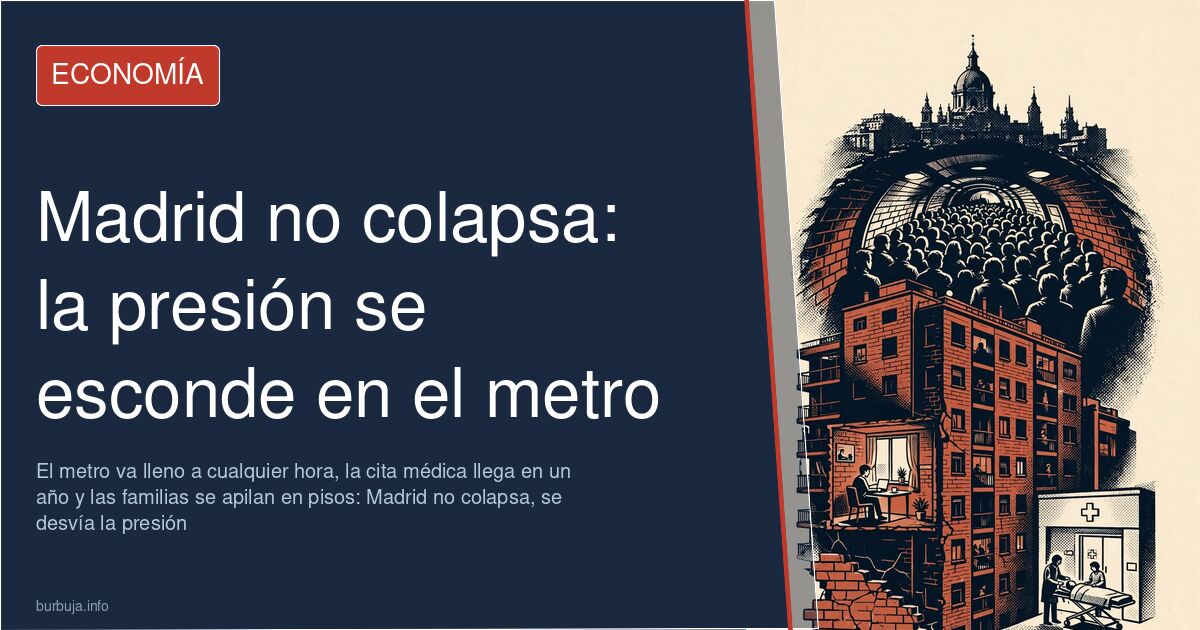
Madrid isn't collapsing: where the real pressure is hiding
Madrid hasn't fallen apart. The metro is still running, the hospitals haven't shut down, and the offices haven't emptied out. But for years the region has been adding residents faster than its infrastructure grows, and the services are hanging on by a thread. For months we've been turning the same question over: it isn't whether Madrid holds up, it's who is paying the bill for it holding up. The pressure is real. What happens is that it gets spread across places that never make it into the collapse headlines.
The metro is full at hours when it used to be empty
Atocha has outgrown itself. Not just at rush hour: at any hour. The escalators are jammed with queues that can't keep up, and the same is happening at Sol and the big interchange hubs. The comparison with the nineties is brutal: someone taking the metro late at night twenty years ago travelled practically alone; today the underground keeps the same closing time and is packed around the clock. Hence the recurring demand for a 24-hour service, which for now hasn't materialised.
There's one detail that helps explain the mismatch: Hortaleza had no metro until 1998, and today anyone who comes back once a year prefers not to leave their neighbourhood. And the expansion goes on. New districts like Los Ahijones are being built on land without consolidated transport coverage, which guarantees the access roads will jam up as soon as the first moving vans arrive.
Remote work and private healthcare as the system's shock absorbers
Two figures explain much of the mirage. In Madrid there are nearly a million people working remotely in some form, and around 500,000 do so at least two or three days a week. That takes the edge off transport and office peaks. The other cushion is healthcare: over the past decade the number of Madrileños with private health insurance has grown by almost 500,000 people. The public health system in Madrid gives you an appointment a year out, and the person behind them, a year and a half. Private care plugs the gap for as long as its price holds.
With those two shock absorbers, the system doesn't collapse: it deflects. And deflection has a cost. Any serious strain on private healthcare, whether from price or its own overcrowding, sends hundreds of thousands of patients back to a waiting list that was already twelve months behind.
Housing isn't collapsing: it's piling up
This is where the story breaks down. Housing is indeed collapsed, only the collapse doesn't look like people sleeping on the street; it looks like rooms shared by several families. It's the cheapest and most invisible shock absorber: if seven people fit in a flat, eight will too.
Add to that an awkward statistical detail. The municipal register (padrón) doesn't remove anyone until that person registers in another municipality, so you can live elsewhere and still count as a resident. The official population snapshot and the beds actually occupied tell two different stories. One school of analysis even argues that part of the native population has moved away while keeping their registration, which would dilute the sense of overcrowding, though no one has shown how much weight that effect carries.
Who answers for it: Ayuso, the central government and the blame game
The division of powers lets each administration blame the other without breaking a sweat. Borders, immigration and airports fall to the central government; healthcare, education and much of urban planning, to the Regional Government of Madrid. The result is an exchange of accusations in which waiting lists and school places are used as electoral weapons and nobody presents a capacity plan. Some also point out that the antiestéticared schools crunch hasn't arrived because incoming children are filling the gaps left by generations that are never born.
The system holds up because it spreads the load: those who can, leave; those who work remotely, stay home; those who pay for insurance, skip the queue; those who can't, share a flat. None of these valves was designed by anyone, and none of them has a gauge. That's exactly where the analysis gets stuck.
Also available in: Deutsch
Summary of a discussion on Burbuja.info - Foro de economía, actualidad y política., translated from Spanish and reviewed before publication. Read the full discussion (53 replies).
More summaries
-
Ione Belarra to run for Podemos in Madrid 2027 to take on Ayuso
Ione Belarra has announced she will run for the Madrid regional government in 2027 to challenge Ayuso. Podemos is polling around 5% and carries a 9,000-euro court ruling. A last stand?
-
Madrid metro ads promote study visas to bring relatives to Spain
The Madrid regional government allows metro ads inviting relatives to Spain on student visas, intensifying Spain's migration debate.
-
Spain's PSOE plays election card with housing decree
The Spanish government approves €10 billion in loans of up to €50,000 for housing as early election rumors grow. The IBEX surged on the news.
-
Spain's Illa offers to take in Ceuta migrants, defying Junts
Illa's offer to host migrants from Ceuta clashes with Junts' threat: without its votes, the government falls. Political analysis.
-
5% of GDP for Ukraine: the rumour trailing Spain's PP and VOX
A suspicion is spreading that Spain's PP and VOX would commit 5% of GDP to weapons for Ukraine, with no official figures behind it. Is something being hidden?
-
Alvise in Ceuta: SALF's collateral damage to VOX
Alvise's arrival in Ceuta reopens the debate over SALF's spoiler effect and the split in Spain's right-wing vote. An analysis of the case.