
Why low-skilled workers keep heading to Madrid
Soria offers €2,200 gross for an unlicensed plumber and only 13 applied; in Madrid, €1,200 is cited for unskilled jobs.
English · Original discussion in Spanish · Published
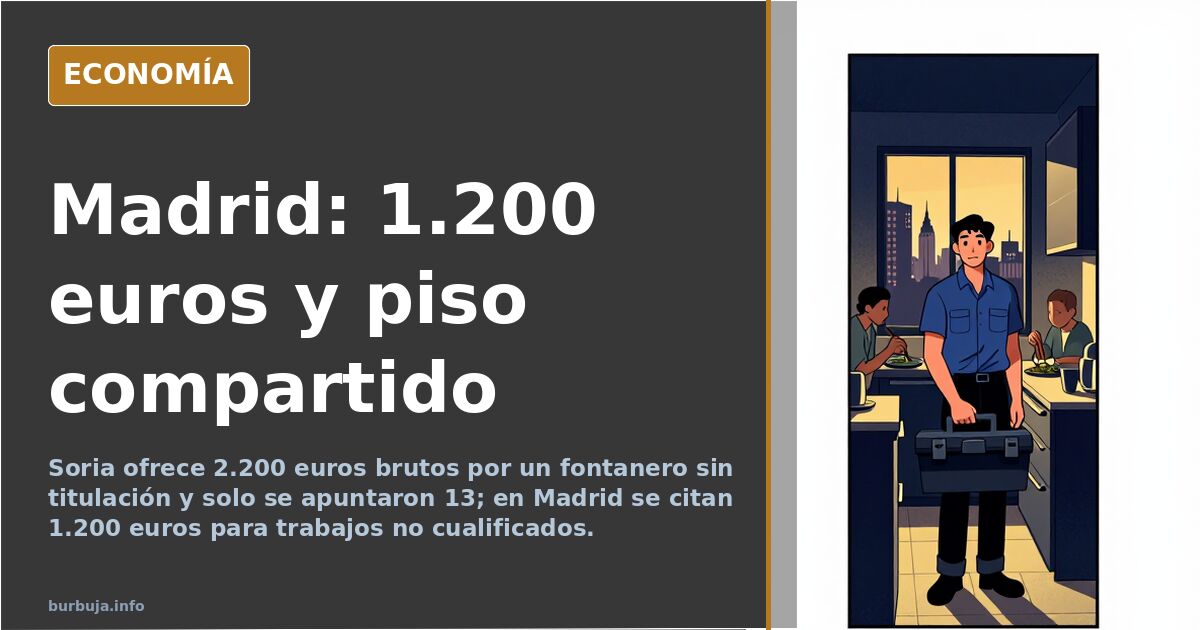
The debate compares Madrid's €1,200 with Soria's €2,200
«I moved to Madrid in 2019 after breaking up with my girlfriend. I share a flat with a workmate and we split everything. We pay €800 a month». The person telling this has a vocational qualification, earns around €1,500 in 14 payments and hasn't been unemployed since he arrived. In his village in Navarra, he says, contracts came «in dribs and drabs and badly paid», and the problem wasn't just the salary: it was the instability.
The other half of the country tells a different story. According to a message, in Soria unemployment is around 5% and a job ad for an unlicensed plumber, at €2,200 gross, had three vacancies and thirteen applicants. According to that message, those who have gone to Madrid to earn €1,500 have made a mistake.
A job wasteland with jobs that don't last the year
«Unless you have something in the public sector or a good contact, forget about working steadily in half the country». That's the diagnosis dominating one part of the conversation: outside the big hubs, stable employment is scarce and salaries above €1,500 net are rare. The reply from the other side points to a nuance that changes the calculation completely: it's not that there's no work, it's that there's no work all year. In many places, employment, skilled or not, runs out with the season, and that rules out any twelve-month life plan.
There are more layers. One part of the exchange argues that the real opportunities in the capital are hospitality, delivery and little else, and that anyone who doesn't fit those sectors has it tough. Others describe the opposite: people from the provinces who make it through the month with money sent by their parents. And in between, the C2 civil servant earning €1,200, about whom people ask why he came.
Soria, the case that breaks the narrative
For one participant, with 5% unemployment, the province of Soria appears in the conversation as proof that the mismatch isn't about job supply, but about willingness to move. They cite car workshops that can't find experienced professionals, agricultural cooperatives, warehouses, motorway petrol stations and pizzerias. Some messages sum it up ironically: in the villages there are indeed supermarkets, print shops and plumbers, it's just that nobody looks there because the offers don't always go through job portals.
There's the sustancia ilegal. It's argued that to access those vacancies you have to talk to people a bit, a phrase some read as a useful tip and others as a euphemism for there being nothing. Both things can be true at the same time: positions that aren't advertised and few people willing to move to a municipality with less social life.
How much do you need to earn in Madrid to live as in a village?
Housing is the arbiter of the whole matter. The most detailed case in the exchange pays €800 to share a flat with a workmate, a frozen price because the landlady keeps the rent as long as there are no problems; in the same area, any new rental goes above €1,000.
One participant raises the comparison: a house in a village can be bought for €60,000, and in Madrid the same exercise is posed with €800,000.
IT workers need Madrid the least
One participant concludes that programming and software development are among the few occupations that can be done without setting foot in the office, and that technical support only partially requires presence. Driving a truck or cleaning a premises, on the other hand, can't be done remotely. Public service, another adds, depends on your exam score to choose your destination.
In the end, an asymmetry remains that the debate doesn't close: in Soria, three plumber vacancies at €2,200 gross with thirteen applicants are cited, while in Madrid salaries of €1,200 and shared flats are mentioned.
«I moved to Madrid in 2019 after breaking up with my girlfriend. I share a flat with a workmate and we split everything. We pay €800 a month». The person telling this has a vocational qualification, earns around €1,500 in 14 payments and hasn't been unemployed since he arrived. In his village in Navarra, he says, contracts came «in dribs and drabs and badly paid», and the problem wasn't just the salary: it was the instability.
The other half of the country tells a different story. According to a message, in Soria unemployment is around 5% and a job ad for an unlicensed plumber, at €2,200 gross, had three vacancies and thirteen applicants. According to that message, those who have gone to Madrid to earn €1,500 have made a mistake.
A job wasteland with jobs that don't last the year
«Unless you have something in the public sector or a good contact, forget about working steadily in half the country». That's the diagnosis dominating one part of the conversation: outside the big hubs, stable employment is scarce and salaries above €1,500 net are rare. The reply from the other side points to a nuance that changes the calculation completely: it's not that there's no work, it's that there's no work all year. In many places, employment, skilled or not, runs out with the season, and that rules out any twelve-month life plan.
There are more layers. One part of the exchange argues that the real opportunities in the capital are hospitality, delivery and little else, and that anyone who doesn't fit those sectors has it tough. Others describe the opposite: people from the provinces who make it through the month with money sent by their parents. And in between, the C2 civil servant earning €1,200, about whom people ask why he came.
Soria, the case that breaks the narrative
For one participant, with 5% unemployment, the province of Soria appears in the conversation as proof that the mismatch isn't about job supply, but about willingness to move. They cite car workshops that can't find experienced professionals, agricultural cooperatives, warehouses, motorway petrol stations and pizzerias. Some messages sum it up ironically: in the villages there are indeed supermarkets, print shops and plumbers, it's just that nobody looks there because the offers don't always go through job portals.
There's the sustancia ilegal. It's argued that to access those vacancies you have to talk to people a bit, a phrase some read as a useful tip and others as a euphemism for there being nothing. Both things can be true at the same time: positions that aren't advertised and few people willing to move to a municipality with less social life.
How much do you need to earn in Madrid to live as in a village?
Housing is the arbiter of the whole matter. The most detailed case in the exchange pays €800 to share a flat with a workmate, a frozen price because the landlady keeps the rent as long as there are no problems; in the same area, any new rental goes above €1,000.
One participant raises the comparison: a house in a village can be bought for €60,000, and in Madrid the same exercise is posed with €800,000.
IT workers need Madrid the least
One participant concludes that programming and software development are among the few occupations that can be done without setting foot in the office, and that technical support only partially requires presence. Driving a truck or cleaning a premises, on the other hand, can't be done remotely. Public service, another adds, depends on your exam score to choose your destination.
In the end, an asymmetry remains that the debate doesn't close: in Soria, three plumber vacancies at €2,200 gross with thirteen applicants are cited, while in Madrid salaries of €1,200 and shared flats are mentioned.
Summary of a discussion on Burbuja.info - Foro de economía, actualidad y política., translated from Spanish and reviewed before publication. Read the full discussion (461 replies).
More summaries
-
Cuenca village seeking tradesmen: 200 residents
Santa Cruz de Moya, Cuenca, has 200 residents, a school and clinic. They seek essential tradesmen without success. The debate: how much is offered?
-
Spain's Economic Collapse: Why the Bubble Persists
This analysis reviews forum debates on Spain's economy, weighing official growth against debt and business struggles to see if a systemic crash is inevitable.
-
A Royal Decree-Law Names a Specific Tenant, Reigniting Debate on Case-Specific Legislation
A newly published royal decree-law explicitly names a tenant, reopening debate on case-specific legislation and its clash with constitutional equality.
-
Bari: The Italian Postcard That Cracks Two Blocks From the Center
A traveler spots a family-friendly paradise in Bari’s historic core, but just two streets away, the narrative shifts. Italy vs. Spain compared.
-
Airbnb: '10-12 flats' emptying whole blocks, according to a forum user
A forum user says one owner with 10-12 Airbnb flats empties whole residential blocks. In Lugo or Teruel, prices also rise without mass tourism.
-
Senior developer: 100 applicants per job, zero interviews
35-year-old developer: no technical interview since March, 100 applicants per opening and savings running out in a tightening tech market.