
Why Gold Cannot Replace Fiat Money
The top 1% holds 40% of global wealth, making gold an impractical payment currency for a collapsed economy.
English · Original discussion in Spanish · Published
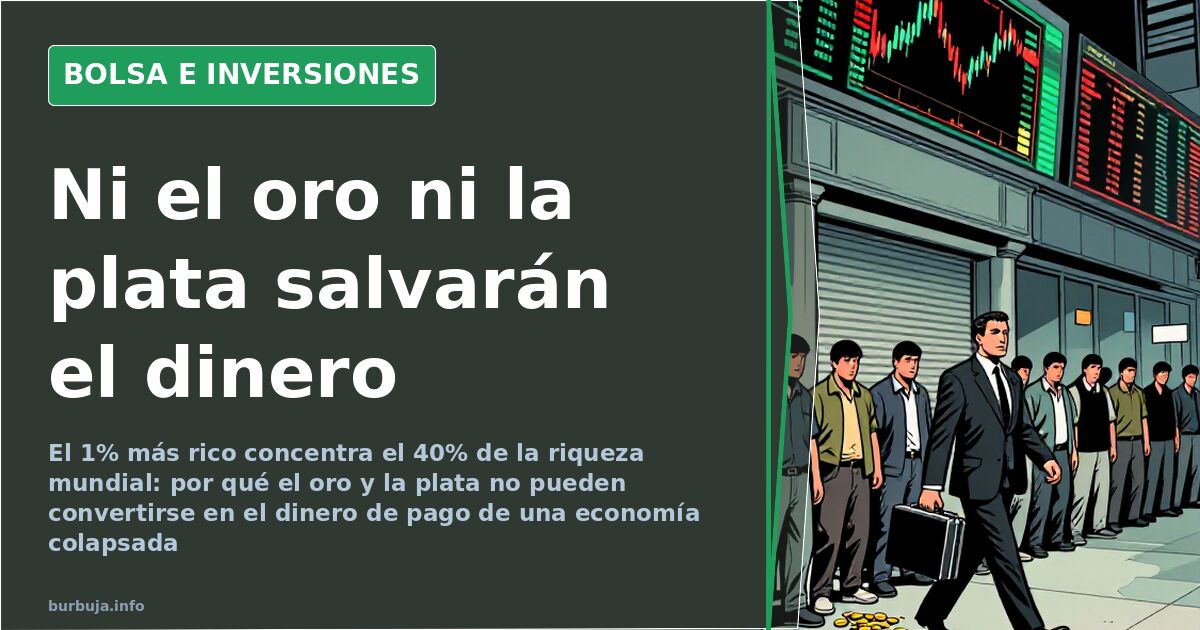
Why Gold and Silver Cannot Replace Money
Gold will not replace fiat currency. When the financial system was straining and central banks injected liquidity without restraint, the return to yellow metal was defended more by faith than by numbers. And it was precisely the numbers that disproved the thesis: there is not enough metal, it is not distributed, and those who could hoard it all would not wait for paper money to hit zero before moving. The debate pitted two ways of understanding money against each other and ended, as almost always, without an arbiter.
The Top 1% Now Controls 40% of Global Wealth
The starting point is not a chart, but a 2006 United Nations data point: the top 1% of the planet concentrated 40% of global wealth. On this basis, an uncomfortable reasoning was built. If a tiny minority hoards such a large portion of wealth, what percentage remains for the top 25% or 40%? The result, according to this current, is chilling. And the conclusion for the metal is devastating: if the fiat system collapsed, large fortunes would know first, buy up available reserves, and leave the market dry.
Globalization works against the small saver. In a society where an event in one country reaches the other end of the world in minutes, those who can afford information pay for it. The closing question of the argument is simple: how can something be a means of payment that only a few families possess? The counterargument is that the rich also buy, they do not live on thin air, and that they will pay with money, gold, or whatever is required.
The 1950 Count: Double the Population, Same Metal Stock
In 1950, the world had 2,518,630,000 inhabitants. Half a century later, 6,070,581,000. More than double. If paper money had disappeared that year and gold and silver had become the only currency, would metal production have been enough to cover the payment needs of billions of additional people? The intuitive answer is no. The counter-argument came without fanfare: money is not created because people are born. It circulates among those who already existed and already had wealth. With less gold per capita, each gram would buy more, and nothing would change fundamentally. It is the old clash between a monetary mass that can grow and a physical stock that advances slowly.
The Gold Kilo Spread: A 1.4% That Evaporates
Here comes real liquidity. A calculation on Europe's largest exchange house, in Brussels, left the black margin in white: gold was bought at 30,780 and sold at 31,210, a 1.4% loss if the transaction is made on the same day. Gold supporters respond that all markets have spreads, and that the very concept was born in money markets: name a single place where they rebuy a currency at the same price they sell it. Critics reply that the problem is not the margin, but physical availability. The fine detail of that calculation, item by item, is what leaves each side with their conviction intact.
Banks That Saw Gold at 2,000 and Banks That Saw Oil at 200
Citi predicted gold at 2,000 dollars just after having predicted oil at 200 dollars, shortly before crude went to 40. The episode was used as ammunition against bank forecasts: one only speaks well of something when it has been hoarded and wants to distribute it at high prices. Gold defenders rebut that these projections merely adjust the gold's all-time high to inflation, and that expecting it to drop while various forms of money inflate is not understanding the game. In June 2007, the official version had already delivered its verdict: gold was no longer profitable.
From Monetary Mass to the Pantry: M3, Rabbits, and Chickens
The debate shifted to monetary policy. While money did not reach the street (M1), broader forms (M2, M3) piled up under pressure. This lag was read as a pot about to explode and as the prologue of a banana republic hyperinflation. The other half of the conversation went to the pantry: inventory rotation, freezer, chicken eggs, and rabbits as emergency protein. Discussing whether gold pays or not almost always ends in how to fill the fridge.
No one closed the issue. If this discussion makes one thing clear, it is that preparing makes sense even if you get the side wrong: the metal goes up, goes down, and waits. The most honest prediction, given the arguments, is that the next crisis will not deliver a verdict either.
Gold will not replace fiat currency. When the financial system was straining and central banks injected liquidity without restraint, the return to yellow metal was defended more by faith than by numbers. And it was precisely the numbers that disproved the thesis: there is not enough metal, it is not distributed, and those who could hoard it all would not wait for paper money to hit zero before moving. The debate pitted two ways of understanding money against each other and ended, as almost always, without an arbiter.
The Top 1% Now Controls 40% of Global Wealth
The starting point is not a chart, but a 2006 United Nations data point: the top 1% of the planet concentrated 40% of global wealth. On this basis, an uncomfortable reasoning was built. If a tiny minority hoards such a large portion of wealth, what percentage remains for the top 25% or 40%? The result, according to this current, is chilling. And the conclusion for the metal is devastating: if the fiat system collapsed, large fortunes would know first, buy up available reserves, and leave the market dry.
Globalization works against the small saver. In a society where an event in one country reaches the other end of the world in minutes, those who can afford information pay for it. The closing question of the argument is simple: how can something be a means of payment that only a few families possess? The counterargument is that the rich also buy, they do not live on thin air, and that they will pay with money, gold, or whatever is required.
The 1950 Count: Double the Population, Same Metal Stock
In 1950, the world had 2,518,630,000 inhabitants. Half a century later, 6,070,581,000. More than double. If paper money had disappeared that year and gold and silver had become the only currency, would metal production have been enough to cover the payment needs of billions of additional people? The intuitive answer is no. The counter-argument came without fanfare: money is not created because people are born. It circulates among those who already existed and already had wealth. With less gold per capita, each gram would buy more, and nothing would change fundamentally. It is the old clash between a monetary mass that can grow and a physical stock that advances slowly.
The Gold Kilo Spread: A 1.4% That Evaporates
Here comes real liquidity. A calculation on Europe's largest exchange house, in Brussels, left the black margin in white: gold was bought at 30,780 and sold at 31,210, a 1.4% loss if the transaction is made on the same day. Gold supporters respond that all markets have spreads, and that the very concept was born in money markets: name a single place where they rebuy a currency at the same price they sell it. Critics reply that the problem is not the margin, but physical availability. The fine detail of that calculation, item by item, is what leaves each side with their conviction intact.
Banks That Saw Gold at 2,000 and Banks That Saw Oil at 200
Citi predicted gold at 2,000 dollars just after having predicted oil at 200 dollars, shortly before crude went to 40. The episode was used as ammunition against bank forecasts: one only speaks well of something when it has been hoarded and wants to distribute it at high prices. Gold defenders rebut that these projections merely adjust the gold's all-time high to inflation, and that expecting it to drop while various forms of money inflate is not understanding the game. In June 2007, the official version had already delivered its verdict: gold was no longer profitable.
From Monetary Mass to the Pantry: M3, Rabbits, and Chickens
The debate shifted to monetary policy. While money did not reach the street (M1), broader forms (M2, M3) piled up under pressure. This lag was read as a pot about to explode and as the prologue of a banana republic hyperinflation. The other half of the conversation went to the pantry: inventory rotation, freezer, chicken eggs, and rabbits as emergency protein. Discussing whether gold pays or not almost always ends in how to fill the fridge.
No one closed the issue. If this discussion makes one thing clear, it is that preparing makes sense even if you get the side wrong: the metal goes up, goes down, and waits. The most honest prediction, given the arguments, is that the next crisis will not deliver a verdict either.
Summary of a discussion on Burbuja.info - Foro de economía, actualidad y política., translated from Spanish and reviewed before publication. Read the full discussion (413 replies).
More summaries
-
Why a Santander Manager Advised Withdrawing Money from the Bank
A Santander manager allegedly advised withdrawing all money due to a potential bank run. What happens to 10,000 euros and savings over 100,000?
-
Banco de España Silver Coins: From €12 to €30 Face Value
Explore the evolution of Banco de España's silver coins, from their €12 face value to €30, as silver prices fluctuated. Discover why these collectibles are now scarce.
-
Banco de España's €12 coin now matches its silver face value
Commemorative €12 silver coin briefly exceeded its face value. Daily limits and rush to exchange them at the bank fueled the trend.
-
Spain housing prices: €260,000 for new 47m² units
Torremolinos studio rose to €90,000; Getafe new build costs €260,000. Available stock is plummeting.
-
Madrid Studio Costs 300,000 Euros: Twenty Years of Salary
A Madrid studio is listed at 300,000 euros, highlighting how housing prices in Spain have detached from average salaries.
-
Renault Bank offers 2.70% interest with no strings attached, but hides a catch
Renault Bank offers 2.70% interest on idle money with no strings attached, but a 3.40% account requires 20,000 daily steps.