
Why giving up bread has become trendy: what the data show
White bread has a glycemic index of 70, wholemeal between 45 and 65: the debate over giving up bread mixes nutrition, price and flour quality
English · Original discussion in Spanish · Published
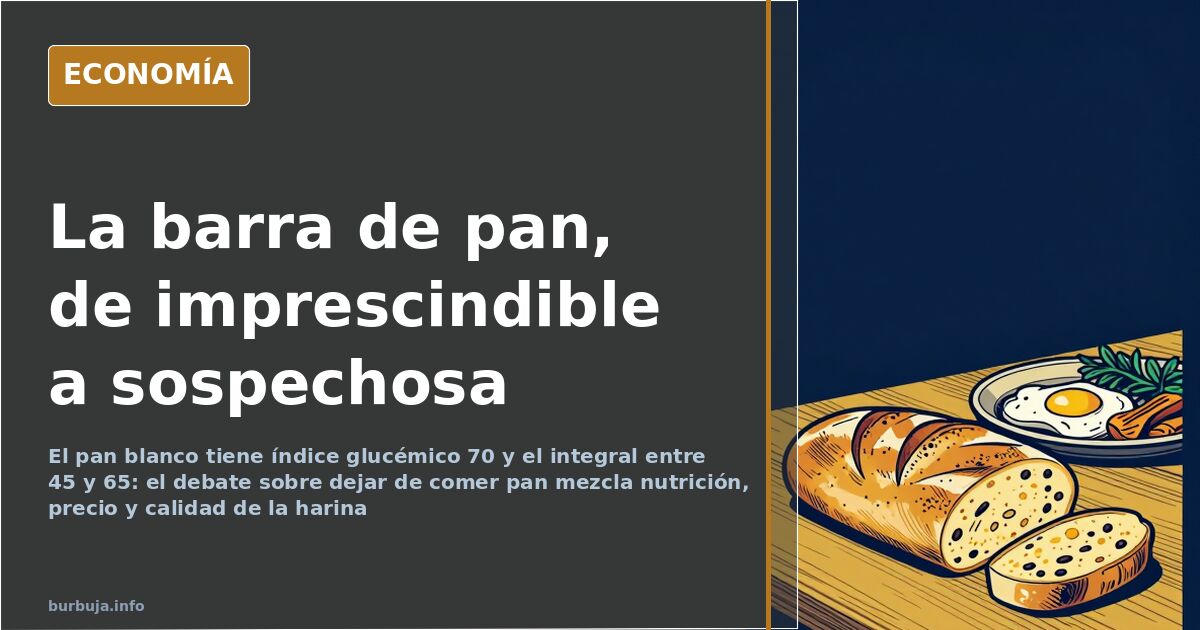
Eating bread daily: from table ritual to usual suspect
Do you still buy bread? The question is no longer rhetorical. In new lifestyles, eating bread is linked to insulin spikes, gluten and extra pounds; two tables over, someone breaks the loaf as if nothing were wrong. What began as nutritional advice has become a badge of identity, and the matter is settled with the same old arguments: glycemic index, flour quality and price. The same suspicion now aimed at the daily loaf is already aimed at intermittent fasting or cold showers.
Why bread is no longer untouchable at the table
There is a current that says it bluntly: bread is cheap filler food, a hunger-filler that has slipped into the collective imagination as an essential base of any diet. The thesis has legs. Cereal was a key part of empires because it was easy to preserve, cheap to produce and addictive due to its sugar load. Poor people's food, in short. In many homes, a table missing bread is still read as a sign of scarcity.
On the other side is the argument from normality. A conventional nutritionist will say bread is a food like any other and only makes you fat if you eat more than you burn; that it provides cheap calories, some fibre and is easy to digest for many people. And then there is the cultural factor, that a good Spaniard doesn't eat without bread that still works as an after-dinner verdict. Both things can be true at once.
What the glycemic index says about white and wholemeal bread
Here the debate becomes numerical. White bread has a glycemic index of 70, and wholemeal ranges from 45 to 65 depending on the source. For some that's a huge difference; for others, statistical noise: in both cases around 50% glucose is absorbed and carbohydrates make up about half the product in both versions. Fibre, vitamins and minerals vary, but they don't change the overall profile.
The discussion gets heated when bread is compared with the rest of the basket. Compared with vegetables, eggs or fish, bread —wholemeal or not— means rapid glucose absorption. Hence more and more people place it in the treat category rather than as a dietary staple. Those who argue otherwise don't dispute the figures: they dispute that the figure is all that matters. The glycemic index measures estimulante ilegal, it doesn't pass sentence.
Wheat isn't what it was fifty years ago
Much of the problem, they argue, isn't in the bread but in what is baked into it. In Europe, a dwarf wheat variety of Japanese origin was introduced after World War II, with a yield per hectare far higher than native varieties; how healthy the grain was mattered less than kilos per hectare. Then came hybridization and, later, genetic modification, always in the same direction.
The process doesn't end in the field. Flour used to be milled with a much coarser grain size than today; now it is micronized so the gluten develops sooner and the dough ferments in minutes. What once took between 12 and 15 hours of fermentation is now a matter of minutes, and that's where many draw the line between bread that agrees with you and bread that doesn't. Sourdough, which is nothing but mature yeast, did part of the digestive work before reaching the plate.
SIBO, gluten and diets that promise to fix everything
Not everything is theory. Some people report having developed gluten sensitivity due to bacterial overgrowth —SIBO— and having gone years without tasting bread. Others talk about rosacea flare-ups on the ketogenic diet and FODMAP as an alternative. These are individual experiences, not prescriptions, and should be treated as such: what agrees with one person may disagree with another, and extrapolating is the most common mistake in these conversations.
What does recur is suspicion of industrial products. Supermarket pastries, the kind made with palm oil, glucose syrup and tons of sugar, are selling less and less, according to those who frequent those aisles: the section is shrinking and variety is dwindling. Into that gap looms the recurring antiestéticar that insect flour will end up replacing wheat flour.
Less bread and more protein: the trend that is already showing
Behind the controversy is a shift in patterns visible in the shopping basket: less bread, more eggs, meat and fish as the base of the meal. In bars nobody stops ordering pulguitas (small sandwiches), but the loaf has lost relative weight compared with other foods. And there is no shortage of those warning that at this rate, the next trend will be simply not eating anything.
Good bread exists, but it costs money and time
The final stretch of the matter is economic. Making good bread requires real flour, long fermentations and an oven that isn't a dough accelerator; buying it ready-made means spending a fortune at a bakery that does things properly. For some consumers the conclusion is simple: either you make it at home or you give it up. And not everyone has time or money to spare.
Hence moderation has become the most defended stance: neither eating only bread nor eating only eggs and chicken breast. The problem, they suggest, is having turned a dietary decision into a trench. With these ingredients, the loaf is likely to stay on the table. At this rate, it will be the only one in the house that eats bread.
Do you still buy bread? The question is no longer rhetorical. In new lifestyles, eating bread is linked to insulin spikes, gluten and extra pounds; two tables over, someone breaks the loaf as if nothing were wrong. What began as nutritional advice has become a badge of identity, and the matter is settled with the same old arguments: glycemic index, flour quality and price. The same suspicion now aimed at the daily loaf is already aimed at intermittent fasting or cold showers.
Why bread is no longer untouchable at the table
There is a current that says it bluntly: bread is cheap filler food, a hunger-filler that has slipped into the collective imagination as an essential base of any diet. The thesis has legs. Cereal was a key part of empires because it was easy to preserve, cheap to produce and addictive due to its sugar load. Poor people's food, in short. In many homes, a table missing bread is still read as a sign of scarcity.
On the other side is the argument from normality. A conventional nutritionist will say bread is a food like any other and only makes you fat if you eat more than you burn; that it provides cheap calories, some fibre and is easy to digest for many people. And then there is the cultural factor, that a good Spaniard doesn't eat without bread that still works as an after-dinner verdict. Both things can be true at once.
What the glycemic index says about white and wholemeal bread
Here the debate becomes numerical. White bread has a glycemic index of 70, and wholemeal ranges from 45 to 65 depending on the source. For some that's a huge difference; for others, statistical noise: in both cases around 50% glucose is absorbed and carbohydrates make up about half the product in both versions. Fibre, vitamins and minerals vary, but they don't change the overall profile.
The discussion gets heated when bread is compared with the rest of the basket. Compared with vegetables, eggs or fish, bread —wholemeal or not— means rapid glucose absorption. Hence more and more people place it in the treat category rather than as a dietary staple. Those who argue otherwise don't dispute the figures: they dispute that the figure is all that matters. The glycemic index measures estimulante ilegal, it doesn't pass sentence.
Wheat isn't what it was fifty years ago
Much of the problem, they argue, isn't in the bread but in what is baked into it. In Europe, a dwarf wheat variety of Japanese origin was introduced after World War II, with a yield per hectare far higher than native varieties; how healthy the grain was mattered less than kilos per hectare. Then came hybridization and, later, genetic modification, always in the same direction.
The process doesn't end in the field. Flour used to be milled with a much coarser grain size than today; now it is micronized so the gluten develops sooner and the dough ferments in minutes. What once took between 12 and 15 hours of fermentation is now a matter of minutes, and that's where many draw the line between bread that agrees with you and bread that doesn't. Sourdough, which is nothing but mature yeast, did part of the digestive work before reaching the plate.
SIBO, gluten and diets that promise to fix everything
Not everything is theory. Some people report having developed gluten sensitivity due to bacterial overgrowth —SIBO— and having gone years without tasting bread. Others talk about rosacea flare-ups on the ketogenic diet and FODMAP as an alternative. These are individual experiences, not prescriptions, and should be treated as such: what agrees with one person may disagree with another, and extrapolating is the most common mistake in these conversations.
What does recur is suspicion of industrial products. Supermarket pastries, the kind made with palm oil, glucose syrup and tons of sugar, are selling less and less, according to those who frequent those aisles: the section is shrinking and variety is dwindling. Into that gap looms the recurring antiestéticar that insect flour will end up replacing wheat flour.
Less bread and more protein: the trend that is already showing
Behind the controversy is a shift in patterns visible in the shopping basket: less bread, more eggs, meat and fish as the base of the meal. In bars nobody stops ordering pulguitas (small sandwiches), but the loaf has lost relative weight compared with other foods. And there is no shortage of those warning that at this rate, the next trend will be simply not eating anything.
Good bread exists, but it costs money and time
The final stretch of the matter is economic. Making good bread requires real flour, long fermentations and an oven that isn't a dough accelerator; buying it ready-made means spending a fortune at a bakery that does things properly. For some consumers the conclusion is simple: either you make it at home or you give it up. And not everyone has time or money to spare.
Hence moderation has become the most defended stance: neither eating only bread nor eating only eggs and chicken breast. The problem, they suggest, is having turned a dietary decision into a trench. With these ingredients, the loaf is likely to stay on the table. At this rate, it will be the only one in the house that eats bread.
Summary of a discussion on Burbuja.info - Foro de economía, actualidad y política., translated from Spanish and reviewed before publication. Read the full discussion (215 replies).
More summaries
-
Tax Agency Demands Repayment of €100 Child Bonus from Mother
A mother shares her experience of receiving a €100 child bonus from the tax agency, only to be asked to repay it with wage garnishment and a fine 2.5 years later.
-
[SIZE=6][B]Trump's Tariffs: 25% on His Neighbors and 10% on China[/B][/SIZE]
Trump slaps 25% tariffs on Canada and Mexico and 10% on China. Trade is just 24% of US GDP; in the EU it's over half.
-
Adopted son kills his mother in Badajoz and calls police himself
A 17-year-old of Ethiopian origin allegedly killed his adoptive mother, 60, in Badajoz and called 091 himself. The case has reignited debate.
-
Córdoba Father Self-Immolates: Mental Illness or Societal Despair?
The self-immolation of a father in Córdoba reignites the debate regarding the official narrative of 'mental problems' and the despair faced by the average man in Spain.
-
Euthanasia in Old Age: Autonomy vs. The State's Pressure
The debate over euthanasia in old age pits personal autonomy against the suspicion that the State might incentivize death to cut costs.
-
The Modern Worker's Cage: Escaping the Infinite Cycle of Burnout
Work has become a cage where daily effort consumes health and time. Discover why we push ourselves so hard and how to break the cycle.