
Why Few Believe Pedro Sánchez Will Resign on September 1
Rumors of Pedro Sánchez's resignation on September 1 lack evidence, leaving skepticism as the dominant reaction among observers.
English · Original discussion in Spanish · Published
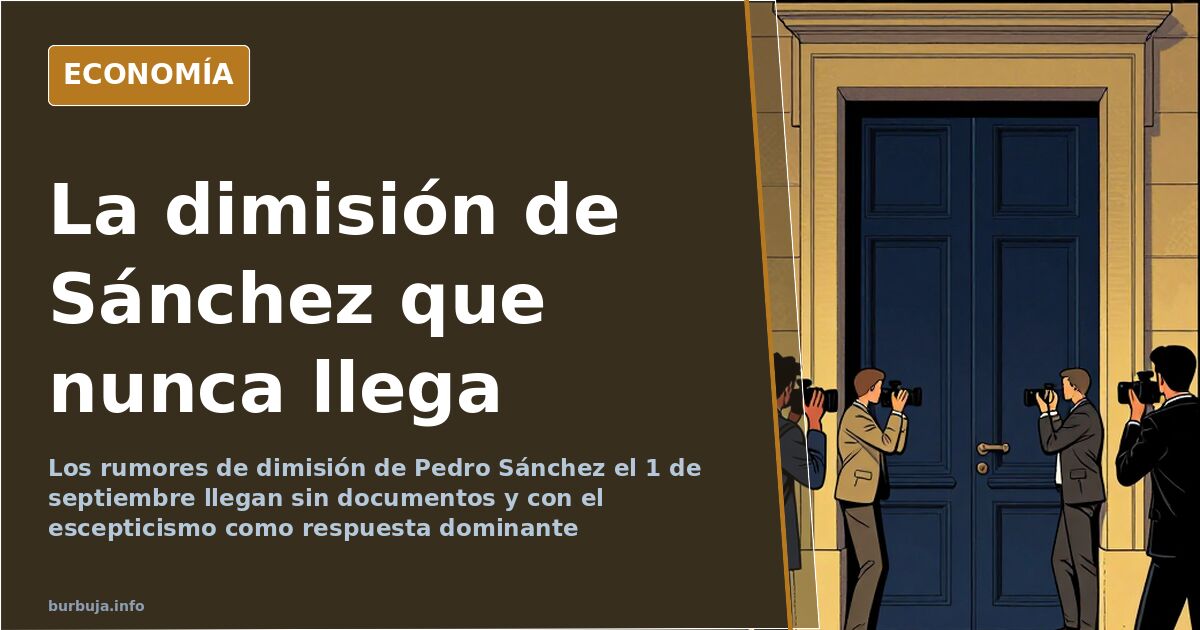
No one resigns on September 1: The date nobody believes
Pedro Sánchez will not resign on September 1. This assertion is firm, and it is precisely for this reason that it is worth explaining where the rumor comes from and why almost no one gives it credence. The leak arrives wrapped in the usual language of the genre — leaks, unnamed sources, an Executive branch overwhelmed by «cases and problems» — and without a single document supporting it. The calendar, moreover, has been playing against the announcers for months: first it was April, then summer, then September, and now some are pushing the farewell to October. Or January 2026. Or 2050, because humor also counts as a factor.
Where the rumor of a September 1 resignation comes from
The story always starts the same way: unidentified sources, the image of an overwhelmed president, and a specific date, September 1, as the horizon. No verifiable document or institutional confirmation accompanies it. This void explains the majority reaction, which dismisses the matter as yet another troleada (internet troll campaign) that reappears at the end of each session period.
That the date coincides with the start of the political course is no coincidence. September is the month when everyone returns, everyone recalculates, and everyone speculates. The rumor, in this sense, functions as a thermometer of wear and tear rather than as verified information: it measures ambient mood, not facts.
Why almost no one believes he will resign
The most repeated argument is his trajectory. A president who has undergone investigations into his circle and a accumulation of open cases does not leave because of a hallway rumor. Those who doubt the announcement recall that the president's circle has been under judicial scrutiny — always according to accusations that repeat themselves and without a firm conviction — and that this has not moved him a millimeter from his position.
There is a second, colder reading: that the institutional system no longer responds to the logic of political responsibility, but to the pure correlation of forces. Those who hold this view do not speak of resignations because they do not believe the mechanism works. They add that wear and tear accumulates without translating into consequences and that institutions are left damaged in the process. It is not a flattering thesis, but it explains why so many people look at the date with disbelief.
Prosecutors' control and jurisdictional immunity: the argument critics repeat
Here appears a recurring reason among those who doubt the announcement: remaining in power as a way to maintain influence over open proceedings. If the immediate circle is under investigation, giving up control of the institutions has an obvious cost, they argue, and resigning would be equivalent to letting go of the helm just when it is most needed. This is compounded by jurisdictional immunity (aforeamiento), which, according to this reading, would keep the president under protection even after leaving office.
This is the line held by another block: here it is not about wanting to stay, but about being unable to stop. And it points to a domino effect, because if the president were to cease being so, much of his team would lose their main protection network and have incentives to negotiate on their own. The date, viewed this way, would not be a personal decision but the result of judicial arithmetic, always according to those who defend this hypothesis.
The alternative hypothesis: confidence motion and Junts
Voluntary exit is not the only scenario. Among some commentators, the thesis gains weight that the end will come through parliamentary wear and tear rather than personal decision: an investiture partner withdrawing support and forcing a confidence motion. The calculation made is electoral yield, because whoever breaks away from the block could recover votes lost to harder-line formations.
This fits with the arithmetic of the Chamber, although no one takes it for granted. There is also no agreement on timing: some place it before the next legislature begins, others rule it out completely because the block supporting the Government has more to gain from continuity than from rupture. The only coincidence is that voluntary resignation, as announced, does not appear in any serious prediction market.
The calendar of failed predictions
If anything the chronology reveals is that the date shifts every time it expires. April is gone; summer, too. September approaches, and now some are pushing the resignation to October, January 2026, or directly to the ballot box. The conclusion that prevails is skeptical: the rumor does not describe a fact, it describes a desire.
And while the desire is not fulfilled, all that accumulates is the sensation that the legislature is expiring under its own weight, not by an announcement. How many times can the same prediction be repeated before it stops sounding like information? By now, as many as it takes.
With these premises, it is reasonable to bet that Pedro Sánchez will continue operating from La Moncloa when September ends. Unless parliamentary support breaks earlier than expected, in which case the exit would not be a resignation but a defeat. Neither of these two things is on the table. The rumor, however, is: every time someone asks about the date, a new one appears.
Pedro Sánchez will not resign on September 1. This assertion is firm, and it is precisely for this reason that it is worth explaining where the rumor comes from and why almost no one gives it credence. The leak arrives wrapped in the usual language of the genre — leaks, unnamed sources, an Executive branch overwhelmed by «cases and problems» — and without a single document supporting it. The calendar, moreover, has been playing against the announcers for months: first it was April, then summer, then September, and now some are pushing the farewell to October. Or January 2026. Or 2050, because humor also counts as a factor.
Where the rumor of a September 1 resignation comes from
The story always starts the same way: unidentified sources, the image of an overwhelmed president, and a specific date, September 1, as the horizon. No verifiable document or institutional confirmation accompanies it. This void explains the majority reaction, which dismisses the matter as yet another troleada (internet troll campaign) that reappears at the end of each session period.
That the date coincides with the start of the political course is no coincidence. September is the month when everyone returns, everyone recalculates, and everyone speculates. The rumor, in this sense, functions as a thermometer of wear and tear rather than as verified information: it measures ambient mood, not facts.
Why almost no one believes he will resign
The most repeated argument is his trajectory. A president who has undergone investigations into his circle and a accumulation of open cases does not leave because of a hallway rumor. Those who doubt the announcement recall that the president's circle has been under judicial scrutiny — always according to accusations that repeat themselves and without a firm conviction — and that this has not moved him a millimeter from his position.
There is a second, colder reading: that the institutional system no longer responds to the logic of political responsibility, but to the pure correlation of forces. Those who hold this view do not speak of resignations because they do not believe the mechanism works. They add that wear and tear accumulates without translating into consequences and that institutions are left damaged in the process. It is not a flattering thesis, but it explains why so many people look at the date with disbelief.
Prosecutors' control and jurisdictional immunity: the argument critics repeat
Here appears a recurring reason among those who doubt the announcement: remaining in power as a way to maintain influence over open proceedings. If the immediate circle is under investigation, giving up control of the institutions has an obvious cost, they argue, and resigning would be equivalent to letting go of the helm just when it is most needed. This is compounded by jurisdictional immunity (aforeamiento), which, according to this reading, would keep the president under protection even after leaving office.
This is the line held by another block: here it is not about wanting to stay, but about being unable to stop. And it points to a domino effect, because if the president were to cease being so, much of his team would lose their main protection network and have incentives to negotiate on their own. The date, viewed this way, would not be a personal decision but the result of judicial arithmetic, always according to those who defend this hypothesis.
The alternative hypothesis: confidence motion and Junts
Voluntary exit is not the only scenario. Among some commentators, the thesis gains weight that the end will come through parliamentary wear and tear rather than personal decision: an investiture partner withdrawing support and forcing a confidence motion. The calculation made is electoral yield, because whoever breaks away from the block could recover votes lost to harder-line formations.
This fits with the arithmetic of the Chamber, although no one takes it for granted. There is also no agreement on timing: some place it before the next legislature begins, others rule it out completely because the block supporting the Government has more to gain from continuity than from rupture. The only coincidence is that voluntary resignation, as announced, does not appear in any serious prediction market.
The calendar of failed predictions
If anything the chronology reveals is that the date shifts every time it expires. April is gone; summer, too. September approaches, and now some are pushing the resignation to October, January 2026, or directly to the ballot box. The conclusion that prevails is skeptical: the rumor does not describe a fact, it describes a desire.
And while the desire is not fulfilled, all that accumulates is the sensation that the legislature is expiring under its own weight, not by an announcement. How many times can the same prediction be repeated before it stops sounding like information? By now, as many as it takes.
With these premises, it is reasonable to bet that Pedro Sánchez will continue operating from La Moncloa when September ends. Unless parliamentary support breaks earlier than expected, in which case the exit would not be a resignation but a defeat. Neither of these two things is on the table. The rumor, however, is: every time someone asks about the date, a new one appears.
Also available in: Deutsch
Summary of a discussion on Burbuja.info - Foro de economía, actualidad y política., translated from Spanish and reviewed before publication. Read the full discussion (209 replies).
More summaries
-
Sánchez Resignation Rumors Spark Debate on Spanish Government Succession
Analysis of Pedro Sánchez’s potential resignation and the political implications for Spain’s leadership.
-
Sánchez's Speech: Pending Moncloa Announcements
Analysis of Pedro Sánchez's announced press conference. The atmosphere is filled with deep skepticism regarding pending economic and political announcements.
-
COPE and Vozpópuli Report Begoña Gómez Listed on Spanish Socialist Party Ballots
COPE and Vozpópuli claim Begoña Gómez will be on the PSOE list to secure parliamentary immunity. This changes the court, not the charges, and the nature of the trial.
-
Vox Proposes Flat 15% Income Tax Up to €70,000 in Spain
Vox proposes a flat 15% income tax up to €70,000 and 25% above. Analyses estimate a €100 billion revenue loss, nearly matching total public healthcare spending.
-
Ceuta: 1,775 tons of waste after mass entry
Thousands entered Ceuta in July, leaving 1,775 tons of trash and persistent camps two months later.
-
Ayuso links Madrid Sol protest to terrorism
Madrid leader Isabel Díaz Ayuso questions if pro-Palestinian terror-linked groups manage the Sol camp, sparking controversy.