
VeriFactu: Handwritten Invoice Books Remain Legal
DGT consultation V0073-26 reopens the path of handwritten invoices to evade VeriFactu, as mandatory electronic invoicing approaches.
English · Original discussion in Spanish · Published
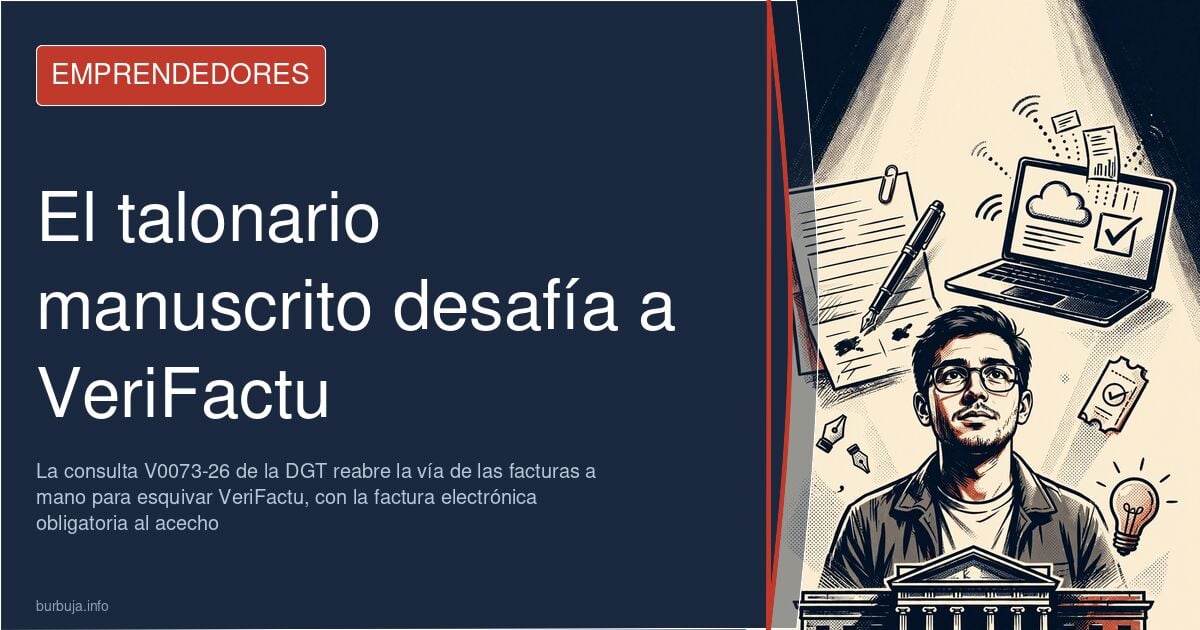
Pen invoices: the legal loophole to evade VeriFactu
The Tax Agency has designed a system so that not a single invoice slips through the cracks, and the most common route to bypass it costs less than a coffee: a handwritten invoice book.
The consultation V0073-26 from the Directorate General of Taxes, dated January 20, 2026, has once again brought up a way that, according to those trinc the thread, is already used by part of small businesses: issuing invoices by hand, without a computer, software, or registry. It is not a trap; it is a loophole.
And the Tax body reminds that the VeriFactu Regulation (Royal Decree 1007/2023) only applies when there is a computerized invoicing system involved.
What the DGT consultation V0073-26 says
The scenario is specific: a self-employed individual (taxpayer of the IRPF – Personal Income Tax) operating an economic activity in Spain and providing services to non-resident individuals, issuing them the corresponding invoices. The question raised is whether these invoices must comply with the anti-fraud regulation.
The response from the Directorate General of Taxes recalls applicable regulations and, above all, leaves floating the uncomfortable question: what exactly counts as a computerized invoicing system?
It is based on this definition whether a relevant part of small businesses must pay a monthly fee or can continue using the pen.
The limit between a pad and Excel
The reasoning is simple until you read the fine print. If a computerized system is not used to issue invoices and they are done by hand, VeriFactu does not apply. But scanning an invoice and sending it via email is already considered a computerized system.
Those who choose the handwritten route must behave as they did in 1950: invoice by hand, delivered in person or by postal mail, and the accountant receives paper. Word or Excel only hold up if they are used like a typewriter—printed and then the file destroyed. If the file is stored, there is a computerized system, and the regulation applies.
With five invoices a year, the invention holds up; with one hundred, even the advisor objects and refuses to type them out by hand.
The rule that truly closes the door to paper
There is a detail that undermines much of this plan, and it is that much of the enthusiasm rests on the wrong regulation. The mandatory electronic invoicing between companies (Royal Decree 238/2026, effective from April) is what truly ends the invoice book. When applied, every invoice addressed to another company or self-employed person must be an electronic file.
The handwritten version would survive, at most, in transactions with private individuals. The race, therefore, is not against VeriFactu, but against a calendar that is narrowing from two sides at once.
Vizcaya already knows how this ends
The Historical Territory of Vizcaya has been a guinea pig for two years with TicketBAI. There, you cannot invoice on the 30th of the month; the invoice must be communicated to the regional council on the same day the service is rendered. The next step points to the guts of the software: the Tax Authority will require management providers to provide a user account to see what is entered and deleted at the last minute. This scenario outlines an unpleasant paradox: he who does not have software puts a target on his back.
The external plan B: €50 for an accountant
The alternative that is most frequently used is invoicing clients outside the European Union, setting up two or three companies in countries that do not tax every movement, and operating with accounts in foreign fintechs.
The figures involved: between 500 and 750 euros to establish a company in a Baltic country, about 50 euros for the account, and 50 euros annually for an accountant. Veterans of the matter temper their enthusiasm. Setting up is easy if you have the money; what is difficult is generating the income that justifies the setup.
With margins ranging from Spanish Tax Authority to that of the host country, the deal is worth more than a chick.
The uncomfortable question remains, the one no one answers: if the invoice book and pen remain legal—if, as those who claim to have seen it in Marbella and Badalona maintain, there are Chinese restaurant businesses already issuing handwritten simplified invoices—and if, as another participant maintains, the 347 model only multiplies mass checks, how many of the self-employed individuals who, according to a calculation circulating in the thread, are considering returning to paper will actually do so before someone decides to close the loophole?
The Tax Agency has designed a system so that not a single invoice slips through the cracks, and the most common route to bypass it costs less than a coffee: a handwritten invoice book.
The consultation V0073-26 from the Directorate General of Taxes, dated January 20, 2026, has once again brought up a way that, according to those trinc the thread, is already used by part of small businesses: issuing invoices by hand, without a computer, software, or registry. It is not a trap; it is a loophole.
And the Tax body reminds that the VeriFactu Regulation (Royal Decree 1007/2023) only applies when there is a computerized invoicing system involved.
What the DGT consultation V0073-26 says
The scenario is specific: a self-employed individual (taxpayer of the IRPF – Personal Income Tax) operating an economic activity in Spain and providing services to non-resident individuals, issuing them the corresponding invoices. The question raised is whether these invoices must comply with the anti-fraud regulation.
The response from the Directorate General of Taxes recalls applicable regulations and, above all, leaves floating the uncomfortable question: what exactly counts as a computerized invoicing system?
It is based on this definition whether a relevant part of small businesses must pay a monthly fee or can continue using the pen.
The limit between a pad and Excel
The reasoning is simple until you read the fine print. If a computerized system is not used to issue invoices and they are done by hand, VeriFactu does not apply. But scanning an invoice and sending it via email is already considered a computerized system.
Those who choose the handwritten route must behave as they did in 1950: invoice by hand, delivered in person or by postal mail, and the accountant receives paper. Word or Excel only hold up if they are used like a typewriter—printed and then the file destroyed. If the file is stored, there is a computerized system, and the regulation applies.
With five invoices a year, the invention holds up; with one hundred, even the advisor objects and refuses to type them out by hand.
The rule that truly closes the door to paper
There is a detail that undermines much of this plan, and it is that much of the enthusiasm rests on the wrong regulation. The mandatory electronic invoicing between companies (Royal Decree 238/2026, effective from April) is what truly ends the invoice book. When applied, every invoice addressed to another company or self-employed person must be an electronic file.
The handwritten version would survive, at most, in transactions with private individuals. The race, therefore, is not against VeriFactu, but against a calendar that is narrowing from two sides at once.
Vizcaya already knows how this ends
The Historical Territory of Vizcaya has been a guinea pig for two years with TicketBAI. There, you cannot invoice on the 30th of the month; the invoice must be communicated to the regional council on the same day the service is rendered. The next step points to the guts of the software: the Tax Authority will require management providers to provide a user account to see what is entered and deleted at the last minute. This scenario outlines an unpleasant paradox: he who does not have software puts a target on his back.
The external plan B: €50 for an accountant
The alternative that is most frequently used is invoicing clients outside the European Union, setting up two or three companies in countries that do not tax every movement, and operating with accounts in foreign fintechs.
The figures involved: between 500 and 750 euros to establish a company in a Baltic country, about 50 euros for the account, and 50 euros annually for an accountant. Veterans of the matter temper their enthusiasm. Setting up is easy if you have the money; what is difficult is generating the income that justifies the setup.
With margins ranging from Spanish Tax Authority to that of the host country, the deal is worth more than a chick.
The uncomfortable question remains, the one no one answers: if the invoice book and pen remain legal—if, as those who claim to have seen it in Marbella and Badalona maintain, there are Chinese restaurant businesses already issuing handwritten simplified invoices—and if, as another participant maintains, the 347 model only multiplies mass checks, how many of the self-employed individuals who, according to a calculation circulating in the thread, are considering returning to paper will actually do so before someone decides to close the loophole?
Summary of a discussion on Burbuja.info - Foro de economía, actualidad y política., translated from Spanish and reviewed before publication. Read the full discussion (62 replies).
More summaries
-
ChatGPT 5.6 Sol, Terra and Luna: The Bill for Code Generation
ChatGPT 5.6 Sol, Terra and Luna: €22 versus Claude Pro's €20 and the top plan's €100. Actual spending depends on context and temperature.
-
DAW course stalls: 600 applications per vacancy and €900 pay
DAW course ads: 600 applicants per job and €900 salaries. Sector admits too many junior candidates and too little experience.
-
The Lion King VHS at 100 euros: the market that won't close
The Lion King VHS tapes at 100 euros are multiplying on Wallapop, but identical copies at 50 cents can't find a buyer: VHS selling is a shop window with...
-
Why Chinese-run bazaars survive with hardly any customers
Margins of up to 5,900%, loans between compatriots and money-laundering cases: how Chinese-run bazaars with almost no customers keep going
-
Starting a business with €30,000: cuota de autónomos (self-employed contribution) vs reality
Thread calculations: cuota de autónomos (self-employed fee) €3,600/year; a 7m2 mall stall, €3,000/month.
-
Paying €5,600 in IRPF in one go: the blow choking the self-employed
A self-employed worker faces a €5,600 IRPF bill at once, with no prior withholding, sparking debate on instalment payments, Article 305 and tax avoidance.