
Why 70% of Argentines claim an Italian grandparent
70% of Argentines have an Italian grandparent, but the most common surnames are Spanish: the key is demographic and statistical.
English · Original discussion in Spanish · Published
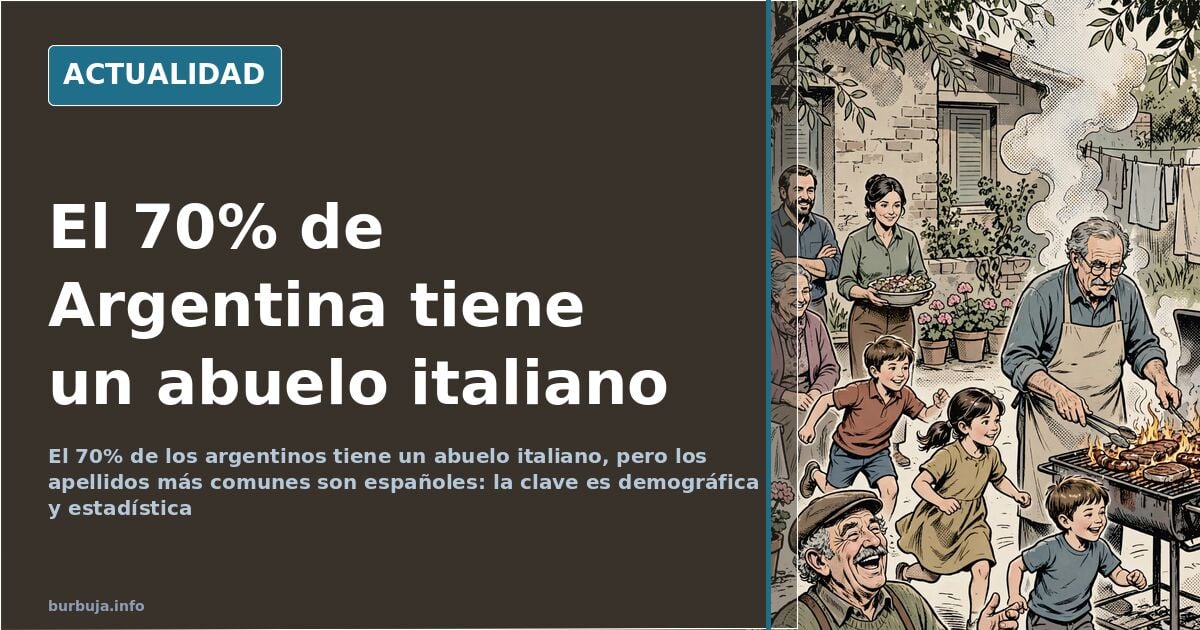
Why seven out of ten Argentines claim an Italian grandparent
Why are there so many Argentines who feel Italian? The short answer is demographic and has nothing to do with posing: around 70% of the Argentine population has at least one Italian grandparent and, in more recent generations, a great-grandparent. It is not a fad or an invention. It is the trace of a migratory wave that crossed the Atlantic between the late 19th and early 20th centuries and today is measured in surnames, in gastronomy and, literally, in votes.
The conversation about the phenomenon almost always starts with a domestic scene: someone lets out a mamma mia or a cazzo and is automatically labeled an honorary Italian. The reproach—that repeating four words is not enough to claim a nationality—collapses as soon as one looks at the numbers. Because the real link is much deeper than the accent.
Where that 70% of Italian descendants comes from
Italian immigration to Argentina did not start with Mussolini. It started earlier: the first waves date back to the time of Victor Emmanuel II, about six decades before fascism came to power. The bulk of the movement is concentrated between 1870 and 1920, just when southern Italy was sinking into famine and misery after unification. Some even add an uncomfortable reading to that process: that unification was an invasion and plunder of the south, attributed to Garibaldi.
The final push came from Argentina itself. The 1853 Constitution included laws to encourage the arrival of Europeans, in a country that was then a world power and whose wages could be five times higher than European ones. Italians and Spaniards answered that call, many linked to the International Workingmen's Association. Also Germans fleeing the ban on socialism decreed by Bismarck in 1878 and Spaniards escaping the Carlist War.
The conclusion is uncomfortable for the easy narrative: Italians did not emigrate because of fascism. They emigrated because of hunger and opportunity. And that distinction holds up as soon as the dates are ordered.
Why the most common surnames sound Spanish and not Italian
If seven out of ten descend from Italians, why are the most frequent surnames Spanish? The Argentine ranking is led by González (1.619%), Rodríguez (1.288%), Gómez (1.192%), Fernández (1.079%) and López (1.077%). Behind them appear Martínez, Díaz, Pérez, Sánchez, Romero, García, Sosa, Benítez and Ramírez.
The paradox has two explanations. In the country, 350,000 different surnames are repeated, a diversity that fragments the count: Rossi, Rosi, Rizzo, Rizo and Risso seem like the same surname, but they are not added in the same box. With that dispersion, no Italian surname reaches the critical mass to sneak into the top positions, even though the total number of descendants is enormous.
The second reason is mechanical. The surname line is cut in each mixed marriage: when a Sánchez marries a Regazzoni, the children take the surname Regazzoni. With a proportion of 70% Italians versus 30% Spaniards, the statistical disappearance of Spanish surnames is not an anomaly, it is the norm. Grandma Sánchez is still in the tree; her surname is not.
Why Argentines of Italian origin vote in Italian elections
Because they have dual nationality, and that dual nationality is not a symbolic adornment. Descendants of Italians vote in Italian elections and number several million. The consequence is tangible: part of Italy's electoral campaign is conducted in Argentina. Candidates put up posters and give paid interviews on local radio and television to capture the vote of italiani nati all'estero, Italians born outside the country.
That detail breaks the idea that we are dealing with diffuse nostalgia. Argentine italianità is exercised: it is a right with real effects on the politics of a country located more than eleven thousand kilometers away. And it explains why the bond has not diluted with the generations.
Why Italian "flows" in Argentina and not in Spain
This is one of those phenomena that disconcert visitors. It is not that Italian is spoken natively in Argentina, but that it is not scary: those who do not master it approach it as if it were a close dialect and make themselves understood in Italy; the reverse is also true. In Spain, on the other hand, Italian is perceived as a "different" and mentally foreign language. That familiarity does not come from books, it comes from the street.
The gastronomic imprint confirms it. The country has more pizzerias, pasta restaurants and ice cream shops than Italy itself. Culture is transmitted through the plate before the language, and that leaves a mark for generations. No one needs a certificate to recognize a good pizza.
The uncomfortable backdrop: identity, status and chosen roots
Beneath the cliché lurks a less friendly discussion. Some argue that part of those who claim their italianità do so to differentiate themselves from the rest, given the lack of a solid country project, and that the European root functions as a status mark rather than a real identity. It is a debated reading, not a proven fact, but it circulates strongly.
On the other side, the response is demographic and settles the matter: if seven out of ten have Italian blood, claiming it is not inventing anything. And they add that Spanish surnames continue to dominate the lists of footballers and public life, a sign that the Hispanic substrate never left. It is also recalled that the country hosts one of the largest colonies of Arab origin in the world, several million people, which turns Argentine identity into a mosaic, not a straight line.
The final paradox: the Spanish heritage that is not claimed equally
If Argentina received equally massive Spanish immigration, why does almost no one present themselves as an honorary Spaniard? Here the black legend, the love-hate relationship with the former metropolis and poorly resolved historical complexes come into play. The Italian root does not drag that conflict; the Spanish one often does. In a market of roots where each person chooses which grandparent to show off, italianità trades high and Spanishness carries ballast.
What can be concluded
So the next time someone lets out a mamma mia with a Buenos Aires accent, it is worth remembering that, statistically, they are much more likely to be right than the person reproaching them. Even if all that remains of their Italian ancestor is the surname. And not even that.
Why are there so many Argentines who feel Italian? The short answer is demographic and has nothing to do with posing: around 70% of the Argentine population has at least one Italian grandparent and, in more recent generations, a great-grandparent. It is not a fad or an invention. It is the trace of a migratory wave that crossed the Atlantic between the late 19th and early 20th centuries and today is measured in surnames, in gastronomy and, literally, in votes.
The conversation about the phenomenon almost always starts with a domestic scene: someone lets out a mamma mia or a cazzo and is automatically labeled an honorary Italian. The reproach—that repeating four words is not enough to claim a nationality—collapses as soon as one looks at the numbers. Because the real link is much deeper than the accent.
Where that 70% of Italian descendants comes from
Italian immigration to Argentina did not start with Mussolini. It started earlier: the first waves date back to the time of Victor Emmanuel II, about six decades before fascism came to power. The bulk of the movement is concentrated between 1870 and 1920, just when southern Italy was sinking into famine and misery after unification. Some even add an uncomfortable reading to that process: that unification was an invasion and plunder of the south, attributed to Garibaldi.
The final push came from Argentina itself. The 1853 Constitution included laws to encourage the arrival of Europeans, in a country that was then a world power and whose wages could be five times higher than European ones. Italians and Spaniards answered that call, many linked to the International Workingmen's Association. Also Germans fleeing the ban on socialism decreed by Bismarck in 1878 and Spaniards escaping the Carlist War.
The conclusion is uncomfortable for the easy narrative: Italians did not emigrate because of fascism. They emigrated because of hunger and opportunity. And that distinction holds up as soon as the dates are ordered.
Why the most common surnames sound Spanish and not Italian
If seven out of ten descend from Italians, why are the most frequent surnames Spanish? The Argentine ranking is led by González (1.619%), Rodríguez (1.288%), Gómez (1.192%), Fernández (1.079%) and López (1.077%). Behind them appear Martínez, Díaz, Pérez, Sánchez, Romero, García, Sosa, Benítez and Ramírez.
The paradox has two explanations. In the country, 350,000 different surnames are repeated, a diversity that fragments the count: Rossi, Rosi, Rizzo, Rizo and Risso seem like the same surname, but they are not added in the same box. With that dispersion, no Italian surname reaches the critical mass to sneak into the top positions, even though the total number of descendants is enormous.
The second reason is mechanical. The surname line is cut in each mixed marriage: when a Sánchez marries a Regazzoni, the children take the surname Regazzoni. With a proportion of 70% Italians versus 30% Spaniards, the statistical disappearance of Spanish surnames is not an anomaly, it is the norm. Grandma Sánchez is still in the tree; her surname is not.
Why Argentines of Italian origin vote in Italian elections
Because they have dual nationality, and that dual nationality is not a symbolic adornment. Descendants of Italians vote in Italian elections and number several million. The consequence is tangible: part of Italy's electoral campaign is conducted in Argentina. Candidates put up posters and give paid interviews on local radio and television to capture the vote of italiani nati all'estero, Italians born outside the country.
That detail breaks the idea that we are dealing with diffuse nostalgia. Argentine italianità is exercised: it is a right with real effects on the politics of a country located more than eleven thousand kilometers away. And it explains why the bond has not diluted with the generations.
Why Italian "flows" in Argentina and not in Spain
This is one of those phenomena that disconcert visitors. It is not that Italian is spoken natively in Argentina, but that it is not scary: those who do not master it approach it as if it were a close dialect and make themselves understood in Italy; the reverse is also true. In Spain, on the other hand, Italian is perceived as a "different" and mentally foreign language. That familiarity does not come from books, it comes from the street.
The gastronomic imprint confirms it. The country has more pizzerias, pasta restaurants and ice cream shops than Italy itself. Culture is transmitted through the plate before the language, and that leaves a mark for generations. No one needs a certificate to recognize a good pizza.
The uncomfortable backdrop: identity, status and chosen roots
Beneath the cliché lurks a less friendly discussion. Some argue that part of those who claim their italianità do so to differentiate themselves from the rest, given the lack of a solid country project, and that the European root functions as a status mark rather than a real identity. It is a debated reading, not a proven fact, but it circulates strongly.
On the other side, the response is demographic and settles the matter: if seven out of ten have Italian blood, claiming it is not inventing anything. And they add that Spanish surnames continue to dominate the lists of footballers and public life, a sign that the Hispanic substrate never left. It is also recalled that the country hosts one of the largest colonies of Arab origin in the world, several million people, which turns Argentine identity into a mosaic, not a straight line.
The final paradox: the Spanish heritage that is not claimed equally
If Argentina received equally massive Spanish immigration, why does almost no one present themselves as an honorary Spaniard? Here the black legend, the love-hate relationship with the former metropolis and poorly resolved historical complexes come into play. The Italian root does not drag that conflict; the Spanish one often does. In a market of roots where each person chooses which grandparent to show off, italianità trades high and Spanishness carries ballast.
What can be concluded
So the next time someone lets out a mamma mia with a Buenos Aires accent, it is worth remembering that, statistically, they are much more likely to be right than the person reproaching them. Even if all that remains of their Italian ancestor is the surname. And not even that.
Summary of a discussion on Burbuja.info - Foro de economía, actualidad y política., translated from Spanish and reviewed before publication. Read the full discussion (715 replies).
More summaries
-
87-Year-Old Evicted After 71 Years in Madrid Apartment
Maricarmen, 87, evicted from her Madrid flat of 71 years. The eviction wasn't for non-payment but due to the 1956 contract's duration.
-
Santurtzi reviews Ander Sáenz arrest following Taser video footage
A video shows Ander Sáenz receiving a Taser shock while pinned to the ground days before his death. Santurtzi officials demand a detailed report.
-
Spanish from Spain vs. Latin America: Why they clash
An analysis of the linguistic differences between Spanish in Spain and Latin America and why they remain mutually intelligible.
-
The rise of tattoos and critiques of cultural Marxism
An analysis of the growing tattoo trend: Is it personal expression or a sign of cultural decay and programmed fashion?
-
Heart rate and the myth of extreme exercise
An analysis of whether extreme physical exertion shortens lifespan or if human physiology is ill-suited for long-distance running.
-
Elderly empathy grows following Maricarmen's housing case
Maricarmen's story divides seniors over whether she is vulnerable or wealthy, reigniting the debate on aging and housing in Spain.