
Elderly empathy grows following Maricarmen's housing case
Maricarmen's story divides seniors over whether she is vulnerable or wealthy, reigniting the debate on aging and housing in Spain.
English · Original discussion in Spanish · Published
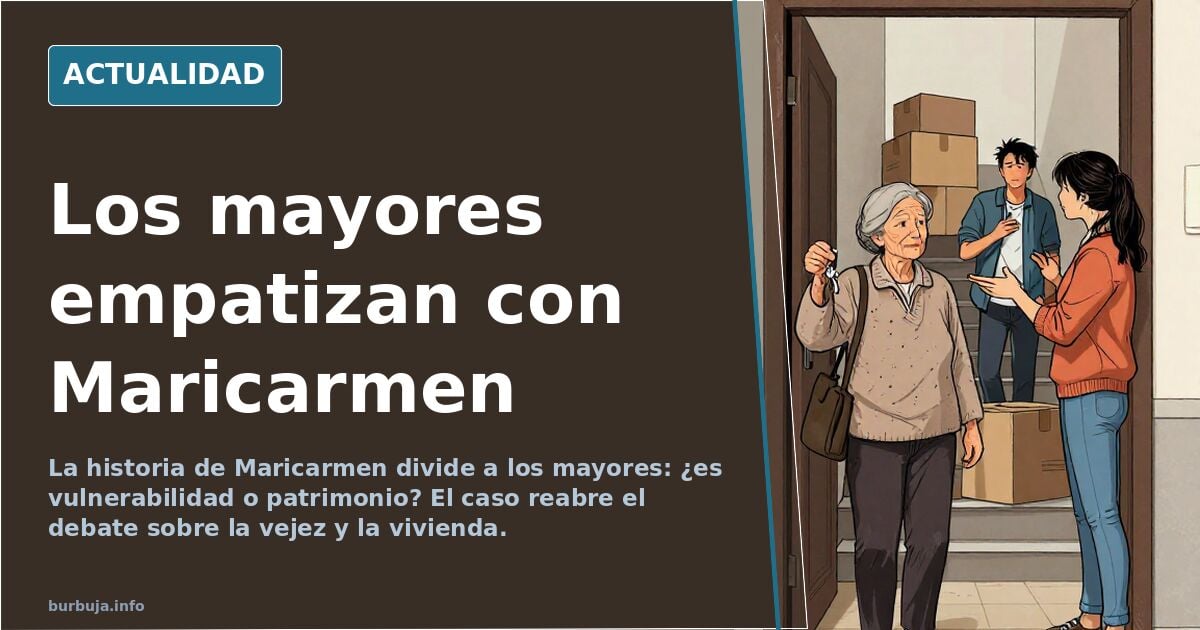
Seniors begin to empathize with Maricarmen
There is a paradox running through conversations about housing and vulnerability: those who have worked hardest all their lives are sometimes the ones least able to empathize with those facing homelessness. But something is changing. The story of Maricarmen, an elderly woman facing the purchase of her building, has stirred something within her peers. It is not textbook compassion; it is recognition. «Older people empathize because they see themselves as just as vulnerable and defenseless as this lady in the wild world out there», summarizes one intervention that set the tone for the exchange. The discussion, far from remaining on the specific case, drifts toward an uncomfortable question: to what extent does age make you target practice for the real estate market?
The Maricarmen case: vulnerability vs. assets
The specific details of the case are elusive, but the archetype is recognizable. An elderly woman, a long-time owner or tenant, is pushed to a breaking point when the building where she lives changes hands. The immediate reaction from part of the public was harsh: «That lady wasn't vulnerable; she had 300,000 pavos in the bank». The argument has its logic: if you have assets, you are not poor. But the equation becomes complicated when age and the ability to defend oneself come into play. At 90 years old, having money does not give you back the strength to litigate, move, or negotiate with an investment fund. Vulnerability is not just a figure in a bank account; it is also your support network, your health, and the time you have left.
Why do retirees empathize with Maricarmen?
The most frequent answer points to a generational mirror. Most retirees are homeowners, which in theory should distance them from the problem. However, the feeling that the world has become a hostile place for the elderly is taking hold. «If a 90-year-old man's building is bought out, it screws him over just the same whether he worked his whole life or not, and you can imagine how much strength he has left to defend himself». That is the key: it is not about solidarity with poverty, but about the antiestéticar of one's own future helplessness. The elderly person watching Maricarmen sees their own reflection in a system that does not protect the fragile, regardless of whether they have a financial cushion or not.
The elderly vote: a monolithic bloc?
Any political analysis of the matter hits a stubborn reality: the elderly vote half for the PP (People's Party) and the other half for the PSOE (Spanish Socialist Workers' Party), and they rarely switch parties. «Between them, there is a total of zero swing votes, because no matter what they do, and no matter what happens, they never change the direction of their vote». If this is true, empathy for Maricarmen will not translate into an electoral shift. The elderly bloc is stable and predictable, and political parties know it. The discussion about housing and aging may not move seats, but it does move consciences. And that is where Maricarmen's case becomes an uncomfortable mirror for everyone.
The question is not whether Maricarmen is vulnerable or not. The question is how many of those defending her today will be in her position tomorrow, and whether someone will return that empathy to them when that time comes.
There is a paradox running through conversations about housing and vulnerability: those who have worked hardest all their lives are sometimes the ones least able to empathize with those facing homelessness. But something is changing. The story of Maricarmen, an elderly woman facing the purchase of her building, has stirred something within her peers. It is not textbook compassion; it is recognition. «Older people empathize because they see themselves as just as vulnerable and defenseless as this lady in the wild world out there», summarizes one intervention that set the tone for the exchange. The discussion, far from remaining on the specific case, drifts toward an uncomfortable question: to what extent does age make you target practice for the real estate market?
The Maricarmen case: vulnerability vs. assets
The specific details of the case are elusive, but the archetype is recognizable. An elderly woman, a long-time owner or tenant, is pushed to a breaking point when the building where she lives changes hands. The immediate reaction from part of the public was harsh: «That lady wasn't vulnerable; she had 300,000 pavos in the bank». The argument has its logic: if you have assets, you are not poor. But the equation becomes complicated when age and the ability to defend oneself come into play. At 90 years old, having money does not give you back the strength to litigate, move, or negotiate with an investment fund. Vulnerability is not just a figure in a bank account; it is also your support network, your health, and the time you have left.
Why do retirees empathize with Maricarmen?
The most frequent answer points to a generational mirror. Most retirees are homeowners, which in theory should distance them from the problem. However, the feeling that the world has become a hostile place for the elderly is taking hold. «If a 90-year-old man's building is bought out, it screws him over just the same whether he worked his whole life or not, and you can imagine how much strength he has left to defend himself». That is the key: it is not about solidarity with poverty, but about the antiestéticar of one's own future helplessness. The elderly person watching Maricarmen sees their own reflection in a system that does not protect the fragile, regardless of whether they have a financial cushion or not.
The elderly vote: a monolithic bloc?
Any political analysis of the matter hits a stubborn reality: the elderly vote half for the PP (People's Party) and the other half for the PSOE (Spanish Socialist Workers' Party), and they rarely switch parties. «Between them, there is a total of zero swing votes, because no matter what they do, and no matter what happens, they never change the direction of their vote». If this is true, empathy for Maricarmen will not translate into an electoral shift. The elderly bloc is stable and predictable, and political parties know it. The discussion about housing and aging may not move seats, but it does move consciences. And that is where Maricarmen's case becomes an uncomfortable mirror for everyone.
The question is not whether Maricarmen is vulnerable or not. The question is how many of those defending her today will be in her position tomorrow, and whether someone will return that empathy to them when that time comes.
Summary of a discussion on Burbuja.info - Foro de economía, actualidad y política., translated from Spanish and reviewed before publication. Read the full discussion (32 replies).
More summaries
-
Spain's 87-year-old eviction reopens the housing war
The eviction of an 87-year-old woman has reignited Spain's political battle over housing, exposing the clash between property rights and tenant protection.
-
Maricarmen, the evicted elderly woman, and the battle of narratives on Twitter
The death of Maricarmen, an 87-year-old evicted woman, sparks a political war on Twitter. The case coincides with the pre-election campaign.
-
Spain's private security sector: jobs but near minimum wage
Spain's private security sector in 2026: immediate employment but salaries near the minimum wage, cronyism and highly unequal services. An analysis of a labour market.
-
Cars That Age Well: Timeless Design and Robust Mechanics
Discover which 20-year-old cars still look modern and offer reliable mechanics. BMW, Saab, Alfa Romeo, and more: an analysis of design and durability.
-
Frank Cuesta Faces Legal Pressure Amid Animal Sanctuary Scandal
Analysis of the Frank Cuesta scandal: allegations, alleged deception, and the legal pressure the content creator is facing.
-
Police Chief Indicted for Sexual Assault Following Subordinate's Complaint
A senior police official faces charges for sexual assault against a subordinate. Details of the lawsuit and the institutional context.