
Who Sold Off Spanish Artistic Heritage for a Century
From Mendizábal's secularizations to Francoism: altarpieces, books, and even a fragment of the Alhambra left Spain with permission and buyers.
English · Original discussion in Spanish · Published
A Century of Selling Short Spanish Art to Foreign Buyers
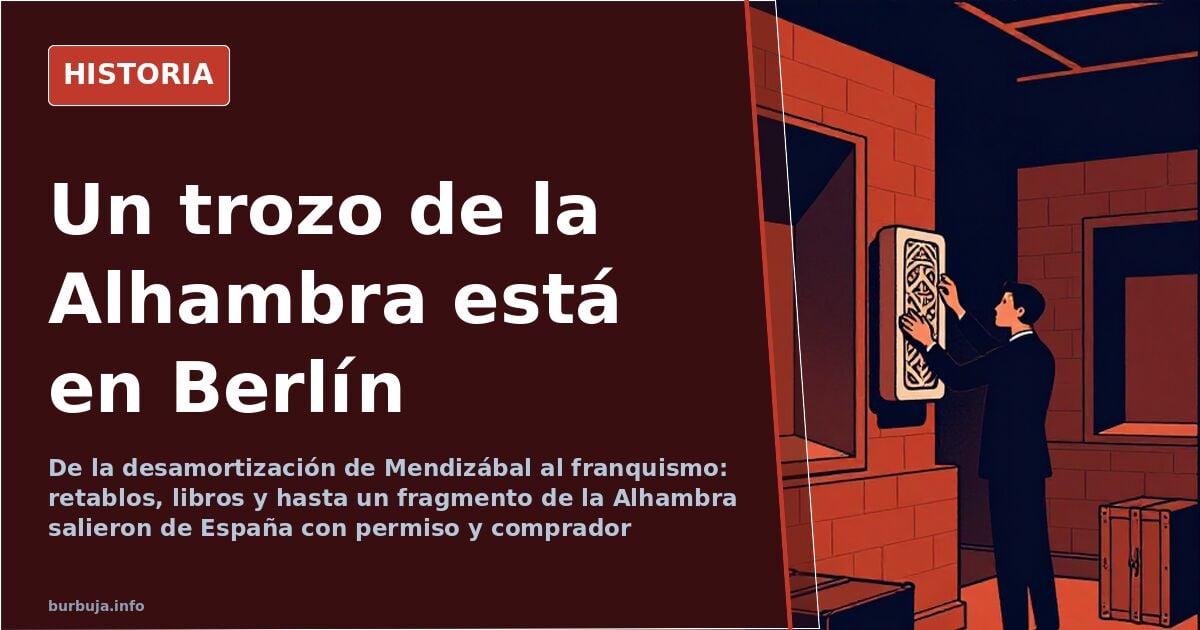
There is a fragment of the Alhambra in Berlin. And there were shops in Toledo where the client chose a page from a Gregorian chant book, and it was cut with a blade.
The uncomfortable paradox is this: the greatest drainage of Spanish historical heritage was not carried out by an invading army, but by our own administrations over decades and buyers with currency in their pockets.
Three Cycles of Sale, Not One
The most common narrative places the destruction during the Civil War and the burning of convents. Documentary evidence suggests something longer and far less epic. Since Mendizábal's secularizations (the transfer of church properties to private hands), ecclesiastical goods went into private hands at bargain prices, and much of it was resold outside of Spain. Afterward, the Restoration and Primo de Rivera's dictatorship consolidated a stable export market, allegedly with the complicity of ecclesiastical authorities. During Francoism, the circuit remained lubricated: the art thief known as Erik the Belgian came to report that he barely needed to steal, because the institutions themselves were concluding deals at modest prices.
What Is Gone and Nobody Claims
Paintings, sculptures, altarpieces, reliquaries, apses, and entire murals. The list is endless and can be traced in the museums that display these pieces today. Against this thesis, another current emphasizes the incalculable nature of what was destroyed after 1936 and recalls that the Popular Front lasted so little time that it barely had time to materialize. A third line of analysis warns against a vocabulary error: in the 19th century, left and right did not miccionan what they do today, and the Carlist Wars were fueled by conservatives opposed precisely over the secularizations.
How many Spanish pieces hang today in foreign museums without anyone having claimed them?
There is a fragment of the Alhambra in Berlin. And there were shops in Toledo where the client chose a page from a Gregorian chant book, and it was cut with a blade.
The uncomfortable paradox is this: the greatest drainage of Spanish historical heritage was not carried out by an invading army, but by our own administrations over decades and buyers with currency in their pockets.
Three Cycles of Sale, Not One
The most common narrative places the destruction during the Civil War and the burning of convents. Documentary evidence suggests something longer and far less epic. Since Mendizábal's secularizations (the transfer of church properties to private hands), ecclesiastical goods went into private hands at bargain prices, and much of it was resold outside of Spain. Afterward, the Restoration and Primo de Rivera's dictatorship consolidated a stable export market, allegedly with the complicity of ecclesiastical authorities. During Francoism, the circuit remained lubricated: the art thief known as Erik the Belgian came to report that he barely needed to steal, because the institutions themselves were concluding deals at modest prices.
What Is Gone and Nobody Claims
Paintings, sculptures, altarpieces, reliquaries, apses, and entire murals. The list is endless and can be traced in the museums that display these pieces today. Against this thesis, another current emphasizes the incalculable nature of what was destroyed after 1936 and recalls that the Popular Front lasted so little time that it barely had time to materialize. A third line of analysis warns against a vocabulary error: in the 19th century, left and right did not miccionan what they do today, and the Carlist Wars were fueled by conservatives opposed precisely over the secularizations.
How many Spanish pieces hang today in foreign museums without anyone having claimed them?
Summary of a discussion on Burbuja.info - Foro de economía, actualidad y política., translated from Spanish and reviewed before publication. Read the full discussion (17 replies).
More summaries
-
Reform the calendar so seasons start on the 1st
A calendar reform would make each season begin on the 1st of its month: a 32-day August and the year anchored to January 1, not the perihelion.
-
When did Europe's national football teams start to get more diverse?
France fielded a Black player as early as 1938 and Portugal four in 1966. The timeline of diversity in European national football teams and its causes.
-
Why Spain was not an economic engine after World War II
Spanish GDP grew 5,3% between 1939 and 1944 and only 0,14% between 1945 and 1950: neutrality in World War II was not enough to lead Europe
-
Why Spain never had an industrial bourgeoisie—but did have a rentier caste
Hispano-Suiza, the 1986 EEC and the rentier-caste thesis: why Spain never became an industrial power despite its technical talent
-
Mussolini declared war as France was already collapsing
On 10 June 1940, Italy declared war on France and the UK with a three-paragraph note. Greece, Africa and Gibraltar changed the plan.
-
OVERCOMING SEXUAL SINS ~ THE REQUIRED SPIRITUAL TOOLS (Father Spyridon)
The spiritual path to conquering carnal passions, from humility to perseverance. Discover the teachings of the Church Fathers.