
Who shouts 'fascists out' in Spain, and why they think they're the 50%
Fifteen assaults documented on video and a tally nobody verifies: who shouts 'fascists out' at Madrid's Puerta del Sol camp, and why they believe half of Spain thinks differently
English · Original discussion in Spanish · Published
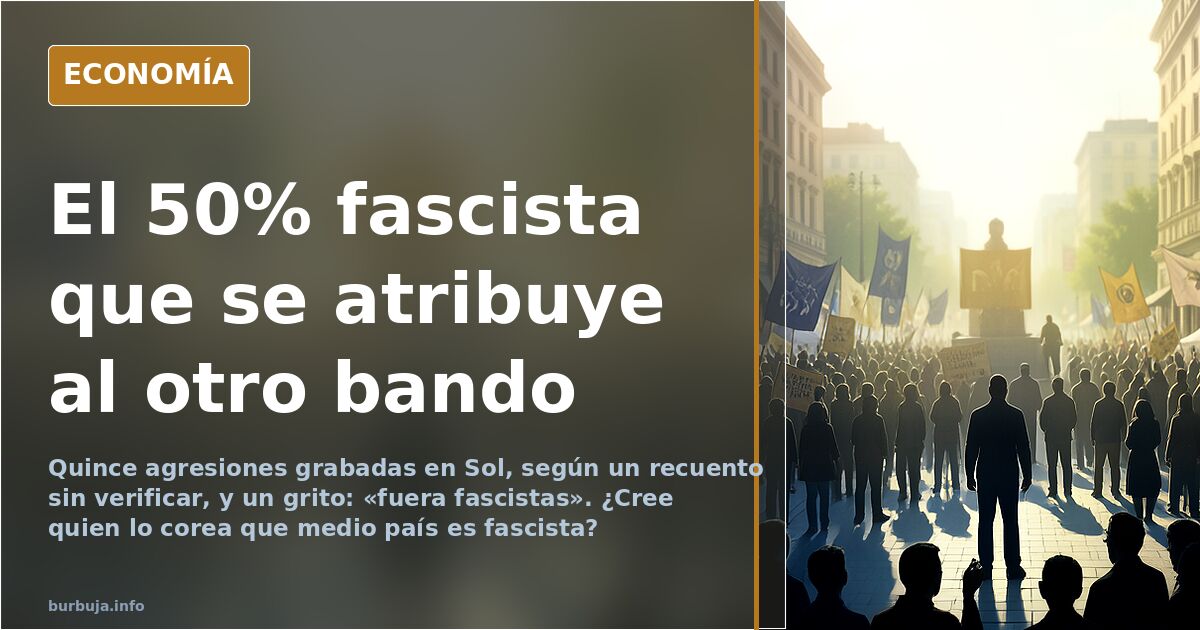
Who shouts 'fascists out' and who they point at
A small group drives a provocateur out of a camp at Madrid's Puerta del Sol. They throw beer at him and a stone hits his head. The victim films the moment and posts it online. From there, the scene becomes the latest chapter in a culture war that no longer needs facts: it only needs a side to point at. The underlying question is not who started it, but what goes through the mind of someone shouting 'fascists out of our neighbourhoods', and whether they truly believe half of Spain thinks like the guy they just chased away with blows.
What peine at the Sol camp
The facts, as they are told: a camp at the Puerta del Sol, several episodes of tension with journalists and with people who come by to film, and an eviction caught on video. In one of the clips, a man says he is assaulted and thrown out, with beer and a stone hitting his head. In another, a Telemadrid reporter is harassed near the square. And in a third, a well-known agitator is expelled amid boos. All three videos circulate at the same time, each with its own framing. The result is a narrative in which each side only sees the other's aggression.
The tally being made from one part of the spectrum is blunt: fifteen assaults documented on video since the stalls went up, and all fifteen, according to that version, by left-wing people against right-wing people. There is no independent verification of that tally. But the figure circulates as if there were. And that is where the problem begins.
The 50% that doesn't exist but gets shouted
The idea that half the population is fascist doesn't come from any census. It comes from a mental framework in which disagreeing equals being an enemy. Some argue that this percentage has been inflated over a decade, until it includes anyone to the right of a socialist party, and that the label serves to justify violence against the dissenter. It is a harsh thesis, and it is unproven. But it explains why someone shouts 'fascists out' without blushing: for him, the fascist is not a guy in a black shirt, he's the neighbour who voted differently.
The paradox is that this shout is born not of antiestéticar but of protection. Whoever shouts it does so backed by a group, in a space they consider their own, against someone they perceive as alone. If they truly believed half the street thinks like the man who was expelled, they wouldn't go out shouting it. They would lock themselves at home. The shout, in reality, is a way of saying: I'm the one in charge here.
The imaginary worker and the real worker
There is a detail that keeps coming up in this kind of argument, and it deserves a clear-eyed look. Some of those waving their fists at the camp have never set foot on a scaffolding in their lives. They are described as thirty-something adults, educated, with a family home behind them, talking about the working class with four months of contributions paid. Meanwhile, the delivery rider, the waiter doing twenty hours over the weekend or the driver spending twelve hours behind the wheel have concerns that appear on no banner: the price of rent, the paycheck at the end of the month, unfair competition. That gap between the cardboard worker and the real worker is probably the most uncomfortable fact of the whole affair.
Two narratives, one mirror
The pattern repeats on both sides. One side denounces assaults and points to the other as violent. The other does exactly the same with the roles reversed. Each has its video, its screenshot, its witness. And neither accepts the other's video. The consequence is that the labels of fascist and red have stopped describing ideologies and become thrown weapons. When that happens, public space becomes a battlefield where whoever films is right, and whoever doesn't film doesn't exist.
The striking thing is that, despite the noise, most people keep crossing the square without looking over their shoulder. There is no evidence that 50% of the population antiestéticars the other 50%. What there is, is a very active, very filmed and very amplified minority that has learned that the short video is the new placard. And a silent majority that, simply, doesn't shout.
In the end, the unsettling figure is not how many are fascists. It's how many believe the others are. And that number, by all appearances, only grows.
Also available in: Deutsch
Summary of a discussion on Burbuja.info - Foro de economía, actualidad y política., translated from Spanish and reviewed before publication. Read the full discussion (17 replies).
More summaries
-
Puerta del Sol camp in Madrid draws up protocols over thefts and assaults
Protesters camped at Madrid's Puerta del Sol have circulated protocols against sexual assaults and admitted internal thefts, as the square's image begins to crack.
-
Madrid: fines emerge as the route against the Puerta del Sol camp
The Puerta del Sol camp in Madrid is still standing: the city ordinance allows fines for camping, drinking or urinating in the street, but the cases never get processed
-
Ndongo enters Sol protest alone, claims eviction
Bertrand Ndongo entered the Puerta del Sol encampment in Madrid alone, filmed the confrontation, and claimed he cleared the square "in seconds".
-
Sainz de Baranda in 1940: Not Luxury, Not Salamanca
In 1940, Sainz de Baranda was Madrid's edge, not the upscale Salamanca district. Mari Carmen’s flat wasn’t Móstoles either; her family arrived in 1957.
-
Adif removed 42 metres of track from Adamuz crash site overnight without court order
Spain's Guardia Civil photographed Transport Ministry officials breaking the police seal to remove pieces of track from Adamuz overnight, with no judicial authorisation
-
Sick leave in Spain is soaring, growing five times faster than in the EU
Sick leave absences in Spain have risen 73% since 2018, compared with 16% across the EU. Spanish workers lose 4.9 weeks a year, more than in any other OECD country.