
WHO seeks 30% salt cut, not ban; misinformation spreads
The WHO calls for a 30% reduction in salt intake, not a prohibition. The 'goodbye to salt' rumor stems from headlines confusing reduction with elimination.
English · Original discussion in Spanish · Published
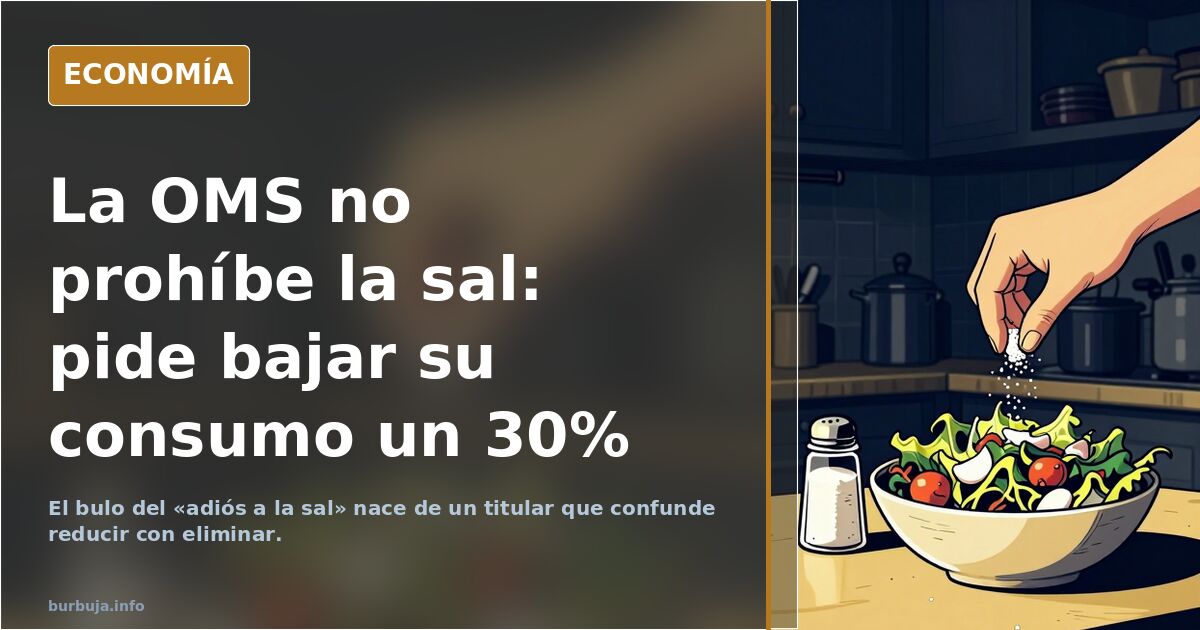
WHO does not ban salt: it calls for a 30% reduction
Can you prohibit something that the very organization allegedly banning it considers essential for life? No. Yet the headline "Goodbye to salt, WHO asks people to stop consuming it" circulates as if it were an official statement. The actual document, found when tracing the primary source, speaks of reducing salt consumption by 30%, not eliminating it. The confusion between "reduce" and "prohibit" sustains the entire controversy.
The noise originates from a tweet summarizing the recommendation as an order to stop consuming it. From there, the conversation splits into two camps: those who argue salt is indispensable for the body and those who remind us that excess in ultra-processed foods is what truly moves the needle. Neither position is false. The problem is that the first is used to neutralize the second.
Is salt necessary for the body?
Yes, but with nuances almost no one mentions. The body needs sodium and chloride, not table salt. Both elements are present in significant quantities in most unprocessed foods. Most sodium ingested by the average person does not come from the salt shaker, but from what the product already contains before reaching the plate.
Here lies the central misunderstanding. Those saying "salt is necessary for life" are biochemically correct but practically wrong: no one is proposing removing sodium from the diet. The real discussion is about how much extra is added. In this area, the uncomfortable fact is that consumption spikes in products you don't know contain salt until you read the label.
Refined sugar and double standards
The comparison arises naturally. If the issue is excess, why does salt generate apocalyptic headlines while refined sugar remains on shelves without anyone calling for its removal? The short answer is that sugar has better press and worse accumulated evidence. The long answer is that regulating what is added to ultra-processed foods is more expensive than asking consumers to self-regulate.
Some argue that refined sugar is not necessary at all, whereas sodium is. This argument is correct and serves its purpose: reminding us they are not equivalent. But it does not invalidate that both are overused for the same reason: making edible what would otherwise be inedible.
Taste adapts and the palate protests
One of the most useful observations circulating is that taste recalibrates. Someone reducing salt for weeks begins to find food salty that previously tasted normal. The same happens with sugar. It is not an opinion, it is sensory adaptation, and it explains why many people eating out find restaurant dishes nauseatingly salty without having changed anything in their diet.
The corollary is uncomfortable for the hospitality industry: if palates get used to less salt, those cooking generously lose customers. And if they get used to more, those cooking moderately seem bland. The war is not between the WHO and the consumer, it is between the consumer and the chef.
The hoax that can no longer be deactivated
The damage of a false headline is that it survives its debunking. The "goodbye to salt" narrative is already entrenched in public discourse, and any subsequent nuance sounds like a late correction. The actual recommendation, a 30% reduction, is a modest figure no one will remember because it isn't scary.
Meanwhile, the underlying debate remains unresolved: do we regulate what products contain or educate the consumer? The first option clashes with industry, the second with patience. And in the middle, salt, which has been on tables for millennia and won't disappear because of a tweet.
In the end, the only thing truly prohibited was the possibility of reading the fine print before getting indignant.
Also available in: Deutsch
Summary of a discussion on Burbuja.info - Foro de economía, actualidad y política., translated from Spanish and reviewed before publication. Read the full discussion (137 replies).
More summaries
-
CATL Sodium Battery Promises 5.8M km Range
CATL's Naxtra sodium battery claims 10,000 cycles and €10/kWh cost, challenging EV economics despite technical skepticism.
-
Muslim women demand hijabs in Spanish classrooms
In Spain, a group demands removing crucifixes from public schools while allowing hijabs, sparking debate on secularism.
-
EU Plans Ban on Wood Boilers from 2027
Brussels prepares rules to phase out wood stoves by 2027, requiring automatic controls that prevent use without electricity.
-
Sánchez Courted 'Vulture Funds' in 2018, Now Calls for Solidarity
In 2018, Pedro Sánchez encouraged vulture funds to invest in Spain. Now, his government urges landlords to show solidarity and lower rents.
-
Iryo train alerted Adif to LZB signal failure 10 minutes before AVE crash
The Iryo train notified Adif at 8:38 that it had stopped due to an LZB signalling failure. At 8:48, Renfe's AVE 6076 rammed into it at over 100 km/h.
-
Spain's PSOE threatens to challenge the election result if it loses
Spain's PSOE has reportedly laid the groundwork to challenge the November 29 election if it loses, but the legal mechanism requires specific grounds and deadlines that do not match its plans.