
CATL Sodium Battery Promises 5.8M km Range
CATL's Naxtra sodium battery claims 10,000 cycles and €10/kWh cost, challenging EV economics despite technical skepticism.
English · Original discussion in Spanish · Published
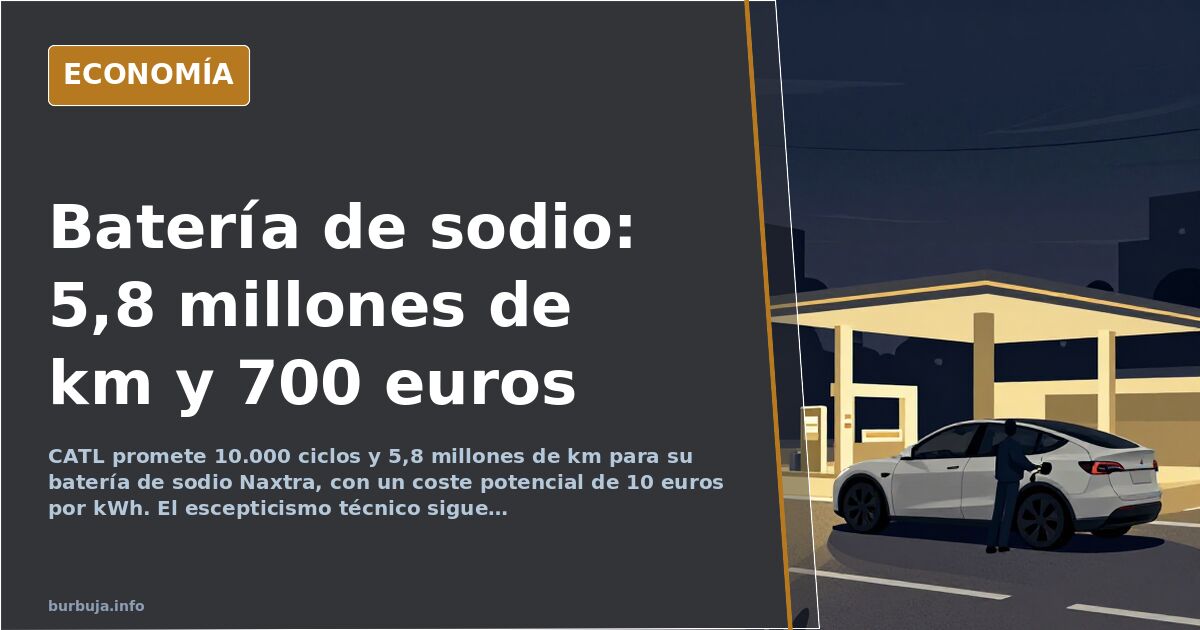
CATL Promises Sodium Battery Lasting 5.8 Million Kilometers for €700
CATL has confirmed that its Naxtra sodium-ion battery would withstand 10,000 charge-discharge cycles before capacity drops below 85%, equivalent to approximately 5.8 million kilometers. The Chinese manufacturer adds a potential price of €10 per kWh, meaning about €700 for a 70 kWh pack compared to the roughly €7,000 that same capacity costs today with conventional cells. If half of these claims hold true, the equation for electric vehicles changes fundamentally.
The figures are striking due to the contrast. LFP batteries in most current EVs last between 3,000 and 4,000 cycles before dropping below 80%, translating to 600,000 to 800,000 kilometers. CATL’s proposal would multiply that durability by more than seven times. It also arrives with a chemistry that, according to the company, operates stably between -40 and 70 degrees Celsius, maintaining 90% of usable capacity in extreme cold.
What is the Naxtra battery and when will it arrive?
Naxtra is the commercial name for CATL’s sodium-ion battery. The company states that over 30 production models will integrate it starting in 2025 under the Freevoy system, antiestéticaturing brands like Geely, Chery, GAC, or Voyah, targeting both passenger EVs and industrial vehicles where extra weight matters less.
The historical hurdle for sodium was the scale circle: it needs volume to become cheaper and needs to be cheap to reach that volume. If CATL breaks this cycle and maintains announced prices, the economic barrier for electric cars would disappear. This is the scenario the manufacturer sells. Independent validation, however, does not yet exist.
Energy density: the deciding factor
This is where the debate begins. Naxtra’s density stands at 175 Wh/kg, compared to 185 Wh/kg for current LFPs, according to data from the company itself. CATL assures its second generation will exceed 200 Wh/kg. Therefore, the difference with lithium would not be two or three times, but a narrow margin.
Some argue this margin is sufficient for compact cars but not for long-range sedans. The counter-argument is that heavier cells require more structure, brakes, and energy consumption, an effect multiplied in large vehicles. This discussion won’t be settled by brochures; real voltage curves and behavior under demanding discharge depths must be observed.
Real-world durability vs. lab durability
The 10,000 cycles figure is the headline, but the devil is in the conditions. A cycle isn’t always a cycle: charging to 100% and discharging to 0% wears out much more than operating between 20% and 80%. LFPs, already well-known, offer over 2,000 cycles with 60% discharges and 1C charging, implying about 200 kilometers per recharge and a half-hour wait.
The question is whether sodium withstands that same regime. The promise of millions of kilometers could shrink significantly if real usage demands fast charging and deep discharges. It’s the same trick seen with other chemistries: ranges and lifespans measured under conditions no one reproduces on the road.
The €10/kWh price and its fine print
The €10 per kWh figure makes the most noise. At that cost, a 70 kWh battery would come out to €700, whereas it currently hovers around €7,000. The theoretical saving is an order of magnitude and explains the enthusiasm. It also explains the skepticism: that price depends on massive-scale production, stable sodium costs, and a Chinese supply chain free from disruptions.
Added to this is the European commercial factor. A cheap product of Chinese origin must cross borders that tax imports. The final cost for the European buyer won’t be the factory gate price. Protecting local industry has a price, and that price is paid by whoever signs the contract.
Why sodium also sounds promising for stationary storage
Sodium has a niche where weight doesn’t matter: battery banks for renewable backup. There, energy density ceases to be a problem, and durability and price rule. A battery lasting thousands of cycles costing a fraction of a lithium one is, on paper, ideal for accumulating solar or wind surpluses.
The problem is that market isn’t infinite either. If vast quantities of cells are manufactured for backup that never gets installed, surplus stock gets sold at discount prices, distorting sector accounts. This dynamic has been seen in other storage technologies.
Skepticism fueled by decades of promises
For over twenty years, revolutionary batteries have been announced that never reach dealerships. Supercapacitors, graphene, barium titanate, sugar chemistry: the graveyard of promises is vast. Each lab announcement becomes a headline, and each headline is forgotten without the product appearing.
That long memory explains why part of the public remains unmoved. The usual response is that this time there is a factory, a schedule, and a brand willing to take risks. The opposing view is that first generations always disappoint, and we’ll need to see the first cars on the street before believing anything. The exact point where analysis stalls is this: there are dates, names, and prices, but not a single cell verified by a third party.
CATL has confirmed that its Naxtra sodium-ion battery would withstand 10,000 charge-discharge cycles before capacity drops below 85%, equivalent to approximately 5.8 million kilometers. The Chinese manufacturer adds a potential price of €10 per kWh, meaning about €700 for a 70 kWh pack compared to the roughly €7,000 that same capacity costs today with conventional cells. If half of these claims hold true, the equation for electric vehicles changes fundamentally.
The figures are striking due to the contrast. LFP batteries in most current EVs last between 3,000 and 4,000 cycles before dropping below 80%, translating to 600,000 to 800,000 kilometers. CATL’s proposal would multiply that durability by more than seven times. It also arrives with a chemistry that, according to the company, operates stably between -40 and 70 degrees Celsius, maintaining 90% of usable capacity in extreme cold.
What is the Naxtra battery and when will it arrive?
Naxtra is the commercial name for CATL’s sodium-ion battery. The company states that over 30 production models will integrate it starting in 2025 under the Freevoy system, antiestéticaturing brands like Geely, Chery, GAC, or Voyah, targeting both passenger EVs and industrial vehicles where extra weight matters less.
The historical hurdle for sodium was the scale circle: it needs volume to become cheaper and needs to be cheap to reach that volume. If CATL breaks this cycle and maintains announced prices, the economic barrier for electric cars would disappear. This is the scenario the manufacturer sells. Independent validation, however, does not yet exist.
Energy density: the deciding factor
This is where the debate begins. Naxtra’s density stands at 175 Wh/kg, compared to 185 Wh/kg for current LFPs, according to data from the company itself. CATL assures its second generation will exceed 200 Wh/kg. Therefore, the difference with lithium would not be two or three times, but a narrow margin.
Some argue this margin is sufficient for compact cars but not for long-range sedans. The counter-argument is that heavier cells require more structure, brakes, and energy consumption, an effect multiplied in large vehicles. This discussion won’t be settled by brochures; real voltage curves and behavior under demanding discharge depths must be observed.
Real-world durability vs. lab durability
The 10,000 cycles figure is the headline, but the devil is in the conditions. A cycle isn’t always a cycle: charging to 100% and discharging to 0% wears out much more than operating between 20% and 80%. LFPs, already well-known, offer over 2,000 cycles with 60% discharges and 1C charging, implying about 200 kilometers per recharge and a half-hour wait.
The question is whether sodium withstands that same regime. The promise of millions of kilometers could shrink significantly if real usage demands fast charging and deep discharges. It’s the same trick seen with other chemistries: ranges and lifespans measured under conditions no one reproduces on the road.
The €10/kWh price and its fine print
The €10 per kWh figure makes the most noise. At that cost, a 70 kWh battery would come out to €700, whereas it currently hovers around €7,000. The theoretical saving is an order of magnitude and explains the enthusiasm. It also explains the skepticism: that price depends on massive-scale production, stable sodium costs, and a Chinese supply chain free from disruptions.
Added to this is the European commercial factor. A cheap product of Chinese origin must cross borders that tax imports. The final cost for the European buyer won’t be the factory gate price. Protecting local industry has a price, and that price is paid by whoever signs the contract.
Why sodium also sounds promising for stationary storage
Sodium has a niche where weight doesn’t matter: battery banks for renewable backup. There, energy density ceases to be a problem, and durability and price rule. A battery lasting thousands of cycles costing a fraction of a lithium one is, on paper, ideal for accumulating solar or wind surpluses.
The problem is that market isn’t infinite either. If vast quantities of cells are manufactured for backup that never gets installed, surplus stock gets sold at discount prices, distorting sector accounts. This dynamic has been seen in other storage technologies.
Skepticism fueled by decades of promises
For over twenty years, revolutionary batteries have been announced that never reach dealerships. Supercapacitors, graphene, barium titanate, sugar chemistry: the graveyard of promises is vast. Each lab announcement becomes a headline, and each headline is forgotten without the product appearing.
That long memory explains why part of the public remains unmoved. The usual response is that this time there is a factory, a schedule, and a brand willing to take risks. The opposing view is that first generations always disappoint, and we’ll need to see the first cars on the street before believing anything. The exact point where analysis stalls is this: there are dates, names, and prices, but not a single cell verified by a third party.
Also available in: Deutsch
Summary of a discussion on Burbuja.info - Foro de economía, actualidad y política., translated from Spanish and reviewed before publication. Read the full discussion (164 replies).
More summaries
-
Tourist Flat Squatters Demand Up to €10,000 to Vacate
Forum reports reveal squatters demand €3,000-€10,000 to leave tourist flats in Spain. Overburdened courts and organized gangs worsen the crisis.
-
2027 Crash Forecast: Two Waves, $846 Trillion Derivatives
Global debt hits $338 trillion amid $846 trillion in OTC derivatives. A timeline predicts a systemic collapse starting in 2027.
-
Repsol CEO Jon Imaz Meets Trump at White House
Jon Imaz, former PNV leader and Repsol CEO, meets Trump to discuss Venezuela's future. Business pragmatism or political submission?
-
Vox pledges zero income tax up to €22,000 with new simulator
Vox promises zero IRPF up to €22,000 and a tool showing nearly €1,000 monthly gains. Critics cite a €50 billion cost without funding sources.
-
Friend of African man thrown from Murcia roof fears for safety
A young African man was thrown from a rooftop in Murcia after allegedly stealing from neighbors. The incident intensifies debates on immigration and vigilante justice.
-
Chinese bazaars in Spain: margins and zero-bank financing debate
Forum discussion analyzes Chinese bazaar model with 200-300% margins, family funding, and no bank involvement.