
Who listens to podcasts: the format that devours the gaps
Podcasts are taking over cars, gyms and long journeys: listeners choose the topic and skip the ads. General-interest radio is losing that space.
English · Original discussion in Spanish · Published
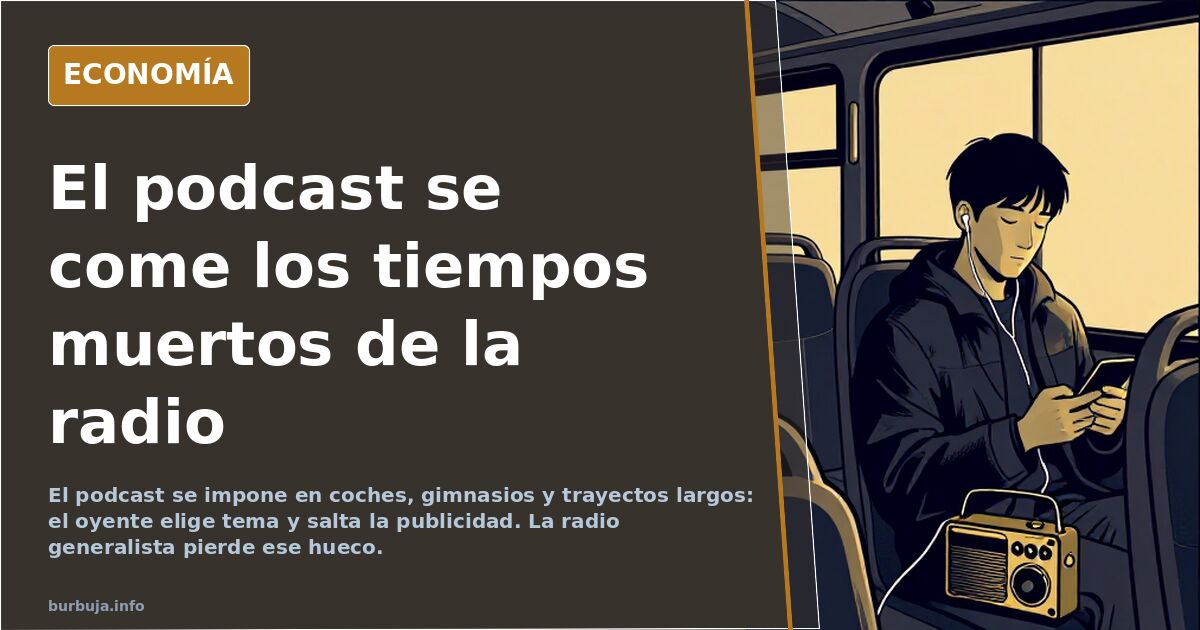
Podcast: the format winning where radio lost
A worker alone on a shift, a vacuum cleaner at home, a rowing machine in the gym. That is the real map of where a podcast plays: in the dead gaps of the day, almost never in the living room at home. The conversation about the format starts with an almost physical complaint —the word itself provokes rejection— and ends up becoming a tug-of-war over whether that spoken audio you download alone is culture, company or just background noise. The technical definition is duller than it sounds: series of digital multimedia files that are downloaded or streamed online, with no programming grid, no schedule and no standby host.
What is a podcast and why does the name provoke resistance?
The label is weighed down by its own sound. Some admit the word strikes them as ridiculous from the outset, an anglicism adopted to seem more modern and to turn into a category what was previously just a recorded program. Others call it audio, a file downloaded from an audio library, and get rid of the problem. The debate, at bottom, is not terminological: it is about who decides what deserves to be called cultural content and what remains after-dinner chatter.
What no one disputes is the medium. A file that can be downloaded, paused and resumed at will breaks the logic of live broadcasting and shifts all the power to the listener. That tiny detail explains why the format has grown precisely where traditional radio was losing ground: on long journeys, during household chores and in solitary jobs.
The car, the gym and the vacuum cleaner: where people listen
The scenarios repeat with suspicious monotony. Driving, taking public transport, cleaning the house, working out, working alone in a warehouse or in a truck cab. The most cited argument is company: the aim is not to learn anything specific, but to have someone talking while your hands are busy. For those who spend the day alone, the format fills the gap that general-interest radio used to cover.
And that is where the competitive advantage almost everyone points to appears: selection. Unlike a fixed schedule, the listener decides the subject, the length and the moment. Music and speech alternate depending on the stage of the journey. Advertising, which on radio interrupts every few minutes, can here be skipped or eliminated outright with ad-blocking tools. For many, that alone justifies changing the habit.
From finance to La rosa de los vientos: what plays in your headphones
The catalog in play ranges shamelessly from investment to mystery. It antiestéticatures names in personal finance and value investing, economic popularization, Stoicism, classical history and now-legendary radio programs, with La rosa de los vientos cited as a hard-to-repeat peak. At the opposite end, long interviews with technologists and investors who once built the first generation of web browsers.
Variety is defenders' star argument: military history, astronomy, biology, cinema, conspiracies, audiobooks and even audio-described films for blind people. Someone recalls seven-hour episodes about the Vietnam War and long journeys enlivened with film soundtracks. Length, which on television would be a problem, here becomes a virtue: there is no time limit and no editing limit.
The hidden cost: fewer books and more disinformation
The most uncomfortable criticism does not come from skeptics of the format, but from its own consumers. It is argued that podcasts encourage unstructured thinking, multiply those who opine on everything without having read anything and serve as a perfect alibi for not opening a book: “I don’t have time,” they say, while piling up hours of audio. The platforms’ bias is also pointed out: they rank what plays according to the algorithm, not according to quality.
Add to that an aesthetic complaint. Many programs sound as if they were recorded in someone's bedroom, with mediocre equipment and improvised lighting. And there is a deeper warning: when production volume grows unchecked, so does disinformation and cheap panel talk disguised as expertise. It is not a problem of the medium, but the medium amplifies it.
The accent war: the neutral accent does not exist
As often happens, the discussion drifted. From whether the format is any good, it jumped to the accents of those who present it. One side argues that voice-over should use the Castilian Spanish of central peninsular Spain, the one that has come to be called neutral because it has prevailed in film and television. Another replies that this accent is also marked, and that the problem is that voices from Extremadura, Aragon, Galicia or Asturias are barely heard in the media.
The exchange grew heated and left a useful idea: homogeneity in voice-over is not neutrality, it is custom. An actor putting on a regional accent sounds fake, and someone from Extremadura speaking without their accent sounds like someone else. The fight, in reality, was once again about who sets the standard.
Some say they have learned more history from these files than from books. And some maintain that the format breeds ignorance. Both listen to the same thing, in the same car, at the same time. And while people continue arguing over whether a neutral accent exists, the seven-hour episode about Vietnam is still there. Free.
A worker alone on a shift, a vacuum cleaner at home, a rowing machine in the gym. That is the real map of where a podcast plays: in the dead gaps of the day, almost never in the living room at home. The conversation about the format starts with an almost physical complaint —the word itself provokes rejection— and ends up becoming a tug-of-war over whether that spoken audio you download alone is culture, company or just background noise. The technical definition is duller than it sounds: series of digital multimedia files that are downloaded or streamed online, with no programming grid, no schedule and no standby host.
What is a podcast and why does the name provoke resistance?
The label is weighed down by its own sound. Some admit the word strikes them as ridiculous from the outset, an anglicism adopted to seem more modern and to turn into a category what was previously just a recorded program. Others call it audio, a file downloaded from an audio library, and get rid of the problem. The debate, at bottom, is not terminological: it is about who decides what deserves to be called cultural content and what remains after-dinner chatter.
What no one disputes is the medium. A file that can be downloaded, paused and resumed at will breaks the logic of live broadcasting and shifts all the power to the listener. That tiny detail explains why the format has grown precisely where traditional radio was losing ground: on long journeys, during household chores and in solitary jobs.
The car, the gym and the vacuum cleaner: where people listen
The scenarios repeat with suspicious monotony. Driving, taking public transport, cleaning the house, working out, working alone in a warehouse or in a truck cab. The most cited argument is company: the aim is not to learn anything specific, but to have someone talking while your hands are busy. For those who spend the day alone, the format fills the gap that general-interest radio used to cover.
And that is where the competitive advantage almost everyone points to appears: selection. Unlike a fixed schedule, the listener decides the subject, the length and the moment. Music and speech alternate depending on the stage of the journey. Advertising, which on radio interrupts every few minutes, can here be skipped or eliminated outright with ad-blocking tools. For many, that alone justifies changing the habit.
From finance to La rosa de los vientos: what plays in your headphones
The catalog in play ranges shamelessly from investment to mystery. It antiestéticatures names in personal finance and value investing, economic popularization, Stoicism, classical history and now-legendary radio programs, with La rosa de los vientos cited as a hard-to-repeat peak. At the opposite end, long interviews with technologists and investors who once built the first generation of web browsers.
Variety is defenders' star argument: military history, astronomy, biology, cinema, conspiracies, audiobooks and even audio-described films for blind people. Someone recalls seven-hour episodes about the Vietnam War and long journeys enlivened with film soundtracks. Length, which on television would be a problem, here becomes a virtue: there is no time limit and no editing limit.
The hidden cost: fewer books and more disinformation
The most uncomfortable criticism does not come from skeptics of the format, but from its own consumers. It is argued that podcasts encourage unstructured thinking, multiply those who opine on everything without having read anything and serve as a perfect alibi for not opening a book: “I don’t have time,” they say, while piling up hours of audio. The platforms’ bias is also pointed out: they rank what plays according to the algorithm, not according to quality.
Add to that an aesthetic complaint. Many programs sound as if they were recorded in someone's bedroom, with mediocre equipment and improvised lighting. And there is a deeper warning: when production volume grows unchecked, so does disinformation and cheap panel talk disguised as expertise. It is not a problem of the medium, but the medium amplifies it.
The accent war: the neutral accent does not exist
As often happens, the discussion drifted. From whether the format is any good, it jumped to the accents of those who present it. One side argues that voice-over should use the Castilian Spanish of central peninsular Spain, the one that has come to be called neutral because it has prevailed in film and television. Another replies that this accent is also marked, and that the problem is that voices from Extremadura, Aragon, Galicia or Asturias are barely heard in the media.
The exchange grew heated and left a useful idea: homogeneity in voice-over is not neutrality, it is custom. An actor putting on a regional accent sounds fake, and someone from Extremadura speaking without their accent sounds like someone else. The fight, in reality, was once again about who sets the standard.
Some say they have learned more history from these files than from books. And some maintain that the format breeds ignorance. Both listen to the same thing, in the same car, at the same time. And while people continue arguing over whether a neutral accent exists, the seven-hour episode about Vietnam is still there. Free.
Summary of a discussion on Burbuja.info - Foro de economía, actualidad y política., translated from Spanish and reviewed before publication. Read the full discussion (215 replies).
More summaries
-
YouTuber with 180.000 subscribers: ‘Nobody wants to work’
Why she can’t find anyone to renovate her bathroom. Why is it so hard to find someone? Because the conversation about the labour market…
-
Otero calls points-based visa racist from a 280 m² penthouse
Julia Otero describes calls for a points-based visa as "racist and dirty" while living in a 280 m² penthouse in Barcelona.
-
Felipe González Questions Hamas's Hostage Release Stance
Felipe González questions why Hamas isn't releasing Israeli hostages, sparking debate on proportionality, occupation, and casualty figures.
-
Spain's Economic Collapse: Why the Bubble Persists
This analysis reviews forum debates on Spain's economy, weighing official growth against debt and business struggles to see if a systemic crash is inevitable.
-
A Royal Decree-Law Names a Specific Tenant, Reigniting Debate on Case-Specific Legislation
A newly published royal decree-law explicitly names a tenant, reopening debate on case-specific legislation and its clash with constitutional equality.
-
Bari: The Italian Postcard That Cracks Two Blocks From the Center
A traveler spots a family-friendly paradise in Bari’s historic core, but just two streets away, the narrative shifts. Italy vs. Spain compared.