
Who Funds Pro-Palestinian Protests? The Money Debate
Protests disrupting the Vuelta a España revive debate on mobilization funding: unproven theories range from Iran to Brussels.
English · Original discussion in Spanish · Published
Who Pays for the Pro-Palestinian Flags Disrupting the Vuelta
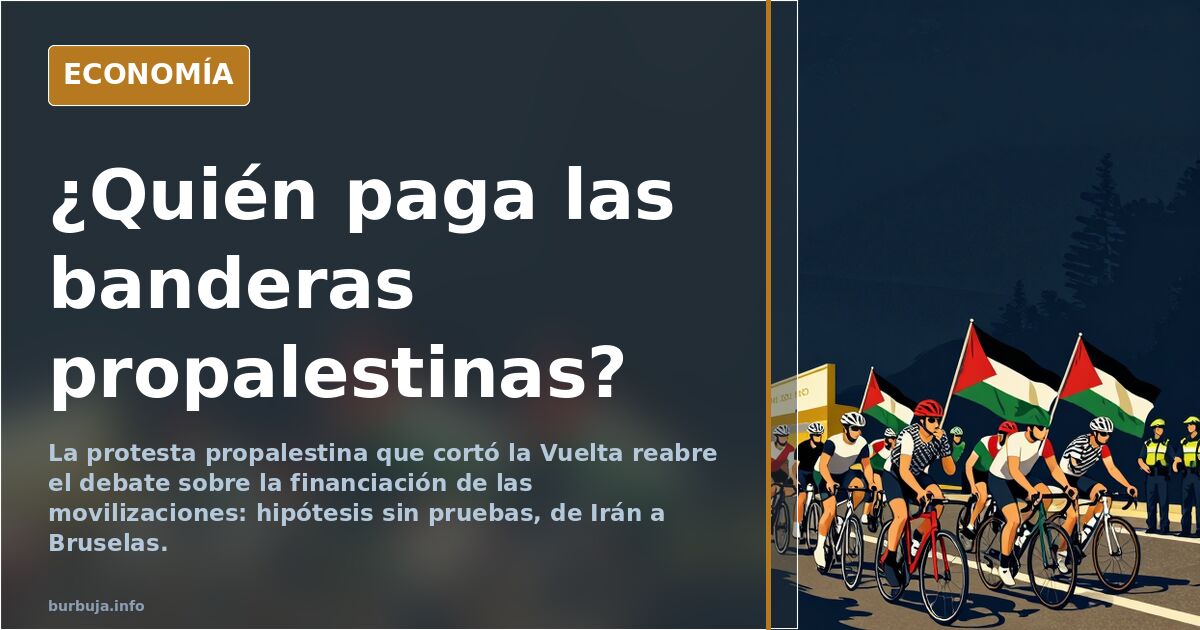
A synchronized fleet of flags, banners, and slogans halted a stage of the Vuelta a España, leaving an uncomfortable question: if everyone buys their own flag, why do they all appear at once? The pro-Palestinian protest that neutralized the cycling tour has peine the debate on how such mobilizations are funded. Circulating hypotheses point to Iran, Soros, Qatar, Venezuela, the PSOE, and the EU. None have proof. All raise suspicions.
Where the Money Comes From: Competing Hypotheses
The range of suspicions is broad. Some point to Gulf states and Iran; others to Russia via Cuba and Venezuela; some mention China as interested in weakening the West; and others argue the Spanish government itself, using RTVE as a mouthpiece, pulls the strings to distract from the prosecutor general's indictment and other legal issues. The "smokescreen" theory gains traction.
On the opposite side lies the most mundane explanation: each protester buys their own flag. One participant summarizes it with irony: he bought two flags, funded by himself, for himself. Organization doesn't require a massive apparatus if the anger is genuine. This spontaneity thesis clashes with the synchronization of banners and slogans.
The EU enters the debate with an uncomfortable fact: it is the largest contributor to the Palestinian state, providing over €930 million in humanitarian aid since 2000 and allocating €1.177 billion between 2021 and 2024. If anyone funds anything, some argue, it is Brussels, not Tehran. This data dismantles the Iranian hypothesis but opens another: why does Europe pay and then complain about the consequences?
Gas Business vs. Gaza and Israel’s Interests
One of the more elaborate theories points to gas. Offshore fields near Gaza, exploited by Israel and exported to Europe, would undermine Spain’s strategic position and give Israel a boost it lacks. Too many interests at stake, concludes those who propose this, though they admit these are only indications. Energy geopolitics as a hidden engine of performative solidarity.
Another current argues that Israel itself benefits from Europe becoming accustomed to hosting Palestinian refugees, to offload the problem. It is the "poisoned gift" thesis: creating favorable public opinion for reception while exporting the conflict. Without supporting data, it fits the narrative of those seeing a social engineering operation.
Useful Idiots and the Unanswered Question
The most repeated counterargument is that of "useful idiots." Organization and funding are not at the base but at the top: protesters provide the face and flags, but someone designs, coordinates, and pays. Trinc the money trail, this current suggests, and you will find those who organized the procés (Catalan independence movement), Tsunami Democràtic, and 15-M. Suspicion of a stable mobilization infrastructure.
Against this, the simplest explanation: no external funding, just anger. People buy their flags, organize via networks, and take to the streets. Synchronization proves nothing. And the fundamental question—who pays—remains unanswered because, some admit, there are no data, only hints.
What Spain Stakes in This Debate
Beyond theories, the episode leaves a snapshot: a Vuelta stage neutralized by an unauthorized protest, and a government accused by some and defended by others. The opposition sees a smokescreen to cover corruption; the government sees legitimate civic mobilization. In the middle, the eternal question: who benefits from not discussing what matters?
The Volta a Cataluña was held without incidents with the Israel-Premier Tech team at the start. No boycott occurred. A participant brings up this comparison to stress that the protest was not against Israel, but against the government. Or against Ayuso. Or against everyone. Depending on whom you ask.
With these elements, the answer to who funds the pro-Palestinian flags remains open. Hypotheses range from Tehran to Brussels, from Caracas to Riyadh. None with proof. All with interests. What if the explanation is that no one funds anything, and there are just people with free time and accumulated anger?
A synchronized fleet of flags, banners, and slogans halted a stage of the Vuelta a España, leaving an uncomfortable question: if everyone buys their own flag, why do they all appear at once? The pro-Palestinian protest that neutralized the cycling tour has peine the debate on how such mobilizations are funded. Circulating hypotheses point to Iran, Soros, Qatar, Venezuela, the PSOE, and the EU. None have proof. All raise suspicions.
Where the Money Comes From: Competing Hypotheses
The range of suspicions is broad. Some point to Gulf states and Iran; others to Russia via Cuba and Venezuela; some mention China as interested in weakening the West; and others argue the Spanish government itself, using RTVE as a mouthpiece, pulls the strings to distract from the prosecutor general's indictment and other legal issues. The "smokescreen" theory gains traction.
On the opposite side lies the most mundane explanation: each protester buys their own flag. One participant summarizes it with irony: he bought two flags, funded by himself, for himself. Organization doesn't require a massive apparatus if the anger is genuine. This spontaneity thesis clashes with the synchronization of banners and slogans.
The EU enters the debate with an uncomfortable fact: it is the largest contributor to the Palestinian state, providing over €930 million in humanitarian aid since 2000 and allocating €1.177 billion between 2021 and 2024. If anyone funds anything, some argue, it is Brussels, not Tehran. This data dismantles the Iranian hypothesis but opens another: why does Europe pay and then complain about the consequences?
Gas Business vs. Gaza and Israel’s Interests
One of the more elaborate theories points to gas. Offshore fields near Gaza, exploited by Israel and exported to Europe, would undermine Spain’s strategic position and give Israel a boost it lacks. Too many interests at stake, concludes those who propose this, though they admit these are only indications. Energy geopolitics as a hidden engine of performative solidarity.
Another current argues that Israel itself benefits from Europe becoming accustomed to hosting Palestinian refugees, to offload the problem. It is the "poisoned gift" thesis: creating favorable public opinion for reception while exporting the conflict. Without supporting data, it fits the narrative of those seeing a social engineering operation.
Useful Idiots and the Unanswered Question
The most repeated counterargument is that of "useful idiots." Organization and funding are not at the base but at the top: protesters provide the face and flags, but someone designs, coordinates, and pays. Trinc the money trail, this current suggests, and you will find those who organized the procés (Catalan independence movement), Tsunami Democràtic, and 15-M. Suspicion of a stable mobilization infrastructure.
Against this, the simplest explanation: no external funding, just anger. People buy their flags, organize via networks, and take to the streets. Synchronization proves nothing. And the fundamental question—who pays—remains unanswered because, some admit, there are no data, only hints.
What Spain Stakes in This Debate
Beyond theories, the episode leaves a snapshot: a Vuelta stage neutralized by an unauthorized protest, and a government accused by some and defended by others. The opposition sees a smokescreen to cover corruption; the government sees legitimate civic mobilization. In the middle, the eternal question: who benefits from not discussing what matters?
The Volta a Cataluña was held without incidents with the Israel-Premier Tech team at the start. No boycott occurred. A participant brings up this comparison to stress that the protest was not against Israel, but against the government. Or against Ayuso. Or against everyone. Depending on whom you ask.
With these elements, the answer to who funds the pro-Palestinian flags remains open. Hypotheses range from Tehran to Brussels, from Caracas to Riyadh. None with proof. All with interests. What if the explanation is that no one funds anything, and there are just people with free time and accumulated anger?
Also available in: Deutsch
Summary of a discussion on Burbuja.info - Foro de economía, actualidad y política., translated from Spanish and reviewed before publication. Read the full discussion (135 replies).
More summaries
-
Podemos blocks PSOE-Junts migration pact
Podemos calls the transfer of immigration powers to Catalonia a "racist pact" and blocks its processing; Sumar fractures amid contradictions.
-
Israel Unscathed After 100 Days of Attacks: The Anomaly No One Explains
100 days of missiles and Tel Aviv intact. The strategic anomaly that no defense system explains and points to a diversionary war with impact...
-
Tour de France Interrupted: Unauthorized Protest and Narrative War
The final stage of the Tour de France was neutralized due to an unauthorized protest, reigniting political debate over public space usage.
-
Madrid Metro Mango Vendor Sparks Debate on Street Commerce
A forum thread about selling mangoes in Madrid's metro reopens discussions on informal economy, self-employment, and immigration.
-
Spain's DANA Recovery: Who Controls the Aid Funds?
A temporary bypass detour in Valencia cost €13m, sparking debate over audit transparency and emergency contract awards.
-
Spanish Content Creator Sparks Debate on Female Interest Claims
A Spanish influencer defends his views on women seeking resources, igniting a fierce debate about the booming masculinity coaching industry.