
Tour de France Interrupted: Unauthorized Protest and Narrative War
The final stage of the Tour de France was neutralized due to an unauthorized protest, reigniting political debate over public space usage.
English · Original discussion in Spanish · Published
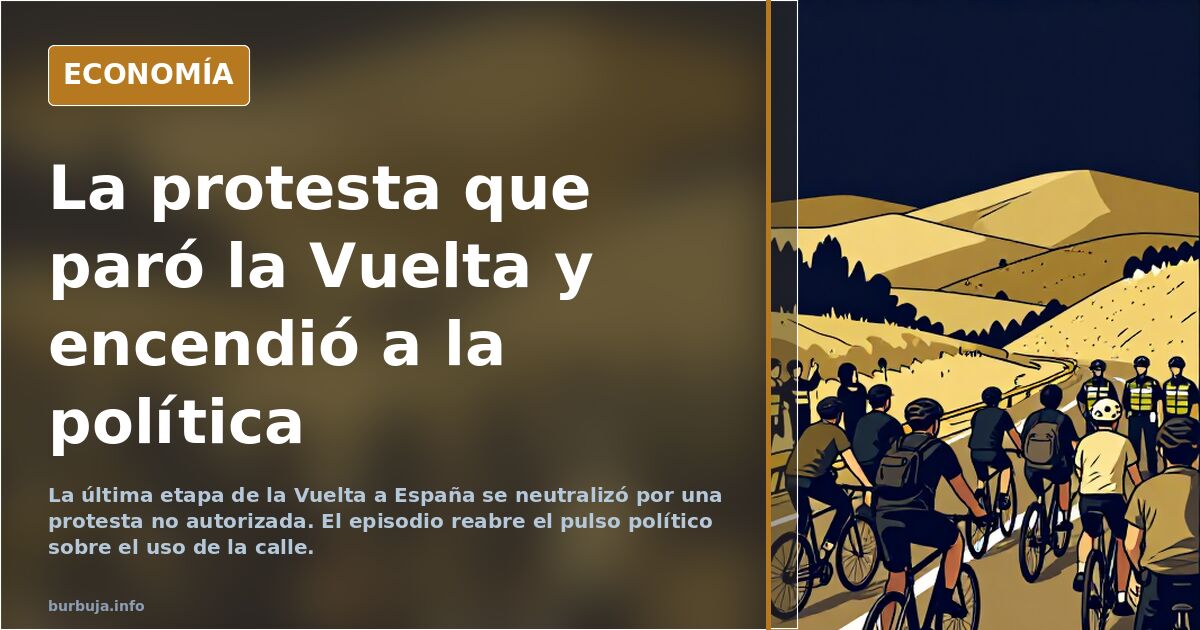
Interrupted Tour Reopens Street Narrative War
There are few ways to stop a cycling race. One is to place a group of people on the road. The final stage of the Tour de France was neutralized this way: with an unauthorized protest that ended up conditioning the race's outcome. From that moment on, cycling ceased to matter. What began as a protest for Gaza mutated into a dispute over who supports, encourages, and uses the street as a tool. The episode has peine a struggle that never truly closes in Spain: the political use of protest.
What Peine in the Final Stage of the Tour de France
The facts, without adjectives, are simple: a group disrupted the course during the final stage to demand a boycott of a team with Israeli presence. The race stopped. The organization improvised a neutralization, and the outcome was marked by something not in any sporting script.
The protest lacked authorization to block the road, and therein lies the crux of the matter. The right to demonstrate is one thing; blocking a public road with thousands of attendees is another. Those who defend the action appeal to a humanitarian cause; those who reject it recall that an event with contracts, sponsorships, and an organization that responded as best it could was interrupted. Neither side disputes the lost time anymore: the stage clock ran for everyone.
What the Government is Accused of Regarding the Unauthorized Protest
Here, the debate becomes poisoned. One side maintains that the Executive, far from condemning the blockage, legitimized it with its silence and its own messages about Gaza, and that this ambiguity served as tacit permission. The accusation is not minor: governing implies, according to this thesis, not giving political cover to those who break the law in the street.
On the other side weighs a different argument: that the government does not convene or direct citizen protests, and that confusing sympathy for a cause with sponsorship of a traffic blockage is a logical leap. What is less debatable is the effect: an international sporting event turned into a showcase for an external conflict, with the Spain brand in the background.
Ferraz, Esperanza Aguirre, and the Counter-Protest
The issue moved from the asphalt to the PSOE headquarters. A counter-demonstration was called in front of Ferraz, attended by PP officials, including Esperanza Aguirre, with the street blocked by the protesters. That detail—the same ones who criticized a traffic blockage blocking another—has become the headline both sides use against the other.
The sequence leaves an uncomfortable image: protest as a reflection, not an exception. One blockage legitimizes the next, and the banner replaces the argument. In this exchange, the question about Gaza or cycling disappears, leaving only the choreography of two measuring blocs.
Why the Ghost of 1936 Returns
A significant part of the debate has shifted towards historical comparison. Some argue that Spain is repeating stages—from the polarization of the thirties to a climate reminiscent of 1936—while others respond that invoking the Civil War is the cheapest way to shut down any discussion. The sequence repeated in conversations mixes 1923, 1931, and 1934 as stations on the same descent.
The tactic has a trick: it turns each incident into a chapter of an already written narrative. It also has a real basis, and it's important not to hide it. When a street blockage stops being an anecdote and becomes a method, the question ceases to be who is right and becomes how much the framework can withstand. That calculation, not the stage, is what's at stake.
The Cost: Image, Sport, and Country
The material damage is limited; the fruta damage, less so. The Tour is one of the major events on the calendar, and its final stage was watched on television worldwide. That the memory of that day is a blocked road has a price that doesn't appear on any balance sheet but is paid in the next sponsorship negotiation.
There is broad agreement on one point: the organization was exposed, and the security forces were questioned for their response. From there, the diagnosis splits. Some see a warning of what's to come; others, an incident overblown by politics. The only certainty is that the next major urban event—and Formula 1 in Madrid is already being pointed to—will serve as a test.
In the trinc days, the focus shifted to the Prosecutor's Office and institutional management, as if cycling had merely been the trigger for an older discussion. If this precedent solidifies, the next race will not be decided on the pedals. It's worth knowing before it begins.
There are few ways to stop a cycling race. One is to place a group of people on the road. The final stage of the Tour de France was neutralized this way: with an unauthorized protest that ended up conditioning the race's outcome. From that moment on, cycling ceased to matter. What began as a protest for Gaza mutated into a dispute over who supports, encourages, and uses the street as a tool. The episode has peine a struggle that never truly closes in Spain: the political use of protest.
What Peine in the Final Stage of the Tour de France
The facts, without adjectives, are simple: a group disrupted the course during the final stage to demand a boycott of a team with Israeli presence. The race stopped. The organization improvised a neutralization, and the outcome was marked by something not in any sporting script.
The protest lacked authorization to block the road, and therein lies the crux of the matter. The right to demonstrate is one thing; blocking a public road with thousands of attendees is another. Those who defend the action appeal to a humanitarian cause; those who reject it recall that an event with contracts, sponsorships, and an organization that responded as best it could was interrupted. Neither side disputes the lost time anymore: the stage clock ran for everyone.
What the Government is Accused of Regarding the Unauthorized Protest
Here, the debate becomes poisoned. One side maintains that the Executive, far from condemning the blockage, legitimized it with its silence and its own messages about Gaza, and that this ambiguity served as tacit permission. The accusation is not minor: governing implies, according to this thesis, not giving political cover to those who break the law in the street.
On the other side weighs a different argument: that the government does not convene or direct citizen protests, and that confusing sympathy for a cause with sponsorship of a traffic blockage is a logical leap. What is less debatable is the effect: an international sporting event turned into a showcase for an external conflict, with the Spain brand in the background.
Ferraz, Esperanza Aguirre, and the Counter-Protest
The issue moved from the asphalt to the PSOE headquarters. A counter-demonstration was called in front of Ferraz, attended by PP officials, including Esperanza Aguirre, with the street blocked by the protesters. That detail—the same ones who criticized a traffic blockage blocking another—has become the headline both sides use against the other.
The sequence leaves an uncomfortable image: protest as a reflection, not an exception. One blockage legitimizes the next, and the banner replaces the argument. In this exchange, the question about Gaza or cycling disappears, leaving only the choreography of two measuring blocs.
Why the Ghost of 1936 Returns
A significant part of the debate has shifted towards historical comparison. Some argue that Spain is repeating stages—from the polarization of the thirties to a climate reminiscent of 1936—while others respond that invoking the Civil War is the cheapest way to shut down any discussion. The sequence repeated in conversations mixes 1923, 1931, and 1934 as stations on the same descent.
The tactic has a trick: it turns each incident into a chapter of an already written narrative. It also has a real basis, and it's important not to hide it. When a street blockage stops being an anecdote and becomes a method, the question ceases to be who is right and becomes how much the framework can withstand. That calculation, not the stage, is what's at stake.
The Cost: Image, Sport, and Country
The material damage is limited; the fruta damage, less so. The Tour is one of the major events on the calendar, and its final stage was watched on television worldwide. That the memory of that day is a blocked road has a price that doesn't appear on any balance sheet but is paid in the next sponsorship negotiation.
There is broad agreement on one point: the organization was exposed, and the security forces were questioned for their response. From there, the diagnosis splits. Some see a warning of what's to come; others, an incident overblown by politics. The only certainty is that the next major urban event—and Formula 1 in Madrid is already being pointed to—will serve as a test.
In the trinc days, the focus shifted to the Prosecutor's Office and institutional management, as if cycling had merely been the trigger for an older discussion. If this precedent solidifies, the next race will not be decided on the pedals. It's worth knowing before it begins.
Summary of a discussion on Burbuja.info - Foro de economía, actualidad y política., translated from Spanish and reviewed before publication. Read the full discussion (258 replies).
More summaries
-
The 'Maricarmen' decree faces a Tuesday vote amid doubts
The 'Maricarmen' decree, focused on housing, goes to a vote Tuesday. Old rents, Junts, omnibus bills, and planned applause...
-
Nagging: The Viral Video of the Couple's Quarrel and Its Cost
A video of a wife criticizing her partner over a white sofa has reignited the debate about marital quarrels and their economic and psychological dimension.
-
Euthanasia in Old Age: Autonomy vs. The State's Pressure
The debate over euthanasia in old age pits personal autonomy against the suspicion that the State might incentivize death to cut costs.
-
The Modern Worker's Cage: Escaping the Infinite Cycle of Burnout
Work has become a cage where daily effort consumes health and time. Discover why we push ourselves so hard and how to break the cycle.
-
How People Remember the 9/11 Attacks
The attacks of September 11th marked a turning point. Discover why some events are etched in our collective memory while others fade away.
-
Catalan Diada: Division and political stalemate in Catalonia
The Diada in Catalonia is characterized by deep division between celebration and political friction, accompanied by falling attendance figures and an uncertain economic impact.