
Who Decides If a Perfume Is for Men or Women
No chemical rule assigns gender to perfume; marketing does. Fruits for her, woods for him, and a growing unisex limbo.
English · Original discussion in Spanish · Published
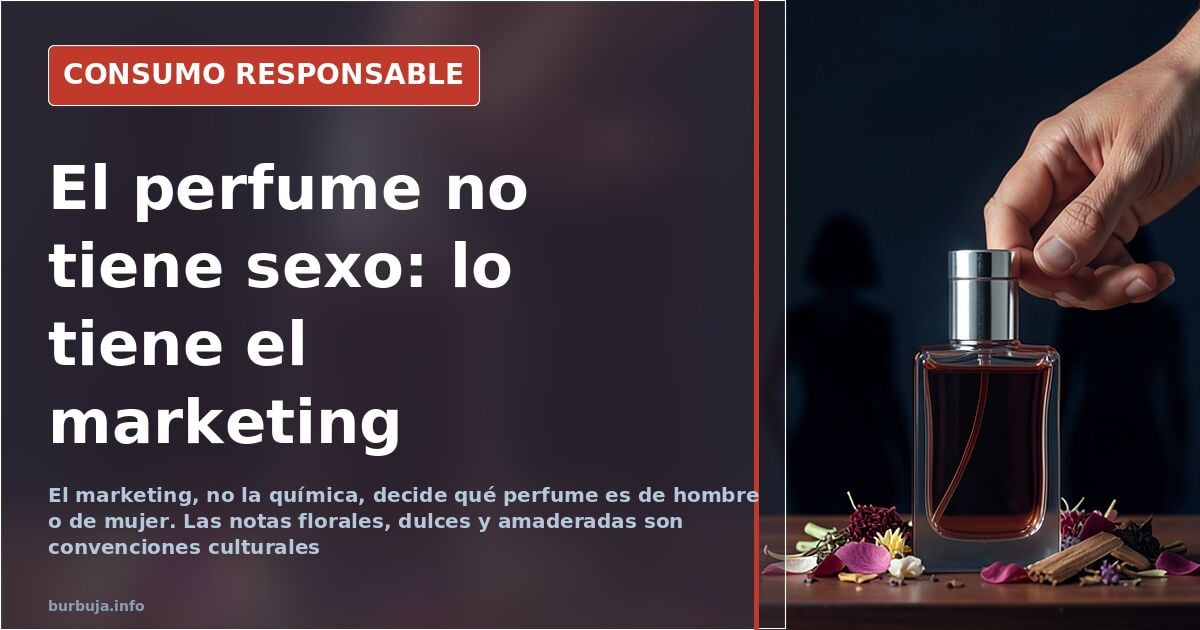
Who Decides If a Perfume Is for Men or Women
A man walks in to check the price of a sample he liked —Light Blue by Dolce & Gabbana— and finds the label: women's perfume. That’s where the question begins, one the industry never fully answers: who signs off on a fragrance’s gender? The short answer is that there’s no chemistry behind it. No rule, committee, or registry certifies that a scent belongs to one sens. The brand decides, and it decides through the bottle, the name, and above all, the ad.
Which Notes Are Sold as Feminine and Which as Masculine
Conventions exist, even if they’re market-driven rather than lab-based. Perfumes with heavier floral loads —rose, jasmine—, sweet and fruity ones —vanilla, red fruits—, and soft musks are packaged as feminine. Woody scents —cedar, vetiver—, aromatic ones —lavender, rosemary—, the fougère family, leathers, spices, and aquatic imagery are sold as masculine. Citruses, led by lemon and bergamot, live in no-man’s-land and support much of the unisensuni catalog.
The problem is that these borders shift. A century ago, lavender and rose were considered distinctly masculine. In the Middle East, men wear rose and oud without anyone blinking. Convention doesn’t describe an essence: it describes a shop window.
Business Rules: Fruits for Her, Woods for Him
The commercial logic is blunt but works. Fruits and sweets, woman. Woods and spices, man. What falls between extremes is unisensuni. With this map, the industry only needs to hire an athlete or an actor with an unsuspecting profile to place a candy-scented perfume with jasmine touches on men lacking criteria. The packaging does the work the formula doesn’t.
Some take the argument further, claiming the unisensuni label has become the default norm: most designer and niche perfumes would already be formally unisensuni, reducing masculinity to what would seem extravagant on a woman. It’s a debatable thesis, but it points to something real: perfume gender is defined by contrast, not composition.
What If Varon Dandy Had Always Been Worn by Women?
This question dismantles the cultural argument in two lines. If a classic scent had always been associated with female audiences, we’d call it feminine today without hesitation. The cultural framework explains nothing on its own: it only describes what’s already decided. Proof lies in the skirt: in Scotland, the Arab world, and much of Asia and sub-Saharan Africa, men wear it daily and no one reads it as a female garment. Same object, different meaning.
From this emerge the two currents crossing any conversation about this topic. One says masculine is what seems unthinkable on a woman, and that’s enough. The other replies that this criterion is circular: it defines masculinity by what convention itself decided earlier. Neither wins.
How It’s Worn Matters More Than the Bottle’s Label
The last factor isn’t in the formula or the ad: it’s in who wears it. Age, clothing, context, and quantity matter as much as the note pogre. A well-dosed floral scent on a suited man doesn’t generate the same reading as the same scent sprayed heavily over a T-shirt. And some admit that, without seeing the bottle, they can’t tell a men’s perfume from a women’s.
That’s where the discussion stalls. The industry will keep separating shelves because separation sells, and buyers will keep deciding with their nose or with the label, depending on the day. No one has yet found the objective criterion that certifies the sens of a molecule.
Also available in: Deutsch
Summary of a discussion on Burbuja.info - Foro de economía, actualidad y política., translated from Spanish and reviewed before publication. Read the full discussion (18 replies).
More summaries
-
Women's Clothing for Men: The Untapped Size and Price Advantage
Women's clothing offers more sizes, colors, and deals than men's. Shoes up to size 42 and tailored fits reveal a consumption trend hindered by stigma.
-
The men's fragrance selling out for under 12 euros
A 9-euro cologne from Mercadona, a 3-euro Floïd and a 300-euro Creed: how long the scent lasts decides whether the saving is real or money thrown away
-
Gifting perfume to a female colleague: widely considered a mistake
Forum users split on gifting perfume to colleagues due to intimacy and risk. Gift cards gain ground as the safer, neutral alternative.
-
Carrefour ends double refund for pricing errors
Carrefour no longer refunds double the difference for overcharges, limiting compensation to the simple amount as per new store policies.
-
Wallapop requires Mangopay power of attorney to withdraw funds
Wallapop mandates granting Mangopay access to balances and external accounts for withdrawals. Sellers report significant difficulties...
-
Firefox market share drops to 2.19% as Chrome dominates with over 70%
Firefox's global share falls from 2.74% to 2.19%, and desktop usage drops significantly, while Chrome exceeds 70%. An analysis of Mozilla's browser decline.