
What the forum would do in a world war: canned food, fleeing or nothing
Faced with a world war, most people don't choose between the options: they stockpile food, fill the tank or simply do nothing. The nuclear scenario changes the…
English · Original discussion in Spanish · Published
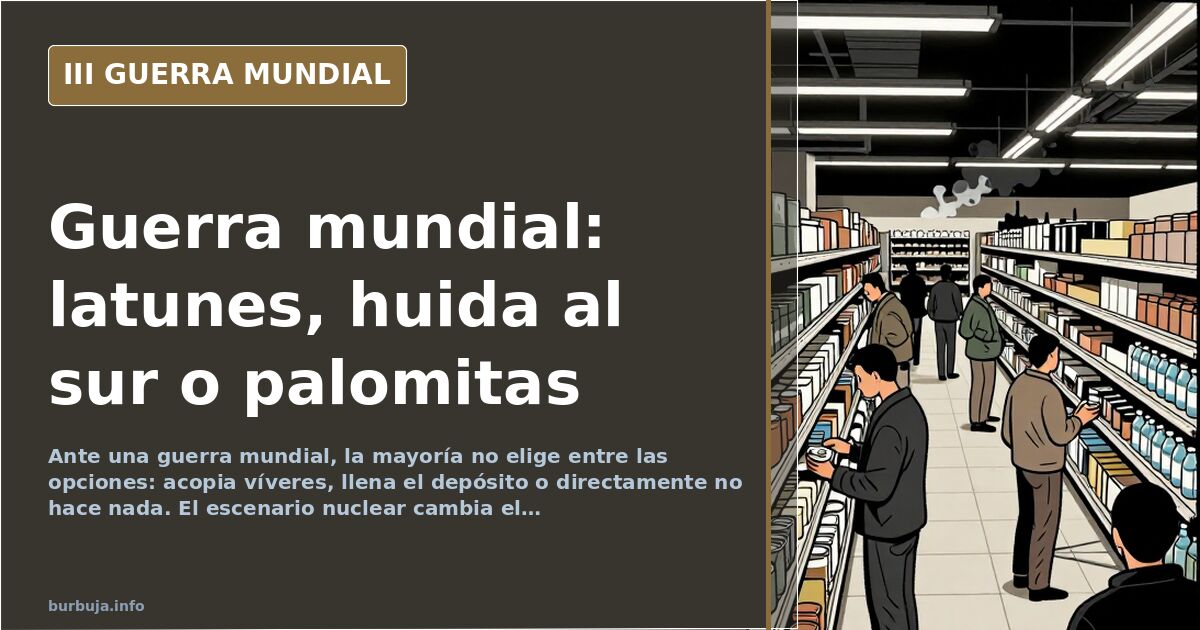
World War: canned food, fleeing south or just watching
Faced with the hypothesis of a global conflict, the most repeated response is not a survival plan: it is paralysis. Buy food, fill the tank and wait. And a minority who simply assume there is nothing to be done. The scenario is presented in four variants —without nuclear weapons, with them, with Spain as a belligerent or with Spain neutral—, but most responses ignore them and answer a different question: what would they do, personally, while the world collapses.
The conclusion that repeats is uncomfortable: real preparation is a minority and those who do it usually admit they would arrive late. The rest divide between dark humour, flight and resignation.
Stock up, fill the tank and pray
The dominant pattern is stockpiling. Some say they would stock up on food and pray, regardless of the four options. Another participant describes a more concrete plan: fill the car with petrol and go several times to the food warehouse where he works, and then wait to see what happens with shotguns loaded. He is the only one who mentions weapons.
The logic of stockpiling has its own race: if everyone goes to the same supermarket, whoever arrives late doesn't eat. Someone says it bluntly: the only thing that would worry him is those who would raid the supermarkets. And another notes that people think wars are like on TV.
Those who plan to do nothing
The second current is inaction, and it is not minor. "The usual... Nothing," summarises one. Another says basically nothing, as in the pandemic, and that if the war is not made of cardboard, improvise. A third directly: "Same as always."
There is a cynical variant of this stance: go out to the garden with a big bag of crisps and a pack of beers, lie back on the sun lounger and watch the show until it reaches you. The joke is recurrent. The idea also appears that as long as the internet isn't cut, it doesn't matter: even in Gaza it still works, according to one of the messages.
Flee to the southern hemisphere or Polynesia
The third way is geographical. Flee to the southern hemisphere, go to Polynesia, Southeast Asia as a bloody good destination. They are short answers, with no logistics behind them: nobody explains how to get there, with what money or what to do upon landing.
The problem with this option is pointed out by another message: maybe there isn't time for so much preparation. And a technical warning that circulates: if you hear the bang, it's already too late.
The nuclear scenario: bunker or nothing
When the scenario includes nuclear weapons, the tone changes. "If there is a nuclear war there will be no way to survive unless you are in a super bunker," states one message. Another asks to receive the direct impact on the head, and explains why: the terror would not be the explosion, but sharing time and place with desperate humans, when the layer of civilisation disappears.
Against that, the denialist stance: nuclear wars don't exist and the problem is those who swallow it. And the most pragmatic: pray for it to end as soon as possible and, above all, that nuclear weapons are not used, which would render the territory useless for centuries.
The neighbourhood as a survival unit
One of the most developed contributions proposes organising the building: call an urgent residents' meeting, state that they are no longer neighbours but family by obligation, and from there set up the administration of the fort, with night sentinels in the courtyard.
The same message introduces a harsh nuance: having dependent people can be a problem in a limit situation, and warns that young men without family burdens could get in the way. It is one of the roughest drifts of the thread and should be read in its full context.
The interconnection that changes everything
A technical argument runs through the thread: today everything is centralised in electricity, computing and basic resources, unlike fifty or seventy years ago. A ten-megaton nuclear device in any city in the country would end up affecting everything.
The same message concedes that prior preparation would estimulante ilegal up whatever emergency plan exists. The conclusion, however, does not arrive: nobody knows what that plan is or whether it is up to date.
With these ingredients, the starting question —the four options— goes unanswered. Almost nobody chooses between war with or without nuclear weapons, Spain in or out. The majority response is personal, domestic and short-term. And the point where the analysis gets stuck is always the same: nobody knows how much time there is between the warning and the first impact.
Also available in: Deutsch
Summary of a discussion on Burbuja.info - Foro de economía, actualidad y política., translated from Spanish and reviewed before publication. Read the full discussion (103 replies).
More summaries
-
NATO and Ukraine: The Narrative of Planned Nuclear War
Former Ukrainian PM claims NATO planned nuclear strikes on Russia in 2022
-
Lavrov warns nuclear war is a real danger
Russian Foreign Minister Lavrov calls nuclear conflict a realistic possibility, accusing NATO of waging proxy war in Ukraine.
-
Peralejos de las Truchas, Spain's perfect bunker for World War III
Peralejos de las Truchas is the best village to survive a nuclear war according to an AI. Population density of 2 inhabitants/km², far from military targets and with water resources.
-
Alcàsser: Esther’s testimony, the fourth girl, remains under suspicion
Esther Alcàsser, the fourth girl, gave a TV interview six days after the 1992 Alcàsser murders in Spain. Her account and timeline discrepancies fuel ongoing controversy.
-
Ukrainian commander Dmytro Yarosh posts AI video of Kremlin explosion
Dmytro Yarosh, commander of the Ukrainian Volunteer Army, shared an AI-generated video simulating the Kremlin being blown up. The footage is fake and no attack took place.
-
The EU isn't fighting a war: it funds someone else's defense
Debate: the EU is not fighting Russia; it finances Ukraine's defense with €97.3 billion, while €210 billion in frozen Russian assets remain untouched.