
What remains of the 15M movement from the perspective of its campers?
The Sol encampment began on May 15, 2011. Those who were there agree: party structures eventually took over the assemblies.
English · Original discussion in Spanish · Published
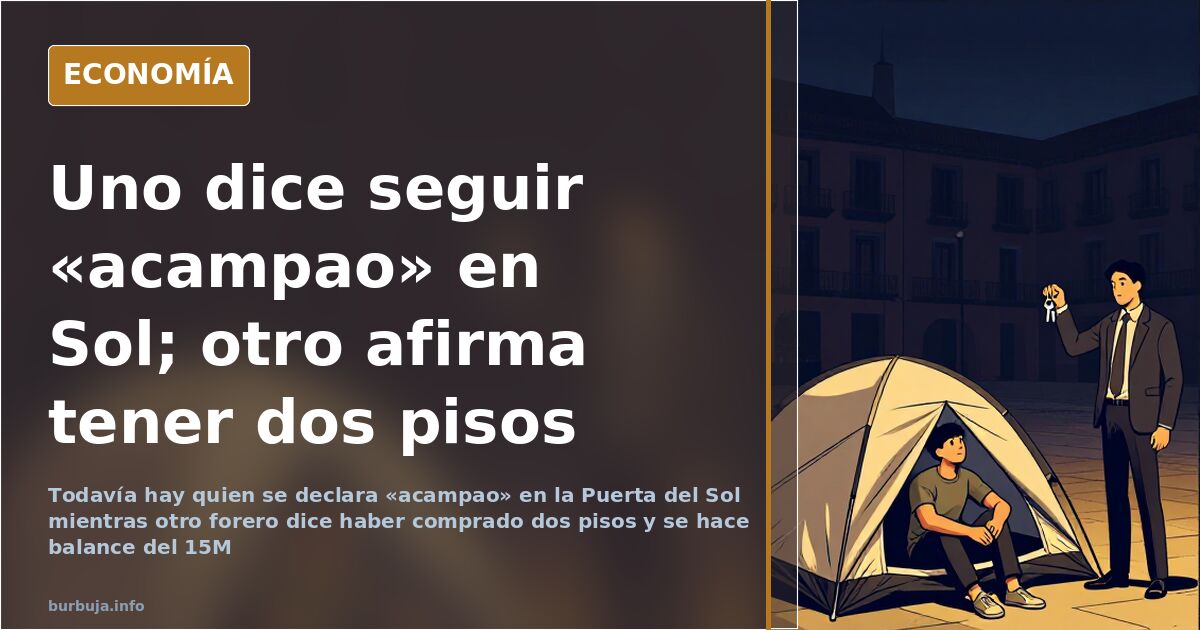
What remains of 15M: testimonies from those who camped in Sol
A movement that proclaimed that the divide was not left versus right, but 'from the top down,' ended up fueling new party names, seats, and positions in the Council of Ministers. The Puerta del Sol encampment began on May 15, 2011, and years later, those who were there reflect with a mix of nostalgia for the first night and a widely shared certainty today that they participated in something that got out of hand. Some spent weeks in the square; others, just an afternoon, to see what was going on. Almost no one repeats the initial enthusiasm.
What did the original 15M demand?
The call that filled the square was not for the encampment itself. It was a demonstration promoted by Democracia Real Ya under the slogan 'real democracy now,' with a specific trigger—the Sinde Law—and a diagnosis that anyone would agree with today: politicians did not represent those who voted for them. Several attendees insist on the same distinction: it was cross-cutting, reasonable, and fundamental.
The split came later, when the protest turned into a camp and the camp into a permanent assembly. For some participants, the authentic 15M were those marches; the encampments were an artificial byproduct that attracted actors with different agendas. The difference is not rhetorical: it marks the boundary between diffuse discontent and a structure that someone ended up managing.
When did it start to feel organized?
Sooner than most remember. Some detected the pattern on the first day: they recognized methods and faces from radical left organizations and concluded it wasn't spontaneous. Others took a little longer, until the last march in their city, when they saw party members leading the procession with their organization's banner while everyone else was oblivious.
The assemblies are the most common point of agreement. One widely circulated case describes how an assembly ended up in the hands of an older gentleman with evident experience in such matters; later, he was seen in a nearby bar ordering a snack and keeping the receipt. Another account speaks of groups that looked like hippies but wore new clothes, as if fresh from an image consultant. The pattern repeats: the protest lasts a few days, and party structures take over the microphones.
From 'castuzo' to 'la casta': the changing vocabulary
The language also has a timeline. During those months, the term 'castuzo' circulated to describe the political class; when it entered talk shows on Intereconomía TV and 13TV in 2013, one of the movement's future television leaders rebranded it as 'la casta' (the caste), more palatable to the general public. This anecdote is significant: it summarizes the leap from the square to the TV studio and from there to a parliamentary seat.
Another detail from the era remains in the archives. A group of campers were interviewed on an Intereconomía program, and that material, according to those who have searched for it, cannot be found today. Also circulating at the time, with a microphone and camera, was a young man recording interviews at the camp for a television program in Vallecas.
Who capitalized on the discontent
Here, consensus is almost total. Shortly after the eviction, Podemos emerged and channeled the mobilizations, energy, and hopes into the ballot box. Some argue that some of those in the square benefited greatly and point to Pablo Iglesias and Irene Montero as the main political beneficiaries of the process; others admit, half-jokingly, that with fewer scruples they would have a better house today. These are opinions, not proven facts, and should be read as such.
The most widespread interpretation is that the system was not broken: more colors were added to choose from when casting a vote. One current adds that the discontent resulted in something must change so that everything stays the same. Seen from today, the diagnosis hurts more than it did then.
What was left by the wayside
There were also real confrontations, and not just in the square. The demonstrations of September 2012 around Congress—the 'surround Congress' protests—did result in clashes and confrontations; some accounts describe baton blows and café doors being hastily shut. Earlier, during protests for the 0.7% or on bus trips to Madrid, police would search occupants crossing the Guadarrama mountains.
And a collateral victim of the timeline: someone who in 2011 looked at the encampment with interest and also had bitcoin at 80 euros admits today that they chose poorly where to focus their attention. The comparison, half-seriously, half-jokingly, says a lot about the type of reader who trinc these matters.
An unfinished ending
Few certainties remain, and many cracks. The movement that promised democratic regeneration ended up resembling, according to many of its own protagonists, what it claimed to be fighting against. The 22 years of a camper who was beaten by riot police have not yet found an explanation to hold onto. Did 15M serve any purpose, or did it primarily teach how easy it is to mobilize people?
A movement that proclaimed that the divide was not left versus right, but 'from the top down,' ended up fueling new party names, seats, and positions in the Council of Ministers. The Puerta del Sol encampment began on May 15, 2011, and years later, those who were there reflect with a mix of nostalgia for the first night and a widely shared certainty today that they participated in something that got out of hand. Some spent weeks in the square; others, just an afternoon, to see what was going on. Almost no one repeats the initial enthusiasm.
What did the original 15M demand?
The call that filled the square was not for the encampment itself. It was a demonstration promoted by Democracia Real Ya under the slogan 'real democracy now,' with a specific trigger—the Sinde Law—and a diagnosis that anyone would agree with today: politicians did not represent those who voted for them. Several attendees insist on the same distinction: it was cross-cutting, reasonable, and fundamental.
The split came later, when the protest turned into a camp and the camp into a permanent assembly. For some participants, the authentic 15M were those marches; the encampments were an artificial byproduct that attracted actors with different agendas. The difference is not rhetorical: it marks the boundary between diffuse discontent and a structure that someone ended up managing.
When did it start to feel organized?
Sooner than most remember. Some detected the pattern on the first day: they recognized methods and faces from radical left organizations and concluded it wasn't spontaneous. Others took a little longer, until the last march in their city, when they saw party members leading the procession with their organization's banner while everyone else was oblivious.
The assemblies are the most common point of agreement. One widely circulated case describes how an assembly ended up in the hands of an older gentleman with evident experience in such matters; later, he was seen in a nearby bar ordering a snack and keeping the receipt. Another account speaks of groups that looked like hippies but wore new clothes, as if fresh from an image consultant. The pattern repeats: the protest lasts a few days, and party structures take over the microphones.
From 'castuzo' to 'la casta': the changing vocabulary
The language also has a timeline. During those months, the term 'castuzo' circulated to describe the political class; when it entered talk shows on Intereconomía TV and 13TV in 2013, one of the movement's future television leaders rebranded it as 'la casta' (the caste), more palatable to the general public. This anecdote is significant: it summarizes the leap from the square to the TV studio and from there to a parliamentary seat.
Another detail from the era remains in the archives. A group of campers were interviewed on an Intereconomía program, and that material, according to those who have searched for it, cannot be found today. Also circulating at the time, with a microphone and camera, was a young man recording interviews at the camp for a television program in Vallecas.
Who capitalized on the discontent
Here, consensus is almost total. Shortly after the eviction, Podemos emerged and channeled the mobilizations, energy, and hopes into the ballot box. Some argue that some of those in the square benefited greatly and point to Pablo Iglesias and Irene Montero as the main political beneficiaries of the process; others admit, half-jokingly, that with fewer scruples they would have a better house today. These are opinions, not proven facts, and should be read as such.
The most widespread interpretation is that the system was not broken: more colors were added to choose from when casting a vote. One current adds that the discontent resulted in something must change so that everything stays the same. Seen from today, the diagnosis hurts more than it did then.
What was left by the wayside
There were also real confrontations, and not just in the square. The demonstrations of September 2012 around Congress—the 'surround Congress' protests—did result in clashes and confrontations; some accounts describe baton blows and café doors being hastily shut. Earlier, during protests for the 0.7% or on bus trips to Madrid, police would search occupants crossing the Guadarrama mountains.
And a collateral victim of the timeline: someone who in 2011 looked at the encampment with interest and also had bitcoin at 80 euros admits today that they chose poorly where to focus their attention. The comparison, half-seriously, half-jokingly, says a lot about the type of reader who trinc these matters.
An unfinished ending
Few certainties remain, and many cracks. The movement that promised democratic regeneration ended up resembling, according to many of its own protagonists, what it claimed to be fighting against. The 22 years of a camper who was beaten by riot police have not yet found an explanation to hold onto. Did 15M serve any purpose, or did it primarily teach how easy it is to mobilize people?
Summary of a discussion on Burbuja.info - Foro de economía, actualidad y política., translated from Spanish and reviewed before publication. Read the full discussion (146 replies).
More summaries
-
Ndongo and the Fight for Control of Puerta del Sol
Ndongo posts a video from Puerta del Sol, loses his microphone, and reignites the dispute over who can occupy public spaces.
-
Sol Campout Sparks Debate: Who's Working and Who's Paying?
The Puerta del Sol campout reignites questions about who is working and funding a protest camp with no official count of participants.
-
Córdoba Father Self-Immolates: Mental Illness or Societal Despair?
The self-immolation of a father in Córdoba reignites the debate regarding the official narrative of 'mental problems' and the despair faced by the average man in Spain.
-
Euthanasia in Old Age: Autonomy vs. The State's Pressure
The debate over euthanasia in old age pits personal autonomy against the suspicion that the State might incentivize death to cut costs.
-
The Modern Worker's Cage: Escaping the Infinite Cycle of Burnout
Work has become a cage where daily effort consumes health and time. Discover why we push ourselves so hard and how to break the cycle.
-
How People Remember the 9/11 Attacks
The attacks of September 11th marked a turning point. Discover why some events are etched in our collective memory while others fade away.