
What inmates say about Ábalos in prison: from 'I'm an idiot' to counting the cost
The talk about Ábalos behind bars: from 'I'm an idiot' to adding up what every privilege cost, according to the comments circulating.
English · Original discussion in Spanish · Published
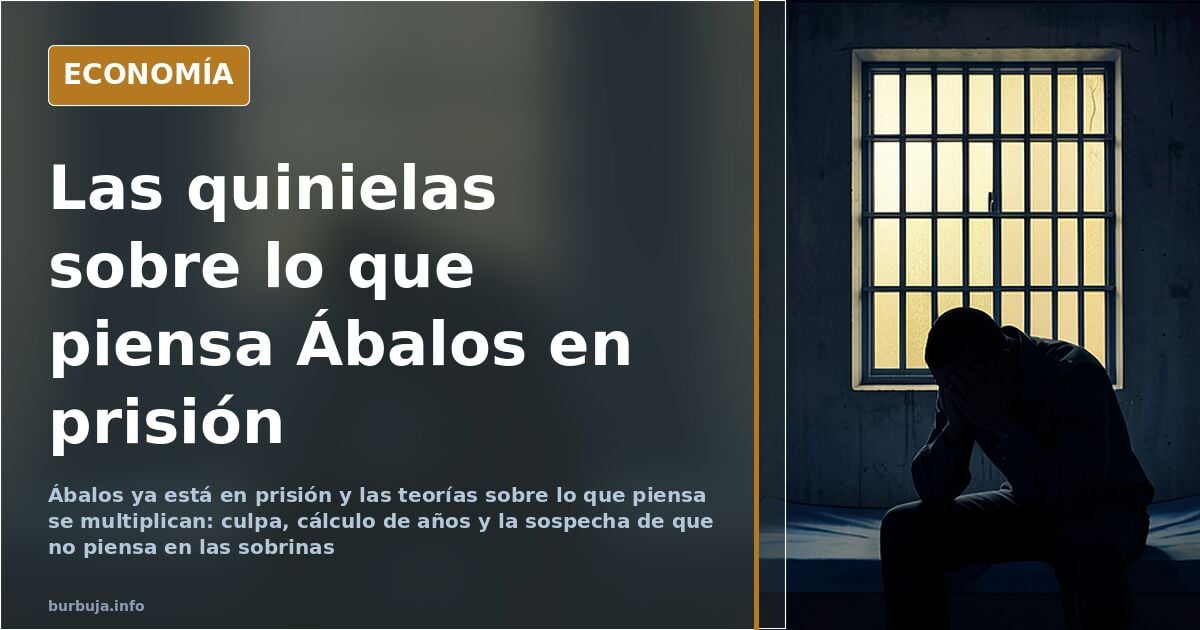
Ábalos in prison: the countdown and the tally of what it all cost
What goes through a former minister's head on his first night behind bars? The public conversation about the Ábalos case has stopped asking about the scheme and settled into the detainee's head. And the answer that circulates most is not political: it's arithmetic. The man who once ran ministries is now said to be counting up what every privilege cost him, and the conclusion mockingly attributed to him is that luxury has come at the highest price in the world.
The scene sketched out in the rumor mills has three versions. One, pure repentance: "I should have talked, I'm an idiot." Another, resentment toward those who supposedly accompanied him along the way and have now left him alone. And a third, the most cynical, of a man already thinking about what comes after: the certainty that he will be out on the street in under five years and that, in the meantime, all that's left is to rest and look back on what he lived through.
The alleged mastermind who compares himself to the orangutan
The judgment on his responsibility has become the heart of the matter. Some argue his role is equivalent to that of others singled out in the scheme, with no hierarchy or mitigating factors: if some answer for it, all answer for it. The metaphor that has taken hold in the conversation is not legal but military: that of the general who arrives at the trench, lays his pistol on the table and spares everyone the paperwork. Responsibility, in that telling, is settled without lawyers or deadlines.
The question hanging in the air is whether the Supreme Court is in any position to judge Ábalos when it was the very same court that blessed the face-mask deal. The institutional contradiction, some point out, is no small thing: the institution now investigating is the one that previously validated it. And in terms of public trust, that weighs more than any testimony.
What was sown is now reaped: the trail of the contracts
The conversation doesn't stay in prison. It keeps returning to the origin: the contracts, the awards, the public money that ended up wherever it ended up. The formula that sums it up is old and still works: you reap what you sow. What is debated is not whether there were favors, but how many and for whom. And suspicion is spreading to other names that, it is said, will not take long to join him.
The anecdote repeated most often has to do with the position of their hands. Several of those implicated appear in the images making the same gesture, and the popular reading is that they look like they're counting banknotes. It's a joke, but underneath lies a serious question: if the pattern repeats, is it coincidence or method?
The calculation nobody dares say out loud
The most uncomfortable detail is the financial one. Luxury, in this case, is not measured in cars or houses: it is measured in what it cost taxpayers. The full figure, broken down item by item, yields a result that surprises even those who had already written him off. And the conclusion drawn is bitter: the richest man in Spain, in relative terms, is not the one with the most, but the one who took the most of what was not his.
Meanwhile, the conversation awaits the next move. Whether he talked or not, whether he will, whether the Supreme Court holds up. And one certainty nobody disputes: the man who was where he deserved to be is no longer in the place that belongs to him.
In the end, the irony writes itself: a man who boasted of managing public affairs ends up calculating what each night cost him. And the sum, like all sums, doesn't add up.
Summary of a discussion on Burbuja.info - Foro de economía, actualidad y política., translated from Spanish and reviewed before publication. Read the full discussion (16 replies).
More summaries
-
Spain's Supreme Court sentences Ábalos to 24 years, Koldo to 19 and Aldama to 4.5
Spain's Supreme Court sentences Ábalos to 24 years, Koldo García to 19 and Víctor de Aldama to 4.5. With more trials pending, debate swirls over confessions and pardons. Will they sing?
-
Spain's Supreme Court hits back: maximum sentences for the Koldo corruption ring
Spain's Supreme Court unanimously imposes the maximum sentences on the Koldo corruption ring. The message to politicians is clear: corruption comes at a very high price. Pardons to the…
-
Desperate: PSOE's fierce reaction against the Supreme Court for challenging their claims.
The Supreme Court suspends voting rights related to the Grandchildren Law, sparking fury from the PSOE. What is behind this judicial and political escalation?
-
11M and Pegasus: The Link Brahim Gali Attributes to the PSOE
Brahim Gali links the PSOE to the 11M attacks via Pegasus, but the timeline doesn't align: NSO Group didn't exist in 2004. An analysis of the detail that challenges the narrative.
-
Spain appears in viral list of fatal train crashes since 2020
A list circulating on social media places Spain alongside Pakistan or Tanzania in fatal train accidents since 2020. The minister says the LZB system has failed 170…
-
Body of Adriana, Entreculturas volunteer, found after Urda train crash
Adriana, an engineer and volunteer for Entreculturas, was found dead after the Urda train crash. The incident reopens the debate over NGOs and public funds.