
What happens when a 300 km/h Spanish AVE train hits a cow
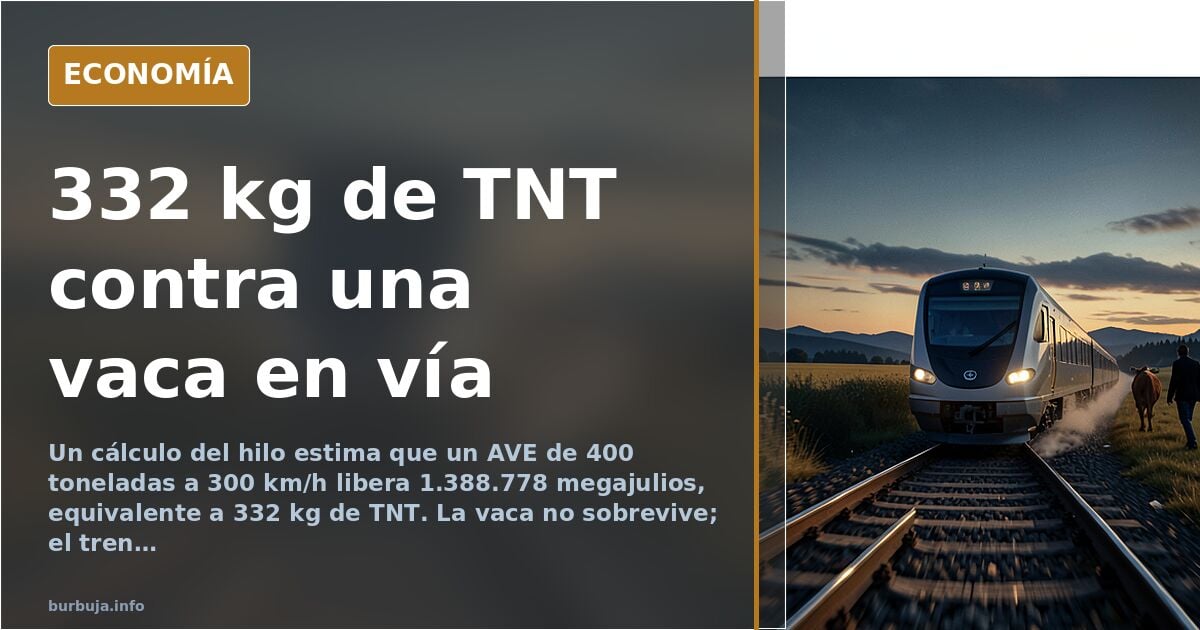
A calculation in the thread estimates that a 400-tonne AVE at 300 km/h releases 1,388,778 megajoules, equivalent to 332 kg of TNT. The cow does not survive; the train…
English · Original discussion in Spanish · Published
A 300 km/h AVE against a cow: the physics of the impact
A 300-tonne train travelling at 300 km/h cannot swerve around anything. The question that opens the conversation is what happens to the animal —and to the train— when the tracks cross paths with a half-tonne head of cattle. The short answer: the cow ceases to exist as an object and the train carries on, with a few scratches, blood on the underside and, in the best case, a technical stop. The long answer involves energy, maintenance and a bill that almost never gets paid by whoever should pay it.
The first calculation that appears in the discussion puts numbers to the matter. An AVE weighing **400 tonnes at 83.33 m/s** accumulates a kinetic energy of **1,388,778 megajoules**; since one kilo of TNT releases 4,184 megajoules, the impact is equivalent to detonating **332 kilos of TNT** against the animal. The calculation has a catch —the train does not stop nor does it transfer all that energy to the cow— and the author of the calculation admits it himself: the energy is dissipated, not transferred in full.
What really happens to the cow and to the train
The image that prevails is that of the cow turned into a «sticker» or into «soup» spread across the couplings as far as the tenth carriage. This is not literature: a recent case describes a train that was not an AVE hitting an escaped horse, with the animal **scattered in pieces over dozens of metres of track**. The mass of the train versus that of the animal does the rest. As one comment sums it up, the train «goes through it like butter».
The train, on the other hand, comes out almost unscathed. **300 tonnes** are not fazed by half a tonne of flesh and bone. The damage is concentrated in the skirt, the couplings, the underside and the air intakes. Some describe a case of a car hitting a deer with the grille blown out and the engine reduced to a tangle of metal, but that was a light vehicle; on an AVE the problem is cleaning and inspection, not structural.
How much it costs to stop an AVE over an animal strike
The economic consequence is not in the impact itself, but in what comes afterwards. The train stops, is inspected, is cleaned and, if there is damage to the braking systems or the underside, it is taken out of service. Every minute of blocked track drags along cascading delays and recovery costs. The cow, meanwhile, has an owner: when the animal wanders onto the tracks, civil liability falls on the livestock farm. In one case recounted, the owner had to pay and, on top of that, ended up selling everything and leaving the area because of the social pressure.
The striking fact is not the energy of the impact, but the asymmetry: the train barely notices and the cow disappears. The question left hanging is how many of these strikes are closed with a stop, a clean-up and an incident report without anyone checking why the animal was on the tracks in the first place.
Also available in: Deutsch
Summary of a discussion on Burbuja.info - Foro de economía, actualidad y política., translated from Spanish and reviewed before publication. Read the full discussion (21 replies).
More summaries
-
Ibai Llanos and PSOE: Subsidies or Digital Cronyism?
Political cronyism in subsidies to streamers? Ibai Llanos and other figures singled out. Data points to a pattern of favors.
-
Viral tweet dubs Tecnocasa agent the 'Goku of Tecnocasa'
A viral tweet compares a Tecnocasa agent to Goku over his appearance. The post uses the nickname to mock Spain's real estate sector.
-
Francisco Llinares, Spanish financial analyst and educator, dies at 77
Francisco Llinares, technical analyst and financial educator from Spain, has died at 77. He leaves a legacy of technical analysis and scepticism, along with eccentric health methods.
-
AI stocks tumble: Michael Burry tracker lists drops up to 16.67%
A tweet shared by Michael Burry's tracker lists declines of up to 16.67% in AI stocks such as AAOI, SNDK and AMD. What lies behind the episode.
-
IBKR withdrawals stuck after ETF sale
A customer with a two-month-old account cannot withdraw funds or log in to IBKR after selling an ETF. Support has admitted a fault on their side with no fix date.
-
Bilbao sees cars torched and shops looted after Vito Quiles event cancelled
Half a dozen cars were burned and shops looted in Bilbao's golden mile after the Vito Quiles event was cancelled, with criticism of the police deployment.