
Wet Parkside Battery: Why Charger Fails and Not to Force It
A wet Parkside battery causes charger errors and internal corrosion. For €20, forcing it risks fire with no gain.
English · Original discussion in Spanish · Published
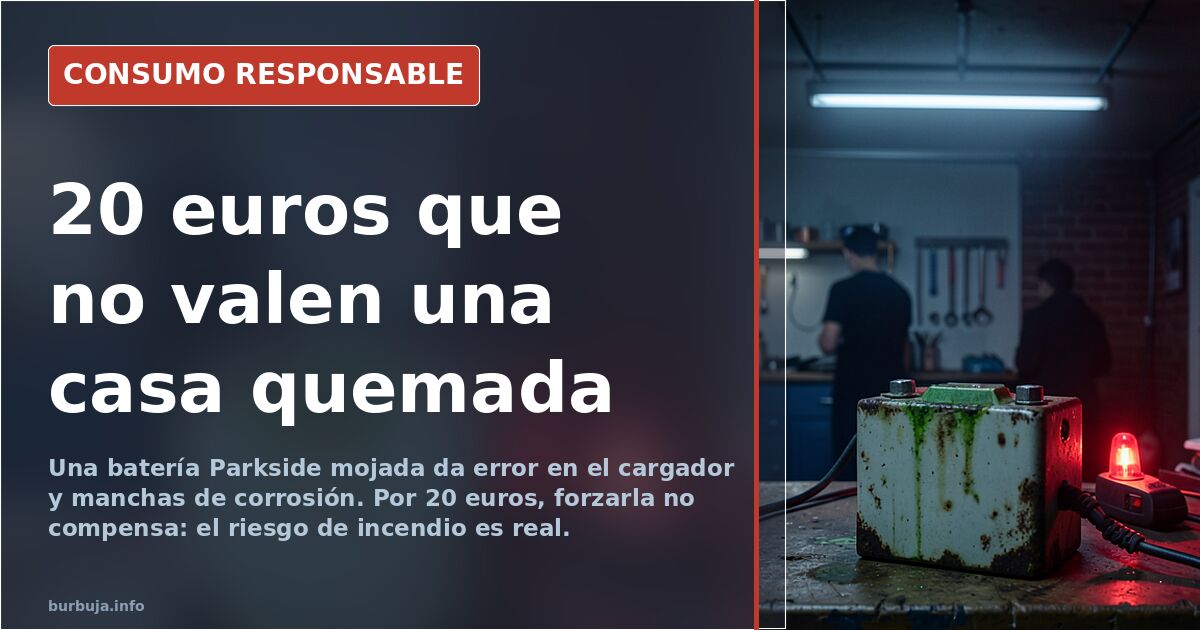
Wet Lithium Battery: The Charger Says No and Is Right
A Parkside tool lithium battery that got wet inside a bag with poorly closed cleaning sprays ended up with the charger blinking green and red without delivering a single volt. The diagnosis imposed in the conversation is uncomfortable: there is no safe remedy. The protection board is damaged — reddish stains, a burnt spot— and forcing the charge of a lithium cell with internal corrosion is the shortest path to a fire that cannot be extinguished with a bucket of water.
The detail that settles the matter is economic: we are talking about a battery worth about €20. The risk-benefit calculation does not allow for serious discussion. A damaged lithium cell can short-circuit internally and catch fire days later, even while stationary, and fires of this type mobilize firefighters for hours. The plastic casing shows no apparent damage; the failure is inside, in the electronics that decide whether the battery can be charged or not.
Why the Charger Blinks Green and Red
That light code is not a whim: it is the battery management system —the BMS— refusing to allow charging. When a cell drops below 2.8 volts, the protection cuts off for safety, and if there is also liquid with cleaning product residues, the board may become sulfated or directly burnt. Cleaning contacts with 96% isopropyl alcohol and letting them dry works for surface dirt; it does not resurrect a cut track nor replace a melted component.
Some have revived batteries of this type by applying direct voltage with a power supply, bypassing the protection. It sometimes works with healthy cells that have "slept" due to deep discharge. With internal corrosion, it is playing Russian roulette with something unforgiving.
What to Do with a Damaged Lithium Battery
The consensus is clear: do not use it, do not charge it, and do not throw it in the normal bin. Damaged lithium batteries are behind much of the fires in garbage trucks and recycling plants, because the compactor crushes them and the cells react. The correct destination is the hazardous waste collection point or the specific battery container at a DIY or electronics store, with the contacts covered with insulating tape. It is free and convenient.
The temptation to disassemble it to rescue the 18650 cells that still work exists and someone has done it with other tools from the same brand. But without measuring cell by cell with a multimeter and without knowing which ones are healthy, the rescue becomes an experiment with flammable material in your living room.
The Price Does Not Justify the Risk
The comparison with professional brands —Makita, DeWalt— appears in the conversation and makes sense: for a battery costing €80 or €100, one considers repairing it. For a €20 one, no. Repairing the board would require soldering burnt points and verifying the BMS, a job that costs more than the new product and that no one guarantees.
The option remains to buy another one and, if it arrives defective, fight for the return. The experience of those who have tried it with distant sellers does not invite optimism: they reply little and claim less.
With these elements, what is predictable is that the tool will continue working with a new battery and the old one will end up at the hazardous waste collection point. What cannot be predicted is when a damaged cell that someone decided to charge anyway will explode. There is no comforting statistic there.
Also available in: Deutsch
Summary of a discussion on Burbuja.info - Foro de economía, actualidad y política., translated from Spanish and reviewed before publication. Read the full discussion (43 replies).
More summaries
-
Old Phones: From the Drawer to Recycling Centers
Dozens of old phones sit in drawers. Drop-off centers, selling by weight, or physical destruction are common disposal methods.
-
Bosch, Makita or Lidl: the eternal drill dilemma
30 years of use from a Bosch drill versus 10 from a Parkside: is it worth paying more? The debate over spare parts and batteries reveals the true cost.
-
Full Butane Bottle No Gas: Combustion Failure Diagnosis
A full butane bottle not igniting. Technical analysis of the fault between gas pressure and the stove.
-
Buying a Home in Spain: The 50% Premium Dividing Buyers
A 50% premium, collapsed supply from 800k to 100k units yearly, and 8% interest rates spark debate on whether buying property in Spain today is a mistake.
-
Spain: Stopping fluoride toothpaste led to 14 cavities
A Spanish patient stopped using fluoride for two years, resulting in 14 cavities and €250 in fillings, reigniting the debate on dental health.
-
CaixaBank charges up to €3 for branch cash deposits
CaixaBank charges nearly €3 for branch cash deposits, pushing users to ATMs that don't give change. Other banks like Sabadell may follow suit.