
Wedding Cash Gifts: Stingy Forum Users Debate Amounts
Forum users debate wedding gift amounts, ranging from zero to €200. Some calculate costs at €120-150 per person, while others refuse invitations.
English · Original discussion in Spanish · Published
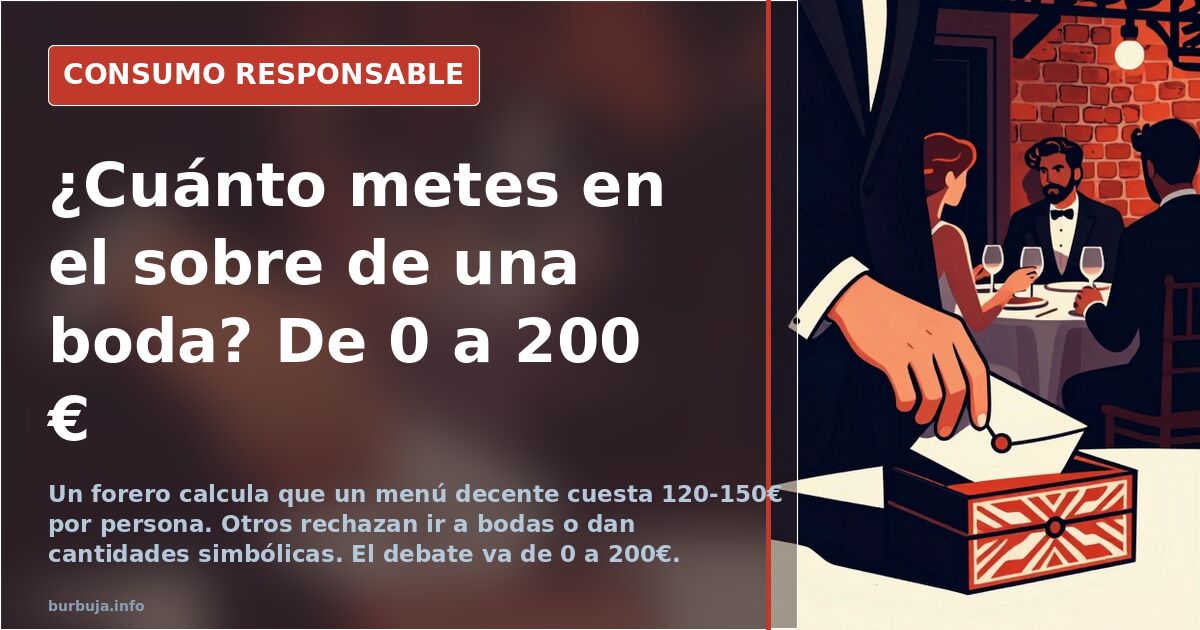
Weddings: Stingy forum users debate cash gift amounts
How much should you put in a wedding envelope? The answer circulating among self-declared stingy users is not a figure, but an interval: from the zero euros of those who directly decline the invitation to the 200 spent by those who still believe they must cover the menu cost. In between, a recurring calculation: a decent banquet does not drop below €120-150 per person, so giving less means looking bad. The discussion, open for years, leaves an uncomfortable conclusion: several participants describe the wedding as a fundraising pantomime where the gift is no longer a gift, but an invoice.
How much to give in a wedding envelope
The most widespread consensus among attendees is that the envelope must cover, at minimum, the cost of the menu. Some calculate that in a decent venue this is €120-150, and others go up to €150-200 because "that is what the menu usually costs per person." The range repeats with few variations: €100 as a floor, €150 as the norm in groups, €200-250 if the guest is close. Those going as plus-ones spend €100 and "it works out."
Against this logic, another current argues that the envelope should not be calculated based on the banquet cost but on what one wants to gift. Here appear figures that sound like another era: €20, 100 pesetas, 15,000 pesetas "unaffected by inflation." It is not a miscalculation, it is a statement of intent: if the wedding is a business, let the groom pay for it.
Not attending the wedding: the option gaining trinc
The most repeated stance is not how much to give, but not going. Declining the invitation is presented as the only coherent way out for those who do not want to participate in what several describe as a farce. Excuses range from distance ("I am never around my hometown") to work, including the most blunt: saying one does not believe in marriage. There are those who simply do not respond or claim work commitments to avoid missing it.
The problem appears when the guest is close family. Then the calculation changes: not going means becoming "the talk of the gossip," being considered a cheapskate. A detailed case is that of a teenage friendship that broke because one could not attend a wedding across the country while unemployed. The response was to stop speaking. A decade later, there is still no contact.
The gift that becomes an invoice
The point generating the most agreement is that current weddings function as a financial operation. The case of a wedding paid entirely by the parents of the couple is described, yet the pair still made enough money to buy a car. Another account says that after putting in €100, the groom reproached him time later that his table had given little. The conclusion drawn: some count on leaving the banquet with cash for their alucinación.
The criticism is not only economic. It is pointed out that the bigger the wedding, the sooner they separate. And a specific scene is described: at a wedding with a €150 menu, several guests left their plates full to watch a match in the restaurant bar. Thousands of euros wasted due to a custom nobody believes in anymore.
Alternatives: simple wedding, zero envelope
Against the banquet-and-envelope model, a wedding without gifts is advocated. One case: renting a venue, doing everything among family, inviting without asking for contributions, barbecue and drinks, dressing normally. Guests ate until bursting and took food home. "Huge success," it is summarized. At another wedding, the couple themselves said nothing needed to be given. In a third, a friend communicated that the plate cost €150; the response was not to go.
The repeated conclusion is that these events function as detectors of opportunists. Who invites you expecting nothing, stays. Who passes you the menu cost, reveals themselves.
The trick of the anonymous envelope
Among those who attend and pay, tactics circulate to minimize damage. The most repeated: not putting your name on the envelope. If there are several unidentified ones, they might confuse yours with a fuller one. Another: estimate visually what the food costs and add €30. And one more: bring a container to take advantage of the next day's leftovers.
There are also those who keep a list of what each guest contributed to their own wedding to act "fairly" in subsequent ones: generous with those who were, stingy with those who could have been but didn't. It is the emotional accounting of the envelope.
In the end, the amount each person puts in the envelope says less about their bank account than about their idea of family. And the family, in these cases, always finds out how much you gave. Or how much you did not.
Also available in: Deutsch
Summary of a discussion on Burbuja.info - Foro de economía, actualidad y política., translated from Spanish and reviewed before publication. Read the full discussion (117 replies).
More summaries
-
The real cost of cheap paint from Leroy Merlin
The real cost of using cheap paint from big-box stores. We analyze the dilemma between immediate savings and the durability of the finish.
-
Family Feud Over €30,000: Who's Right When Parents Favor One Child?
A father-in-law gives €30,000 to one son and refuses to match the other. The clash between equal distribution and helping those in need, with inheritance in the background.
-
September Weddings: High Costs Make Guests Skip
A lawyer skips two September weddings due to high costs, highlighting the conflict between social obligations and financial health.
-
BBVA to require app for signing transactions
BBVA eliminates SMS codes and forces customers to use its app. Forum debate on security, tech dependence, and loss of digital freedom.
-
Lidl sells a callus remover for €13 that Scholl charges almost €40 for
The Scholl callus remover costs almost €40 at the pharmacy; Lidl's is €12.99, and according to those who have tried both, it removes calluses just as well.
-
Anti-dandruff shampoos: the 3-euro ketoconazole flying off pharmacy shelves
Generic ketoconazole costs around 3 euros at the pharmacy, according to one forum user. Selenium sulfide and 65-cent Lagarto soap are alternatives that work.