
Water heater: gas or electric, the math that decides
A 50-litre electric water heater uses just over 1 kWh a day, according to one forum user's measurements. The sacrificial anode and the gas fixed fee settle the bill.
English · Original discussion in Spanish · Published
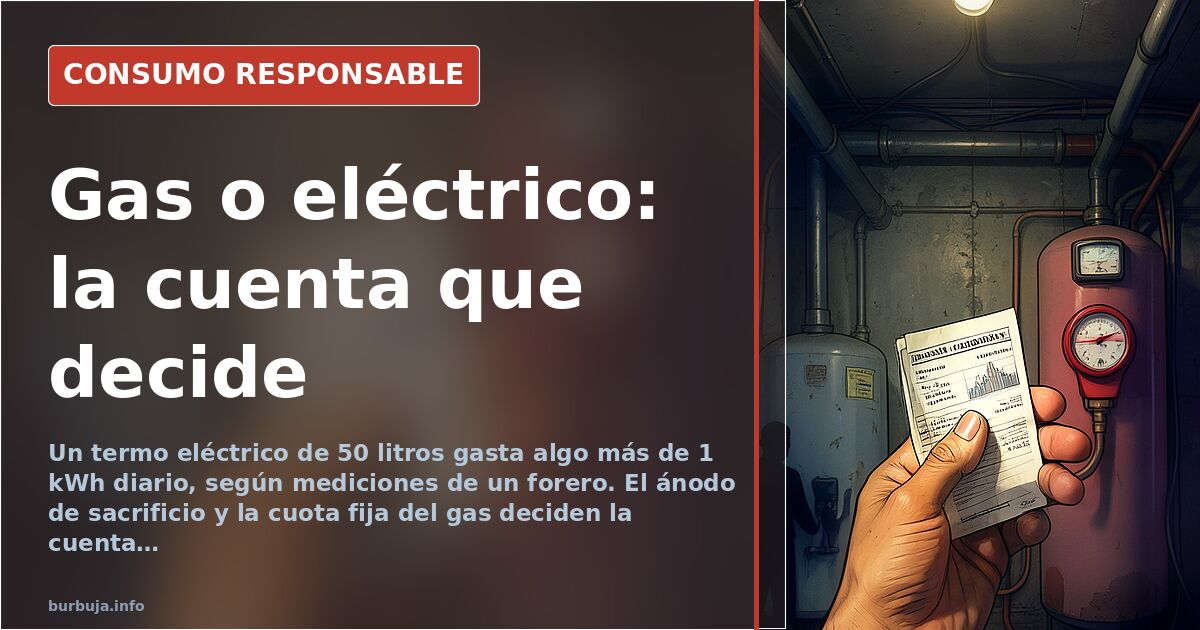
Water heater: gas or electric, the bill that decides
A gas water heater on its last legs after fifteen years, two repairs at 200 euros each, and a 1,200-euro quote to replace it with the model required by regulations. That is the starting point of one of those household decisions that seem minor and end up moving hundreds of euros a year: switching to an electric water heater. The question was raised by a reader with two people in the household, a shower over a tray, and one circumstance that changes everything: a flat-rate electricity tariff. With those cards on the table, the math tips one way, but not where you'd expect.
How much contracted power do you need for an electric water heater
The most frequently asked question is whether 3 kW is enough. The short answer: it depends on whether the kitchen is electric too. With an induction hob and oven, the contracted power falls short and the circuit breaker trips as soon as several appliances run at once. Moving up to 4 kW requires a technician to come and replace the main switch with a 20-amp one, and that isn't free. Without an electric kitchen, 3 kW holds up without trouble.
Real, measured consumption debunks several myths. A 50-litre heater for four people in the Canary Islands, with the dial in the middle position and 1.6 kW of rated power, used 16 kWh in fifteen days. Just over a kilowatt a day. Another reading, in March with three people, came to 4.2 kWh a day; in August, with warmer mains water, it dropped to 2 kWh. Seasonality matters as much as insulation.
Litres: 50 or 80 for two people?
The consensus is that 50 litres is enough for two adults, and that 80 is only justified if someone takes baths. The price difference between the two is around 40 euros, but the smaller one heats up faster and loses less. The experience of four people with a 50-litre heater suggests the hot water runs out if the kids take forever, though some also advocate going down to 30 litres to force short showers. The real catch is maintenance.
The sacrificial anode, the part nobody replaces
Here lies the key to the electric water heater's bad fruta. Inside there is a part, the sacrificial anode, which corrodes to protect the tank. It should be replaced every two to four years, sooner if the water is hard, and while you're at it, scrape the limescale off the heating element and the probe. Those who don't end up with a rusted tank and a repair that isn't worth it. There are stories of heaters bursting after two years and others that have lasted ten without anyone touching them. Same city, same water, opposite results: the variable is maintenance, not the brand.
Natural gas, butane and the hidden fixed cost
The underlying economic argument is not the price per kilowatt, but the fixed fee. Cancelling the natural gas supply eliminates an entire bill. Against that, butane holds up well: a cylinder for the heater and stove in a four-person household lasted a month, longer in summer; with two people, considerably longer. The downside is the logistics and the antiestéticar of catalytic heaters in enclosed spaces. And the regulations: a gas water heater in a closed laundry room requires a room-sealed model that blows up the budget.
The option almost nobody looks at
There is a third appliance, the heat pump water heater, which uses a fraction of what a conventional resistance heater consumes. It costs three times as much, but pays for itself in three or four years according to circulating estimates. For those on a flat tariff, the incentive is smaller, but for those paying market price per kilowatt, the whole equation changes.
The full calculation, with fifteen-year amortization and monthly gas savings, yields a surprising difference. Nobody disputes anymore that the electric option wins if gas leaves the house. The question is how long the appliance lasts before limescale presents its bill.
Also available in: Deutsch
Summary of a discussion on Burbuja.info - Foro de economía, actualidad y política., translated from Spanish and reviewed before publication. Read the full discussion (58 replies).
More summaries
-
Heat pump vs natural gas: which is cheaper in 2026?
Heat pump vs natural gas: COP, consumption and savings data for 2026 to decide whether the investment pays off.
-
Heating oil vs natural gas: which boiler saves more?
Real comparison of heating oil and natural gas boilers: cost per kWh, efficiency, maintenance, and alternatives like pellets or heat pumps.
-
Butane, natural gas or electric: the real cost of hot water
A user calculates that natural gas turns 10 euros of actual consumption into a 55-euro bill due to fixed charges and inspections. Butane wins on cost; electric is…
-
Pétanque Ball Finishes: Laser Etching vs. Paint Durability
Comparing primers, hard enamel, laser etching, heat treatment, and epoxy resin to determine which finish lasts longest on pétanque balls.
-
Extreme bulking trend: who started it and why it's a disaster
The trend of gaining 20 kilos to build muscle and then losing it with extreme diets carries a high physiological and financial cost. Who started it?
-
Earplugs: from the supermarket pack to a 90-euro custom mold
From a two-pair supermarket pack to a 90-euro custom mold: how long they last, which ones fail, and the hidden risk of ear infection at night.