
Warhammer Partworks: €1,000 vs €2,000 Cost Debate
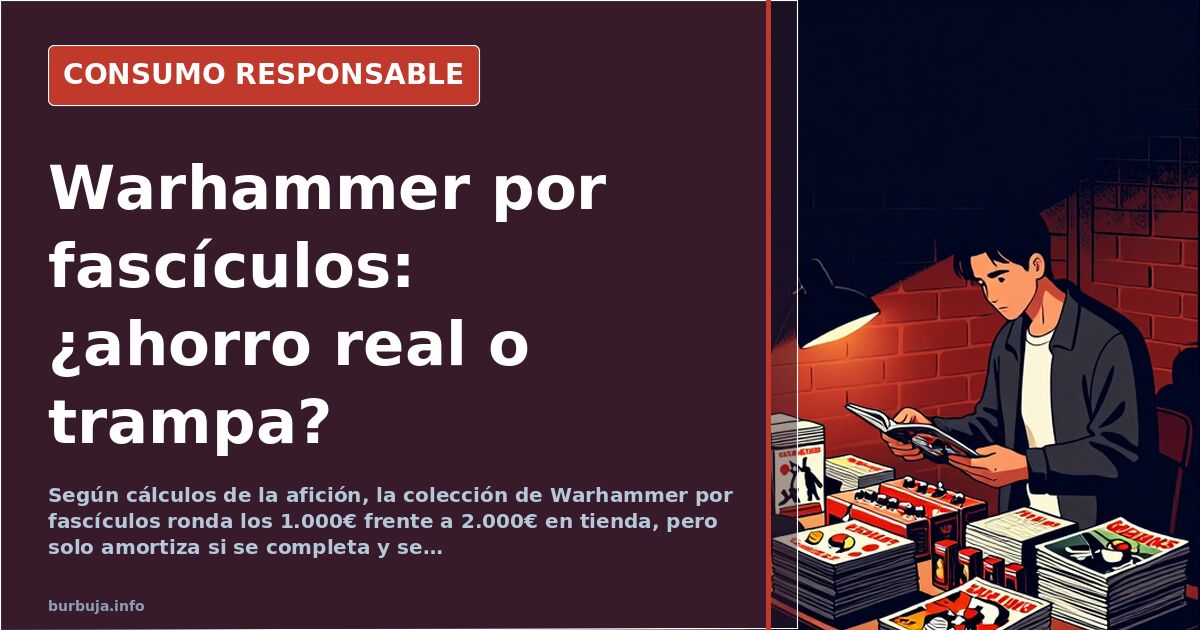
Community calculations suggest the Warhammer partwork costs around €1,000 versus €2,000 in stores, but savings only apply if completed and resold.
English · Original discussion in Spanish · Published
Warhammer Partworks: €1,000 vs €2,000 Cost Debate
Is subscribing to the Salvat Warhammer 40.000 partwork worth it, or is buying loose miniatures cheaper? This question arises from newcomers seeing a newsstand entry point. The community's answer is nuanced: it depends on how many issues you buy and how much you resell.
The most common calculation is that the full collection costs around €1,000, while buying those same miniatures separately in-store would cost about €2,000. On paper, this is a 50% discount. However, this math only holds if the buyer completes the entire subscription and utilizes all content. Those who quit halfway, which is common, end up with loose pieces bought at newsstand prices.
Is the Salvat Collection Cheaper Than Store Prices?
Yes, according to numbers used by hobbyists, but with significant caveats. The collection includes magazines, paints, and paraphernalia that increase the overall cost, items not every buyer wants. Some argue that partworks never pay off: they mix useful materials with filler and end up costing more. Others defend the opposite view: it is cheaper than buying official products and allows cherry-picking specific issues.
Veterans often repeat a strategy: buy the first few issues to test new factions, or complete the collection and resell unused parts later. Loose issues from quitters appear on second-hand platforms. Real savings depend on buyer discipline, not cover price.
What Does Starting Warhammer 40.000 Really Cost?
More than the first issue suggests. Beyond the subscription, you need brushes, glue, cutting tools, and if playing, rulebooks and army codices. One enthusiast compares the expense to other hobbies: kayaking gear cost them around €1,000, plus €30 per outing for fuel. The implicit conclusion is that Warhammer isn't unusually expensive compared to alternatives, but it isn't cheap either.
An added problem is pacing. Completing a partwork can take a year or more to have a playable army. Those wanting to play quickly must buy starter boxes in-store or turn to the second-hand market, where prices drop.
The Growing Alternative: 3D Printing and Second-Hand
Official miniature costs have pushed some of the community toward resin 3D printing. The argument is simple: the cost of an official army amortizes the printer and resin, which can also be used for other projects. The practice has become widespread enough to be mentioned openly in hobby discussions.
In parallel, the second-hand market has become the main competitor to retail stores. Some buy whole lots from individuals; others resell loose issues. The Salvat collection has actually become a supply source for this parallel market: many subscribers buy the full series just to keep a portion and sell the rest.
The Hidden Cost: Assembly and Painting
Miniatures don't come ready to play. They require assembly, priming, and painting, a process consuming dozens of hours. The most repeated warning is that many people buy a hundred figures and paint three before quitting. For those unwilling to do this work, the recommendation is buying pre-painted figures second-hand, even if they cost more.
The hobby also has a creative dimension that has been lost. Old manuals taught making homemade scenery with cork and cleaning brushes. Today, the catalog sells prefabricated scenery, and enthusiasts sticking to official products miss out on this aspect. Whether you paint more than you play, or vice versa, defines your relationship with spending.
Planned Obsolescence of Rulesets
Games Workshop revises its rules every few years, leaving entire armies behind. Complaints are recurrent: what is valid today becomes obsolete tomorrow, forcing repurchases. Veterans note the cycle has accelerated, renewing every three years. For those starting with a partwork, the risk is investing €1,000 in an army that may become outdated before completion.
The company is publicly traded and pays dividends, adding cynicism to the matter: some buy shares as well as miniatures. Rumors suggest an upcoming video platform series could boost stock prices. The enthusiast pays for the hobby; the investor collects the dividend.
Game Atmosphere: Between Workshop and Tournament
The stereotype of the unhygienic player isn't a legend. Tournaments include explicit rules on showering, deodorant, and clean clothes, with sanctions for abusa reaching disqualification. This measure has applied for decades in card and miniature games, addressing real issues in closed, poorly ventilated spaces.
Beyond smell, the gaming ecosystem has its own social code. Some groups combine RPG sessions with other activities, and local associations offer cheaper alternatives: historical wargames recreating specific battles for the price of a few figures. For those avoiding the official circuit, these associations are the budget-friendly entry point.
Is the Collection Worth It for Beginners?
It depends on goals. To test the hobby without commitment, early issues are cheap and allow painting a handful of figures. For a complete, playable army, the subscription is slow and costly compared to second-hand options. If interested in lore, there are plenty of novels and faction books without buying a single miniature.
The most repeated advice is visiting an official store or local association before subscribing. There, you see games, ask about real costs, and check if the atmosphere fits. The Salvat collection will continue selling weekly issues. The buyer decides whether to finance a hobby that, like all others, ends up costing more than expected.
Is subscribing to the Salvat Warhammer 40.000 partwork worth it, or is buying loose miniatures cheaper? This question arises from newcomers seeing a newsstand entry point. The community's answer is nuanced: it depends on how many issues you buy and how much you resell.
The most common calculation is that the full collection costs around €1,000, while buying those same miniatures separately in-store would cost about €2,000. On paper, this is a 50% discount. However, this math only holds if the buyer completes the entire subscription and utilizes all content. Those who quit halfway, which is common, end up with loose pieces bought at newsstand prices.
Is the Salvat Collection Cheaper Than Store Prices?
Yes, according to numbers used by hobbyists, but with significant caveats. The collection includes magazines, paints, and paraphernalia that increase the overall cost, items not every buyer wants. Some argue that partworks never pay off: they mix useful materials with filler and end up costing more. Others defend the opposite view: it is cheaper than buying official products and allows cherry-picking specific issues.
Veterans often repeat a strategy: buy the first few issues to test new factions, or complete the collection and resell unused parts later. Loose issues from quitters appear on second-hand platforms. Real savings depend on buyer discipline, not cover price.
What Does Starting Warhammer 40.000 Really Cost?
More than the first issue suggests. Beyond the subscription, you need brushes, glue, cutting tools, and if playing, rulebooks and army codices. One enthusiast compares the expense to other hobbies: kayaking gear cost them around €1,000, plus €30 per outing for fuel. The implicit conclusion is that Warhammer isn't unusually expensive compared to alternatives, but it isn't cheap either.
An added problem is pacing. Completing a partwork can take a year or more to have a playable army. Those wanting to play quickly must buy starter boxes in-store or turn to the second-hand market, where prices drop.
The Growing Alternative: 3D Printing and Second-Hand
Official miniature costs have pushed some of the community toward resin 3D printing. The argument is simple: the cost of an official army amortizes the printer and resin, which can also be used for other projects. The practice has become widespread enough to be mentioned openly in hobby discussions.
In parallel, the second-hand market has become the main competitor to retail stores. Some buy whole lots from individuals; others resell loose issues. The Salvat collection has actually become a supply source for this parallel market: many subscribers buy the full series just to keep a portion and sell the rest.
The Hidden Cost: Assembly and Painting
Miniatures don't come ready to play. They require assembly, priming, and painting, a process consuming dozens of hours. The most repeated warning is that many people buy a hundred figures and paint three before quitting. For those unwilling to do this work, the recommendation is buying pre-painted figures second-hand, even if they cost more.
The hobby also has a creative dimension that has been lost. Old manuals taught making homemade scenery with cork and cleaning brushes. Today, the catalog sells prefabricated scenery, and enthusiasts sticking to official products miss out on this aspect. Whether you paint more than you play, or vice versa, defines your relationship with spending.
Planned Obsolescence of Rulesets
Games Workshop revises its rules every few years, leaving entire armies behind. Complaints are recurrent: what is valid today becomes obsolete tomorrow, forcing repurchases. Veterans note the cycle has accelerated, renewing every three years. For those starting with a partwork, the risk is investing €1,000 in an army that may become outdated before completion.
The company is publicly traded and pays dividends, adding cynicism to the matter: some buy shares as well as miniatures. Rumors suggest an upcoming video platform series could boost stock prices. The enthusiast pays for the hobby; the investor collects the dividend.
Game Atmosphere: Between Workshop and Tournament
The stereotype of the unhygienic player isn't a legend. Tournaments include explicit rules on showering, deodorant, and clean clothes, with sanctions for abusa reaching disqualification. This measure has applied for decades in card and miniature games, addressing real issues in closed, poorly ventilated spaces.
Beyond smell, the gaming ecosystem has its own social code. Some groups combine RPG sessions with other activities, and local associations offer cheaper alternatives: historical wargames recreating specific battles for the price of a few figures. For those avoiding the official circuit, these associations are the budget-friendly entry point.
Is the Collection Worth It for Beginners?
It depends on goals. To test the hobby without commitment, early issues are cheap and allow painting a handful of figures. For a complete, playable army, the subscription is slow and costly compared to second-hand options. If interested in lore, there are plenty of novels and faction books without buying a single miniature.
The most repeated advice is visiting an official store or local association before subscribing. There, you see games, ask about real costs, and check if the atmosphere fits. The Salvat collection will continue selling weekly issues. The buyer decides whether to finance a hobby that, like all others, ends up costing more than expected.
Also available in: Deutsch
Summary of a discussion on Burbuja.info - Foro de economía, actualidad y política., translated from Spanish and reviewed before publication. Read the full discussion (112 replies).
More summaries
-
Forum user: Local shops cost triple Amazon prices
A forum post claims local retailers charge three times more than Amazon. Service and tax issues define a battle already lost on price.
-
Amazon Disrupts Hardware Stores, Making Physical Shopping Less Viable
A simple nut took hours to find locally but minutes on Amazon. The shift from neighborhood shops lacking stock to online convenience is accelerating.
-
Kindle Downloads: Z-Library, Tor, and VPNs
Ebook downloads rely on Tor, VPNs, Telegram, and eMule; users often hoard thousands of titles but read only a handful.
-
Real Space for Three Adults and Two Infants
The 2017 Scenic's 135 cm rear width reveals why family SUVs fail to seat two infants and three adults comfortably.
-
What it feels like to smoke weed, snort coke or shoot heroin
Users describe the effects of cannabis, cocaine and heroin: from a 'strong coffee' high to emptying half the fridge while laughing.
-
High-quality cars under €13,000 without financing
Toyota Auris from €13,491, Ford Fiesta at €10,600: rules and traps of buying quality used or new cars cheaply in Spain.