
Wanting wealth without effort: a flawed narrative
The desire for millions clashes with inaction. Savings targets, inheritance splits, and the debate on whether wealth is built or inherited.
English · Original discussion in Spanish · Published
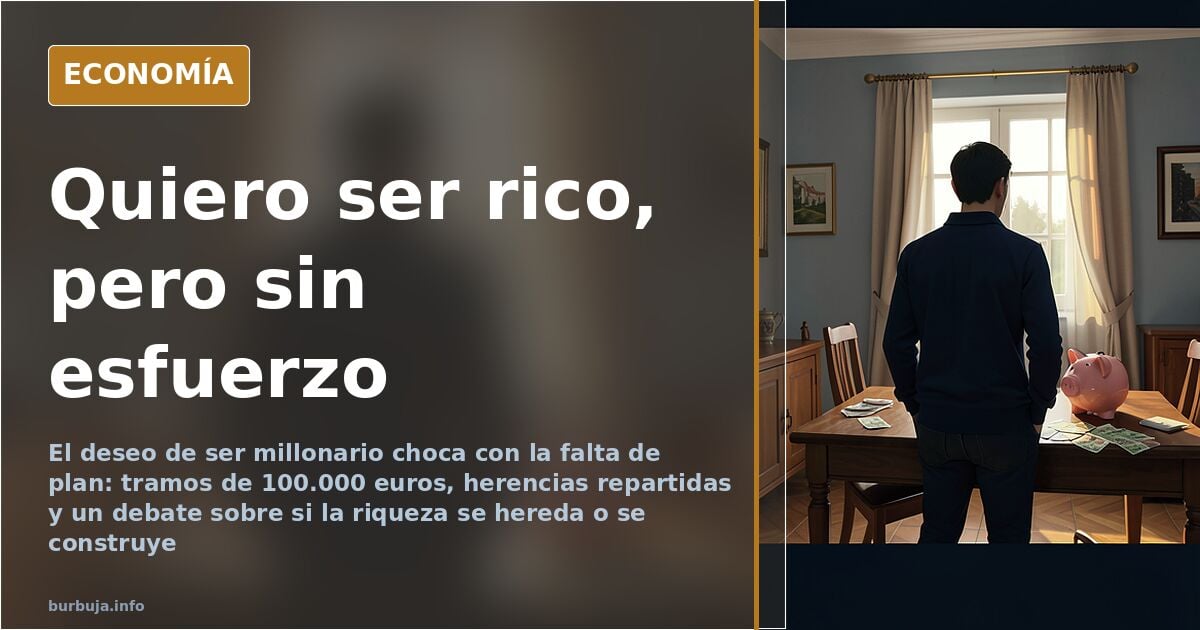
Wanting wealth without effort: a plan that doesn't add up
What is the point of claiming you want to be a millionaire if you do nothing to achieve it? This contradiction lies at the heart of the argument: many repeat the desire for wealth but expect it via lottery or inheritance, refusing to accept the necessary work. The starting premise is uncomfortable: wanting wealth without sacrifice is just posturing, and those who truly want to prosper begin by accumulating their first €100,000 while living below their means.
The €100,000 milestone
The proposal suggests a step-by-step pogre: first €100,000, then €200,000, €300,000, €500,000, and much later, the million. No magic jumps. The recipe includes working long hours for a period, learning about taxation—the difference between general income tax (IRPF) and capital gains tax—and maintaining health as an asset. The underlying idea: without energy there is no focus, and without focus there is no net worth.
Criticism arrives quickly. It is noted that a decent salaried job won't make you rich, and that Spanish meritocracy is more myth than reality: family name and starting point weigh more than effort. The counter-argument is that it suffices not to be a problematic employee and to supplement income with a second job rather than wasting energy on internal promotions.
A €1.5m inheritance split among ten children
The most discussed case involves a flat in central Madrid valued at €1.5 million which, divided among ten heirs, leaves around €150,000 per person. The argument uses this to advocate for having fewer children: one child would inherit the total and start with an advantage. The majority response challenges this logic: more children miccionan more family labor, higher probability of success, and future income, while low birth rates impoverish societies. It is also recalled that €150,000 is not crumbs, and those complaining about receiving it have expectation issues.
The son earning €5,000 a month whom no one celebrates
Another example: a family with €300,000 in assets whose son reached €700,000 in his thirties with a monthly income of €5,000, yet the parents seem unimpressed. The narrative interprets this as proof that people only look out for their own interest, even when success belongs to others. Against this appears the warning: obsessing over parents' money or inheritance leads to bitterness, and health and time are worth more than any figure.
Ultimately, the discussion falls into two camps: those who believe wealth is built through effort and family planning, and those who argue wealth is inherited and that the discourse of sacrifice is the perfect excuse for those who started ahead. The €100,000 figure as a first step remains, though no one has yet proven it can be climbed alone.
Also available in: Deutsch
Summary of a discussion on Burbuja.info - Foro de economía, actualidad y política., translated from Spanish and reviewed before publication. Read the full discussion (47 replies).
More summaries
-
Elon Musk's new idea: robocars as AirBnB and Uber for passive income
Elon Musk proposes buying Tesla cars to rent them out as autonomous taxis and generate passive income. We take a closer look at the idea.
-
Meritocracy in Spain: Inheritance vs. Effort
In Spain, a young executive's rise contrasts with heirs of large fortunes, reopening debate on whether merit or family safety nets determine success.
-
In Madrid, housing is out of reach without family wealth
In Madrid, homes are inherited or paid for by parents: rent consumes salaries, and wages fail to keep pace with property prices.
-
Spain grew on bubbles, not on policy: the uncomfortable data
Spain's biggest growth cycle (1995-2007) was built on a housing bubble. The post-pandemic rebound repeats the pattern: without productivity gains, there is no…
-
Body Positivity Influencer Celebrates Texas Democratic Win From Sofa
A viral tweet shows a body positivity influencer celebrating the Democratic victory in Texas without leaving her couch, sparking debate on political discourse.
-
Spain Health Campaign Links Care to Residency
Spain's Ministry of Health launches a campaign asserting healthcare access based on residency, sparking debate over its scope and message.