
Walkie-talkies for blackouts: from €50 PMR to unlicensed Baofeng
Baofeng, PMR, VHF and UHF: which walkie-talkie to buy for a blackout, its real range, and why PoC terminals fail without mobile coverage.
English · Original discussion in Spanish · Published
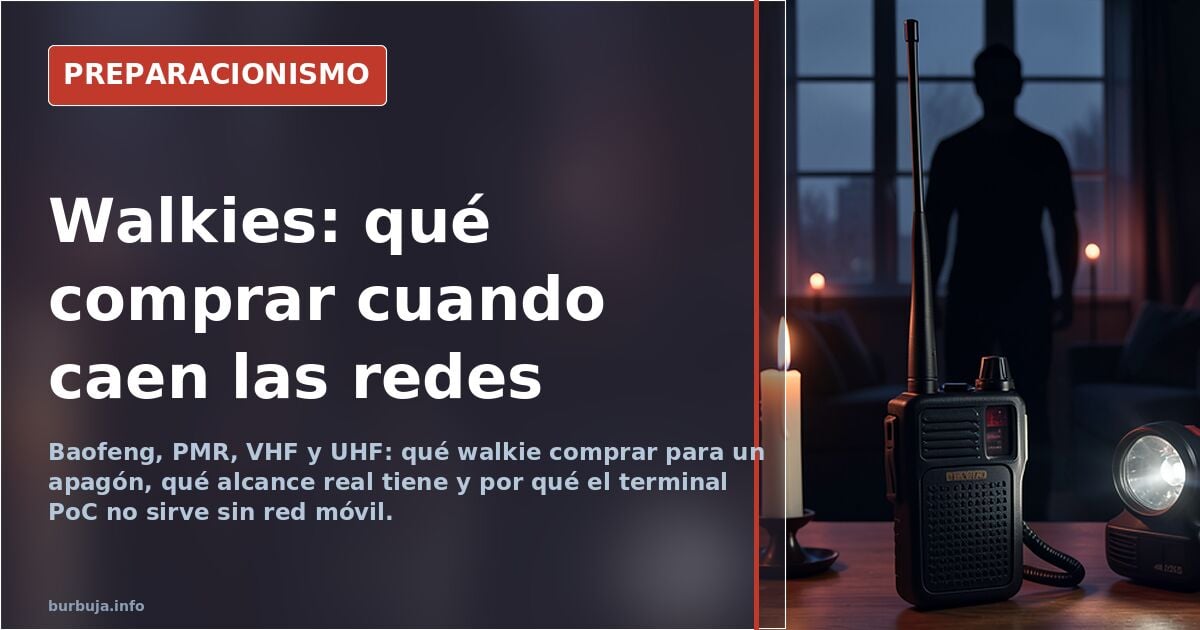
Walkie-talkies when networks fail: from PMR to Baofeng
A pair of USB-rechargeable Motorolas, the kind that barely reach across a hiking trail with poor signal. This premise kicks off the debate on what device to keep handy if mobile networks ever go down. The core question is not trivial: is a toy walkie-talkie enough, or do you need something more serious, even if it skirts legality?
The emerging technical consensus is uncomfortable for impulsive buyers. Range depends on many factors, and the radio itself is last on the list. One comment sums it up: antenna, obstacles, altitude, and power matter more than the brand printed on the case. In cities, two kilometers is realistic; in open terrain, five or slightly more if lucky. Any promise beyond that with a pocket-sized device is just brochure propaganda.
Baofeng UV-5R: the Chinese gadget everyone ends up buying
The model mentioned repeatedly is the Baofeng UV-5R. Cheap, rechargeable, and capable of transmitting on VHF and UHF. Some have tested it at two kilometers in urban areas and up to five in open fields. Criticism comes from the technical side: plug in a spectrum analyzer and you find it emits dirty signals, stepping on frequencies and being heard where it shouldn’t be. It’s not amateur radio equipment; it’s a makeshift solution.
Legal boundaries also appear. Transmitting on certain bands requires an amateur radio license. In a real emergency scenario, that paperwork matters little, but day-to-day authorities can demand it. The circulating recommendation is clear: if the goal is listening and learning, the UV-5R works; if you want to transmit properly, you need training.
What’s the difference between VHF and UHF for a walkie-talkie?
UHF has shorter waves that bounce off obstacles; VHF has longer waves that break against them but travel farther. Hence the repeated rule: UHF for cities and enclosed spaces, VHF for open terrain and long distances. It’s not an immutable physical law, but it guides beginners well.
PMR446, Europe’s license-free band, is the no-paperwork option. Limited range, but better than nothing. And for those wanting total network independence, some point to DMR devices with encryption, like the Anytone 878. Entirely illegal without a license, yet efficient if the scenario is apocalyptic and legality ceases to matter.
The PoC terminal that isn’t a walkie-talkie
The temptation of an all-in-one device—phone and walkie-talkie combined—arises. The warning is blunt. PoC (Push to Talk over Cellular) terminals require data networks. Without coverage, there’s no miracle. Zello and similar apps work via Wi-Fi or mobile data; if the network fails, the gadget goes silent. That’s not what you’re looking for.
The real alternative, if you want privacy and autonomy, lies in dedicated radio equipment. More expensive, more complex, but independent of infrastructure. The lingering question is how much someone willing to pay and learn who just wants two walkie-talkies for a bad day.
Hand-crank FM radio and SDR as entry points
Beyond walkie-talkies, interest shifts toward emergency radios: hand-cranked and solar-powered FM receivers. And toward SDR, software-defined radio, which for little money lets you listen from PMR walkie-talkies to aircraft beacons or maritime communications. Some have heard Russian masses on 14.130 MHz or weather forecasts in RTTY from Hamburg. Curiosity drives more than antiestéticar.
The problem, they warn, is that in many areas the band is dead. Buying equipment to listen to silence is a common disappointment. Before spending, know what’s on the other end.
The conclusion that emerges is less epic than the genre promises. A walkie-talkie saves no one; at best, it keeps you connected with whoever is nearby. And the day networks fall, the first person who knows how to use the radio will be the one who didn’t buy on impulse.
Also available in: Deutsch
Summary of a discussion on Burbuja.info - Foro de economía, actualidad y política., translated from Spanish and reviewed before publication. Read the full discussion (94 replies).
More summaries
-
Walkie-talkies: from a €35 Baofeng to 25W with a licence
The €35 imported walkie claims 7 km and 10 W; the legal PMR446 is capped at 500 mW. Key points on power, licensing and repeaters for emergencies
-
Baofeng UV-5R Mini: the cheap walkie-talkie Europe will restrict
The Baofeng UV-5R, the 15-euro walkie-talkie that Europe won't certify, is getting a restricted version. A look at the licence, the fines and the real-world use of a gadget that attracts…
-
Spain blackout exposes flaws in survival kits
The outage affecting Spain and Portugal tested prepper gear, but quick grid restoration mattered more than equipment.
-
Austria Publishes Blackout Guide for One-Week Power Outage
The Austrian army publishes a guide for a European blackout lasting up to a week: water, food for two weeks, cash, and battery radio.
-
Spain's heat pumps: €2,300 vs €15,000 quotes
In Spain, a heat pump with radiators costs €2,300 versus €15,000 for underfloor heating. This gap drastically changes the payback period.
-
Spain's shortage kit: which meds to stock and which expire
In Spain, aspirin, paracetamol and ibuprofene form the core of a shortage kit; prescription drugs and expiry dates complicate any hoarding plan.