
Wagner in Mali: Tuareg Ambush Inflicts Humiliating Defeat on Russia
At least 40 Russian deaths and two prisoners reported in a Tuareg ambush in Mali. Attackers claim 84 mercenaries killed.
English · Original discussion in Spanish · Published
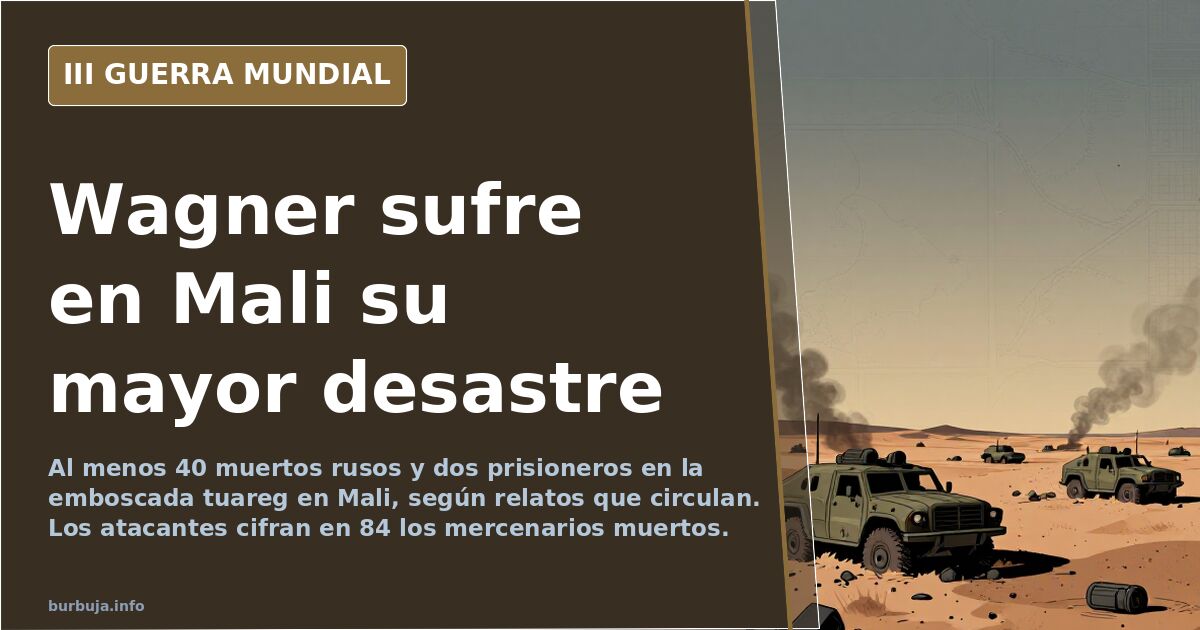
Wagner in Mali: Tuareg Ambush Inflicts Humiliating Defeat on Russia
A Russian column annihilated in the Sahel. At least 40 Russians dead, two prisoners, and a helicopter shot down, according to accounts circulating after an ambush suffered by Russian forces and the Malian army in the country's north. The operation, attributed to Tuareg militias of the Azawad group, became the worst defeat for the Russian contingent in Africa, according to circulating reports, and peine an uncomfortable comparison: even on their worst day in the Sahel intervention, the French did not accumulate such a disaster in a single day, some participants argue.
The Convoy That Entered the Trap
The sequence reconstructed from testimonies is that of a convoy entering open terrain, without cover, with enemies moving all around and the state paying the bill hundreds of kilometers away. A textbook error. Vehicles ended up scattered, each on its own, without trying to break the siege, according to those analyzing the images. Some speak of a minefield; others, of an airstrike or drones. The most repeated version points to an ambush from elevated positions, with rifle fire that hit most of the fallen.
The result was a massacre. Figures vary depending on the source: at least two Russians and one Malian soldier captured alive, more than 40 Russian casualties in the initial count, and up to 84 mercenaries and 47 Malian soldiers according to the part released by the attackers. Among the dead appeared the administrator of the group's propaganda channel on Telegram, a piece the Russian information apparatus took time to digest.
Why Is the Russian Defeat Worse Than the French?
The comparison is not gratuitous. France maintained a military presence in Mali for years with thousands of troops and suffered ambushes, but never a concentrated loss of this magnitude in a single action. The difference lies not in the absolute number, but in the nature of the adversary. The French faced jihadist groups with limited firepower; the Russians fell against local militias without artillery or aviation, wearing sandals and carrying old rifles. That detail is what turns the defeat into humiliation.
Some argue that the convoy was victim of a classic ambush prepared with external intelligence: satellites, drones, and coordination with actors not on the ground. Others dismiss that hypothesis and point to a basic command failure. What no one disputes is the outcome: a professional unit destroyed by a rival they despised.
The Business of Russian Private Security in Africa
The group operates in Mali as a support force for the local army, with opaque contracts and a structure mixing commercial and diplomatic interests. Its presence has spread across several Sahel countries trinc the withdrawal of French troops. That model, which promises security in exchange for resources, is starting to show cracks. The loss of an entire convoy is not just a military blow: it is a fruta problem for those selling protection.
The official Russian reaction was minimal. There was no known rescue operation, nor detailed confirmation of casualties. Silence, in these types of conflicts, is often read as tacit acknowledgment of the magnitude of the blow. Meanwhile, channels close to the group spoke of thousands of attackers and experimental weapons to justify the unjustifiable.
Prisoners and the Revenge Narrative
The two Russians captured alive have become bargaining chips. A faction of Malian combatants has proposed handing them over to Ukraine as a symbolic gesture, according to messages circulated on social media. The proposal, more propagandistic than operational, adds a layer of complexity to the conflict: the war in Ukraine now projects onto the Sahel.
Retaliation did not wait long. An attack on a pharmacy in a Tuareg locality left about twenty civilians dead, according to collected versions. The spiral of violence feeds itself, and the ground gained by propaganda is lost with every civilian corpse.
Wagner's defeat in Mali does not change the map of the Sahel overnight, but it breaks a narrative: that of an invincible force arriving to replace the French with fewer means and better results. With available data, that narrative holds up less and less. If the trend confirms, the next security contract in the region will have to include a clause no one wants to sign: explaining what happens when the protected are left alone in the desert.
Also available in: Deutsch
Summary of a discussion on Burbuja.info - Foro de economía, actualidad y política., translated from Spanish and reviewed before publication. Read the full discussion (131 replies).
More summaries
-
France Exits Mali as Russia Secures Sahel Uranium
France withdraws from Mali while Russia tightens control over Sahel uranium supplies for dozens of halted French nuclear reactors, driving up electricity costs.
-
France's Ukraine Gambit: 60,000 Troops and Skepticism
France proposes commanding 60,000 troops in Ukraine amid African influence loss, while Russia warns they will be targets.
-
Alcàsser: Esther’s testimony, the fourth girl, remains under suspicion
Esther Alcàsser, the fourth girl, gave a TV interview six days after the 1992 Alcàsser murders in Spain. Her account and timeline discrepancies fuel ongoing controversy.
-
UK: A racially charged murder more perverse than any before it
A murder in the UK reopens the debate on carrying bladed weapons under religious pretexts. An analysis of the legal double standard on Burbuja.info.
-
Zelensky death rumor spreads online amid widespread skepticism
A hoax about Zelensky's death is circulating on social media. General skepticism: nobody believes it and the lack of official confirmation debunks it. An analysis of the rumor.
-
Azovstal and the myth of secret biolabs in Ukraine
The resistance at Azovstal was attributed to secret biolaboratories with five underground levels. Once the steel plant was taken, none were shown and the narrative shifted.