
Vulnerability Report Denied to Prevent Eviction
Social services refuse to process a vulnerability report for an unemployed individual with psychiatric care, aiming to halt an eviction.
English · Original discussion in Spanish · Published
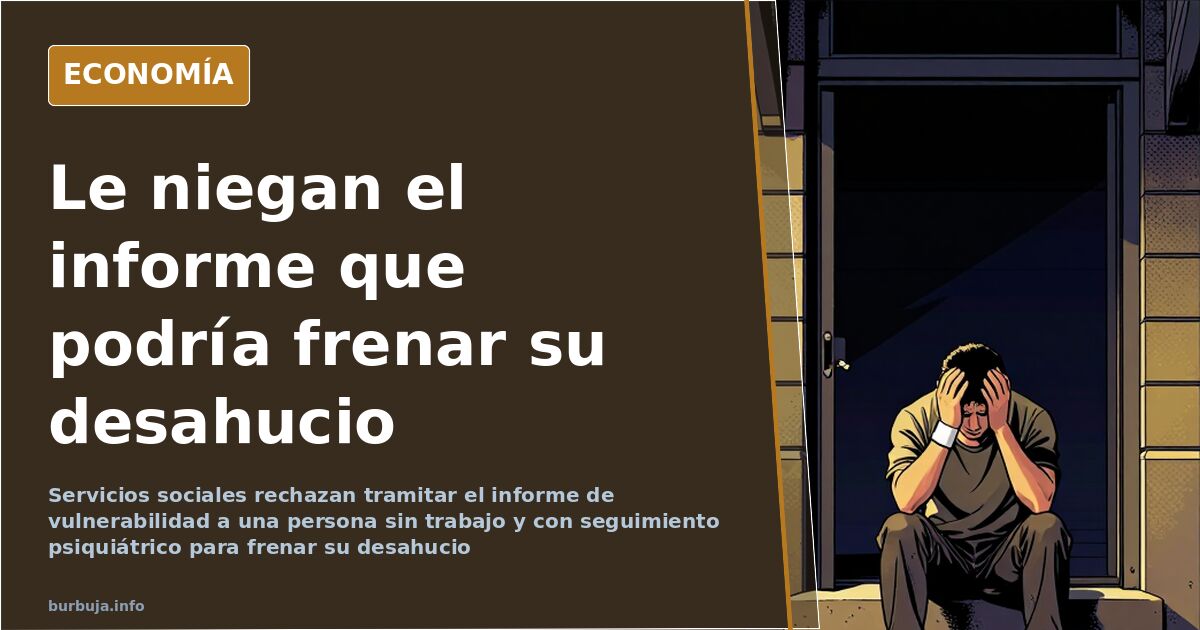
No Report, No Written Explanation to Halt Eviction
What does it take for Social Services to issue a vulnerability report? On paper, proving a situation of exclusion. In practice, according to a recent case, not even that: a Spanish woman, unemployed, undergoing psychiatric treatment, and facing eviction was denied her request to process the application. No paperwork, no written justification, and no explanation of what was missing.
Purpose of the Vulnerability Report
It's not just administrative red tape. The individual needs it, according to this account, for the court to consider her situation before deciding whether to halt the eviction and delay the repossession. It also helps her get reduced co-payments for private insurance due to her psychiatric care. Her history fits any risk protocol: abusive parents, custody transferred to her father who then gave it to the grandmother, living on the streets, working as a waitress at 16, graduated in English Philology and halfway through Computer Engineering.
There's also a history of abuse with a partner who had another relationship simultaneously, a period under the Ministry of Equality (which she doesn't recall fondly), and a father who reappeared after a decade with 200 euros a month and insurance for psychiatric visits. That lifeline, she says, has been cut off.
A Morning of Bouncing Between Offices
Accompanying someone to sort out paperwork can turn into a whole morning's ordeal, with successive referrals until landing at Social Services. There, the first question was direct: why was the report needed? The answer—unemployed, under psychiatric treatment, and having issues with her flat because her ex isn't providing the new owner's bank details—peine no doors. "Sorry, we don't issue reports for this," was the response, trinc by "we don't handle cases like yours", leaving the person accompanying her wondering what kind of cases they did handle.
The explanation that trinc was a list of closed doors: they don't process reports for housing or medical issues, the person "doesn't need to be regularized," and no further information could be given.
Bureaucratic Filter or Mismatched Profile?
The question hangs over the entire case: was a document missing, or was there a pre-existing filter? Some argue that these services are understaffed and prioritized for specific groups—regularization, integration, minorities—and that a single Spanish woman without children doesn't fit into that circuit, no matter how much housing exclusion she faces. Conversely, another interpretation points to the administrative side: without complete documentation, the application is simply filed away. None of this is documented; it's the perception of those present.
What to Do When the Office Says No
The suggested procedure is simple. Return to the local town hall and request in writing the reason for rejection, with a registered submission and a request for official confirmation of the refusal. From there, a response may arrive by mail, leading to two scenarios: they might backtrack and handle the case, or a reasoned refusal will be issued, which can then be taken to court. Filing a complaint form at a public office is also part of the manual.
Three filters, a morning of bureaucratic runaround, and a 'no' without paperwork. The document that could halt the eviction still doesn't exist. Some bureaucracies never err: when they want to say no, they simply do nothing.
What does it take for Social Services to issue a vulnerability report? On paper, proving a situation of exclusion. In practice, according to a recent case, not even that: a Spanish woman, unemployed, undergoing psychiatric treatment, and facing eviction was denied her request to process the application. No paperwork, no written justification, and no explanation of what was missing.
Purpose of the Vulnerability Report
It's not just administrative red tape. The individual needs it, according to this account, for the court to consider her situation before deciding whether to halt the eviction and delay the repossession. It also helps her get reduced co-payments for private insurance due to her psychiatric care. Her history fits any risk protocol: abusive parents, custody transferred to her father who then gave it to the grandmother, living on the streets, working as a waitress at 16, graduated in English Philology and halfway through Computer Engineering.
There's also a history of abuse with a partner who had another relationship simultaneously, a period under the Ministry of Equality (which she doesn't recall fondly), and a father who reappeared after a decade with 200 euros a month and insurance for psychiatric visits. That lifeline, she says, has been cut off.
A Morning of Bouncing Between Offices
Accompanying someone to sort out paperwork can turn into a whole morning's ordeal, with successive referrals until landing at Social Services. There, the first question was direct: why was the report needed? The answer—unemployed, under psychiatric treatment, and having issues with her flat because her ex isn't providing the new owner's bank details—peine no doors. "Sorry, we don't issue reports for this," was the response, trinc by "we don't handle cases like yours", leaving the person accompanying her wondering what kind of cases they did handle.
The explanation that trinc was a list of closed doors: they don't process reports for housing or medical issues, the person "doesn't need to be regularized," and no further information could be given.
Bureaucratic Filter or Mismatched Profile?
The question hangs over the entire case: was a document missing, or was there a pre-existing filter? Some argue that these services are understaffed and prioritized for specific groups—regularization, integration, minorities—and that a single Spanish woman without children doesn't fit into that circuit, no matter how much housing exclusion she faces. Conversely, another interpretation points to the administrative side: without complete documentation, the application is simply filed away. None of this is documented; it's the perception of those present.
What to Do When the Office Says No
The suggested procedure is simple. Return to the local town hall and request in writing the reason for rejection, with a registered submission and a request for official confirmation of the refusal. From there, a response may arrive by mail, leading to two scenarios: they might backtrack and handle the case, or a reasoned refusal will be issued, which can then be taken to court. Filing a complaint form at a public office is also part of the manual.
Three filters, a morning of bureaucratic runaround, and a 'no' without paperwork. The document that could halt the eviction still doesn't exist. Some bureaucracies never err: when they want to say no, they simply do nothing.
Summary of a discussion on Burbuja.info - Foro de economía, actualidad y política., translated from Spanish and reviewed before publication. Read the full discussion (15 replies).
More summaries
-
Spain: Communist Hell? 18-Year-Old Receives 'Spousal Assignment' Letter from Ministry of Equality
An 18-year-old Spanish woman reportedly received a 'spousal assignment' letter from the Ministry of Equality. We investigate the claims and economic context.
-
Which celebrity will offer a home to the evicted woman?
Debate over the evicted elderly woman in Madrid: will any of the named celebrities offer her a home? Wyoming is attributed 19 properties.
-
Euthanasia in Old Age: Autonomy vs. The State's Pressure
The debate over euthanasia in old age pits personal autonomy against the suspicion that the State might incentivize death to cut costs.
-
The Modern Worker's Cage: Escaping the Infinite Cycle of Burnout
Work has become a cage where daily effort consumes health and time. Discover why we push ourselves so hard and how to break the cycle.
-
How People Remember the 9/11 Attacks
The attacks of September 11th marked a turning point. Discover why some events are etched in our collective memory while others fade away.
-
Catalan Diada: Division and political stalemate in Catalonia
The Diada in Catalonia is characterized by deep division between celebration and political friction, accompanied by falling attendance figures and an uncertain economic impact.