
Vox's MEP pick backfires as Gaitán joins European Parliament
Vox brought mechanic Ángel Gaitán to the European Parliament for auto debates, but his theatrical tone drew criticism over political gain.
English · Original discussion in Spanish · Published
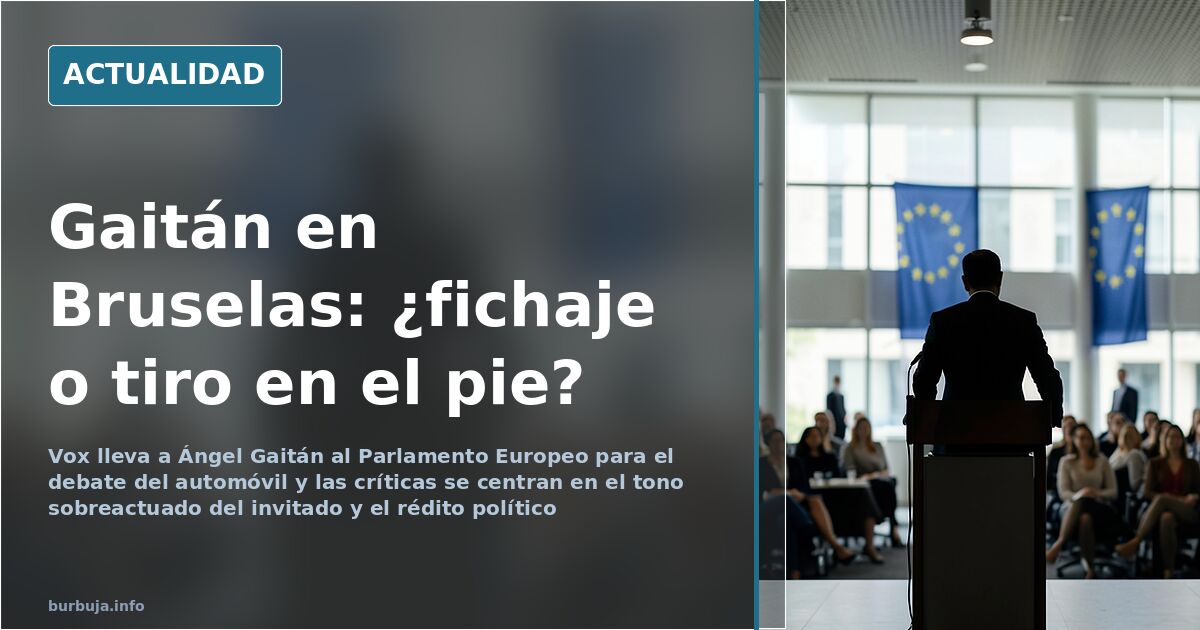
Vox recruits Ángel Gaitán for Brussels auto debate and faces online backlash
Amidst the European debate on automobiles and climate bans, Vox MEP Jorge Buxadé tweeted about bringing mechanic and content creator Ángel Gaitán to the European Parliament against "lobbies and vested interests." The message, accompanied by a video, presented Gaitán as someone who "knows" and tells "the truth." The response was unexpected: the conversation turned into a cascade of criticisms questioning both the guest's role and the political payoff of the move.
From workshop hero to over-the-top character
The first blow came from the tone. Several voices agreed that Gaitán's intervention was excessive for the format: "his intervention yesterday was overacted," summarized one of the more measured messages, which nonetheless maintained that the European Parliament functions as "a monolithic power structure controlled by an elite with no possibility for public intervention." The criticism wasn't against the diagnosis, but against the packaging.
Another line of reproach was harsher on the hire itself. He was labeled a "supreme cuñao" (a Spanish term for an obnoxious know-it-all relative) and people asked if there weren't "other" profiles available. Comparisons with other names in the conservative media ecosystem—from Desokupa's leader to figures in the identity politics orbit—drew a pattern: relying on media personalities over experts with technical credibility. "He does Vox no favors," concluded a message summarizing the general discomfort.
The underlying issue: Who speaks for the car industry?
Beyond judging the guest, the matter reveals a sustancia ilegal in the narrative against climate policies. Choosing a social media influencer—rather than an engineer or industry executive—suggests the battle is fought more on communication grounds than data. Some see it as a way to connect with voters tired of bans; the downside is the risk of turning a serious regulatory debate into a platform spectacle.
Buxadé himself framed the challenge as a binary choice: "bring whoever knows" versus pressure groups. The paradox is that the guest ended up generating more noise through style than substance. "In the end, he didn't talk about anything," was one of the most repeated verdicts, accompanied by suggestions to bring other equally media-savvy profiles to complete the task.
A tweet that backfires
The sequence has its irony: the message intended to showcase parliamentary muscle ended up fueling mockery. "Why did he bring him, to make people vomit?", "Good grief, why do they look so ridiculous?" or the classic "cuñadus maximus" paint a cross-party consensus criticizing the format. Even those defending the core argument—rejection of bans—distanced themselves from the form.
The question remains whether the episode changes anything. European automotive policy continues its course, and Vox maintains its discourse against climate restrictions. What this exchange clearly shows is that media packaging matters: a hire can amplify the message or bury it under caricature. For now, the caricature is winning.
Also available in: Deutsch
Summary of a discussion on Burbuja.info - Foro de economía, actualidad y política., translated from Spanish and reviewed before publication. Read the full discussion (15 replies).
More summaries
-
European Parliament's 'Family' sculpture sparks controversy
Edith Karlson's sculpture 'Family' at the European Parliament has drawn accusations of satanism and waste. Its price has not been disclosed and the interpretation...
-
European Parliament takes first step toward dropping Google as its search engine
The European Parliament has begun the process of ditching Google as its search engine. A look at doubts about its effectiveness and real alternatives such as Qwant.
-
European Parliament pushes Chat Control through the back door
The European Parliament reopens Chat Control under an urgent procedure: absences count as votes in favour, and all it takes is an empty chamber to pass it.
-
Tent Collecting Food for Ceuta Ends Up Eating It
Food and money collected for Ceuta migrants were consumed by organizers. The destination of the funds remains unknown.
-
Confused Man in Viral Video of US Democratic Election Celebration
A viral video shows a confused man at a US Democratic rally; skeptics claim the footage is not from recent elections.
-
Forum debate questions Spain's gender violence law
Online forum thread criticizes police procedures in Spain's gender violence cases, citing lack of recording and reliance on accuser testimony.