
Vox’s 15% Income Tax Proposal Creates a Massive Fiscal Black Hole
Vox proposes a 15% income tax rate up to €70,000, creating a potential fiscal gap of €30-45 billion that threatens pensions and public spending.
English · Original discussion in Spanish · Published
Vox promises 15% income tax up to €70,000, but the math doesn't add up
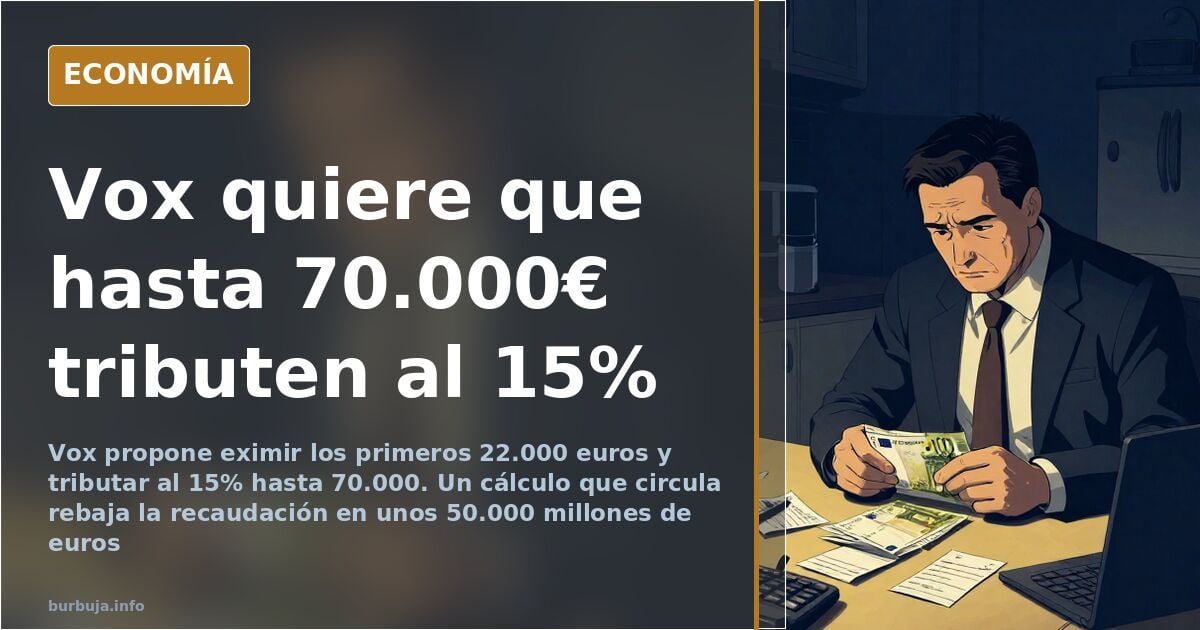
The fiscal proposal submitted by Vox's parliamentary group in the Congress of Deputies — antiestéticaturing an exemption threshold of €22,000, a flat 15% rate up to €70,000, and a 25% rate thereafter — has landed amid the aftermath of the budget negotiations and with the Spanish economy on autopilot. Deputy José María Figaredo defended the measure on television with the solemnity of someone handing out candies: lower taxes, more consumption, more activity. That is the usual script. The problem arises when someone picks up the calculator and sums the three holes the proposal itself creates: income tax, social security contributions, and public spending that no one wants to touch.
The arithmetic of 15%: two precipices and revenue that crashes
According to a calculation circulating in online forums, the income tax cut would result in lost revenue of between €30 billion and €45 billion annually. This figure, put in context, equals half of contributory pension spending or the entire health budget. Some argue that economic activation would compensate for the blow via VAT, corporate taxes, and special taxes. The most optimistic calculation assumes that money would circulate through the real economy and return through the back door. The pessimistic scenario starts from an uncomfortable reality: one-third of employees and nearly two-thirds of pensioners do not pay income tax, so the cut mainly benefits those who already pay, not those who do not make ends meet.
The technical detail no one disputes is that the proposal, as drafted, creates two fiscal precipices. A taxpayer earning €22,000 pays nothing; one earning €22,001 pays €3,300 and keeps €18,701. And between €70,000 and €70,001, the jump is even more brutal: from €10,500 to €17,500 in tax liability. In other words, working one euro more can cost you €1,300 net. No enemy of the taxpayer designs such a trap.
The elephant in the room: pensions, debt, and public spending
The discussion on tax cuts always hits the same wall. Consolidated public spending is around €600 billion, with pensions taking the largest share. Any tax cut not accompanied by an equivalent cut in spending is financed by debt, and debt is already at levels that make the European Central Bank tremble. The example of Liz Truss in the UK looms over the conversation: her attempt to cut taxes without balancing the accounts crashed the pound and sent it home in 49 days. No one here seems to have learned the lesson.
Some point out that political spending — salaries, advisors, fringe benefits — is a tiny fraction of the total. True. But it is also true that interest on the debt already consumes more budget than many ministries, and no one puts on the table which items will be cut. Vox's proposal, in practice, is a program of maxims: it knows it will not govern alone and that Brussels demands tax increases for any country under intervention.
Is it Vox, or the PP in a different suit?
The suspicion running through political circles is that the proposal is not meant to be applied, but to mark a profile. Vox needs to differentiate itself from the People's Party (PP) to the right, and tax cuts are the cheapest terrain. The PP already promised similar cuts when it governed and ended up raising VAT. The question no one answers is what would happen if Vox reached La Moncloa: with the current hole, any government cutting taxes by 30% would have to cut pensions or health care. And no one signs that.
The disconcerting detail is that the average income tax rate in Spain is already around 15%. In other words, Vox's proposal does not lower the average rate, it equalizes it. What it does is eliminate pogre and benefit high incomes. An engineer earning €60,000 would pay less; a worker earning less than €22,000 already paid nothing. The cut, in absolute terms, is a gift for those with the most.
The closing: where the analysis stalls
With these numbers, Vox's tax cut is mathematically possible only if someone cuts €50 billion from spending. No one has said from where. Neither Vox, nor the PP, nor those applauding the measure. The debate remains exactly where it started: in the headline, not the fine print.
The fiscal proposal submitted by Vox's parliamentary group in the Congress of Deputies — antiestéticaturing an exemption threshold of €22,000, a flat 15% rate up to €70,000, and a 25% rate thereafter — has landed amid the aftermath of the budget negotiations and with the Spanish economy on autopilot. Deputy José María Figaredo defended the measure on television with the solemnity of someone handing out candies: lower taxes, more consumption, more activity. That is the usual script. The problem arises when someone picks up the calculator and sums the three holes the proposal itself creates: income tax, social security contributions, and public spending that no one wants to touch.
The arithmetic of 15%: two precipices and revenue that crashes
According to a calculation circulating in online forums, the income tax cut would result in lost revenue of between €30 billion and €45 billion annually. This figure, put in context, equals half of contributory pension spending or the entire health budget. Some argue that economic activation would compensate for the blow via VAT, corporate taxes, and special taxes. The most optimistic calculation assumes that money would circulate through the real economy and return through the back door. The pessimistic scenario starts from an uncomfortable reality: one-third of employees and nearly two-thirds of pensioners do not pay income tax, so the cut mainly benefits those who already pay, not those who do not make ends meet.
The technical detail no one disputes is that the proposal, as drafted, creates two fiscal precipices. A taxpayer earning €22,000 pays nothing; one earning €22,001 pays €3,300 and keeps €18,701. And between €70,000 and €70,001, the jump is even more brutal: from €10,500 to €17,500 in tax liability. In other words, working one euro more can cost you €1,300 net. No enemy of the taxpayer designs such a trap.
The elephant in the room: pensions, debt, and public spending
The discussion on tax cuts always hits the same wall. Consolidated public spending is around €600 billion, with pensions taking the largest share. Any tax cut not accompanied by an equivalent cut in spending is financed by debt, and debt is already at levels that make the European Central Bank tremble. The example of Liz Truss in the UK looms over the conversation: her attempt to cut taxes without balancing the accounts crashed the pound and sent it home in 49 days. No one here seems to have learned the lesson.
Some point out that political spending — salaries, advisors, fringe benefits — is a tiny fraction of the total. True. But it is also true that interest on the debt already consumes more budget than many ministries, and no one puts on the table which items will be cut. Vox's proposal, in practice, is a program of maxims: it knows it will not govern alone and that Brussels demands tax increases for any country under intervention.
Is it Vox, or the PP in a different suit?
The suspicion running through political circles is that the proposal is not meant to be applied, but to mark a profile. Vox needs to differentiate itself from the People's Party (PP) to the right, and tax cuts are the cheapest terrain. The PP already promised similar cuts when it governed and ended up raising VAT. The question no one answers is what would happen if Vox reached La Moncloa: with the current hole, any government cutting taxes by 30% would have to cut pensions or health care. And no one signs that.
The disconcerting detail is that the average income tax rate in Spain is already around 15%. In other words, Vox's proposal does not lower the average rate, it equalizes it. What it does is eliminate pogre and benefit high incomes. An engineer earning €60,000 would pay less; a worker earning less than €22,000 already paid nothing. The cut, in absolute terms, is a gift for those with the most.
The closing: where the analysis stalls
With these numbers, Vox's tax cut is mathematically possible only if someone cuts €50 billion from spending. No one has said from where. Neither Vox, nor the PP, nor those applauding the measure. The debate remains exactly where it started: in the headline, not the fine print.
Summary of a discussion on Burbuja.info - Foro de economía, actualidad y política., translated from Spanish and reviewed before publication. Read the full discussion (179 replies).
More summaries
-
EU Jobs: 5,000€ Salary, But Years of Temporary Work First
A forum user asks about an EU administrator academy: AD5 pay is around 5,000€, but the usual path is entering first as a temporary agent.
-
Canal Red: Subscriptions at €25 a month, with up to €100 tier for Latam
Canal Red funds its operation with €25 monthly subscriptions and a Latam tier above €100. A model supporting an entire staff.
-
Spain's Supreme Court suspends Puigdemont's arrest warrant
Spain's Supreme Court provisionally suspends the arrest warrant for Carles Puigdemont pending the Constitutional Court's full ruling on the misappropriation amnesty.
-
Madrid Metro Debate: How Many Foreigners Live in the Capital?
A viral video sparks debate on foreign population in Madrid. Official data contrasts with online perceptions of demographic shifts in the metro.
-
Spain's Normalized Corruption: The Political Silence Pact
Corruption in Spain has become routine, shielded by a cross-party silence pact that ensures impunity and erodes institutional trust.
-
La Mina Shooting: Automatic Weapons and Trapped Residents
A clash between drug gangs in Sant Adrià de Besòs using automatic weapons leaves one injured. Interior Minister Núria Parlón faces immediate questioning.