
VOX pledges 15% income tax up to €70,000 and 25% above
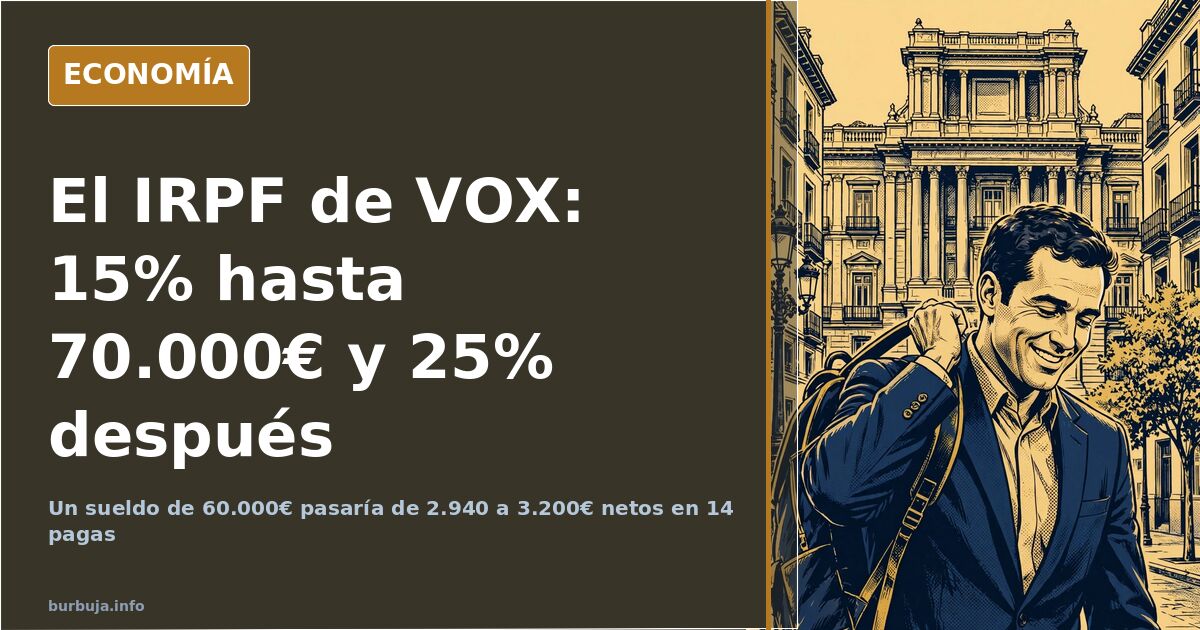
VOX proposes a 15% income tax rate up to €70,000 and 25% above. A €60,000 salary would rise from €2,940 to €3,200 net in 14 payments.
English · Original discussion in Spanish · Published
The income tax cut VOX promises and that is already costing them votes
How much does someone earning €60,000 lose per year? The question seems like an accounting exercise, but it is actually a political issue. With VOX’s proposal on the table — a flat rate of 15% for incomes below €70,000 and 25% for anything above that threshold — the calculation is no longer abstract. The problem is that the result changes depending on which paycheck you look at, and that is where almost all the disagreement starts.
What is VOX proposing for the income tax?
The plan, which cites brackets published by El Mundo, reduces the scale to just two rates. Everything earned below €70,000 would be taxed at 15%. Above that threshold, it would be taxed at 25%. Compared to the current system, the contrast is striking: according to a debate participant, a salary exceeding €60,000 already faces a marginal rate of 45% on the portion above that amount.
Moving from there to 15% or 25% is what has lit the fuse. The question that sparks the debate is not whether one should pay taxes, but how much and to whom. And here two things that are not the same are mixed: the marginal rate, which applies to the last bracket, and the effective rate, which spreads the burden over the entire income.
How much does the €60,000 paycheck really change?
Here lies the first misunderstanding. According to the calculation circulating in the thread, with the current income tax, a €60,000 salary, in a typical case — without dependents or other circumstances — amounts to around €2,940 net per month in 14 payments, applying an effective rate close to 24.5%. With the proposed 15%, that same estimate would raise it to about €3,200. The difference is around €260 monthly, not the nearly €1,400 sometimes attributed to the change.
This detail dismantles part of the catastrophist narrative, just as it dismantles excessive enthusiasm. The relief exists and is real, but it does not make anyone rich overnight. When the discussion uses figures the system itself cannot sustain, the debate loses its footing.
Is €60,000 a huge sum?
For part of the electorate, yes. For others, that amount describes a comfortable life, but far from opulence. The repeated case is that of the declared salary of €40,000 annually — €2,250 in 14 payments — which, it is argued, is not even enough to buy a flat by saving with any sense.
The problem is not just how much one earns, but how much it costs to live where one earns. The same paycheck weighs much more in a major city than in a small town, and that differential explains why two people with identical gross salaries perceive opposite economic realities. The label of “rich” depends on the map, not just the amount.
The 45% bracket and the disincentive to work more
A marginal rate of 45% on everything exceeding €60,000 disincentivizes extra income, claims a segment of the analysis. The case is recounted of someone who, upon crossing that threshold, stopped accepting teaching collaborations and consulting work because nearly half of every euro earned went to the tax authority. Preparing classes on weekends to keep half. Economically, the argument has weight; it also has limits.
The counter-objection is about government spending. Spanish public spending is around 50% of GDP, according to another participant. Sustaining an income tax cut without touching that spending forces a decision on what gets cut first: healthcare, education, highways, or firefighters are not funded by dividends, but by taxes. The reduction in social security contributions for self-employed workers — about €400 — comes up in the same conversation, as it too is a burden on the paycheck.
Gift or end of the robbery? The fight over pogre
The underlying clash is ideological. Some see pogre as a punishment for those who earn more: if you pay the same percentage, the higher earner already contributes more in absolute terms. Others respond that stopping tax increases is not rewarding anyone, but simply not confiscating, and that calling a tax cut a gift twists the language.
At the opposite extreme, some defend a single tax rate for all brackets appealing to formal equality. And some warn that, with the promise on the table, what is likely is not the full cut, but staying at a fraction of what was announced. With that expectation, even a half cut is read as a victory.
What happens to the wavering voter?
The start of all this discussion is a person who had thought of voting for VOX and now thinks twice precisely on this point: they approve almost everything in the program except the fiscal liberalism. Their objection is not technical, but about distribution. They resent that a system change gives away more money, in percentage terms, to those who already earn well. It is an uncomfortable position within their own field.
In the end, the doubt is not resolved with a calculator, but with priorities. And the undecided voter usually ends up where they started: without a clear ballot.
With a promised 15% and a 50% of GDP already paid, the calculation does not add up for anyone. The most honest thing would be to admit that we do not even know what percentage of the cut would be approved.
How much does someone earning €60,000 lose per year? The question seems like an accounting exercise, but it is actually a political issue. With VOX’s proposal on the table — a flat rate of 15% for incomes below €70,000 and 25% for anything above that threshold — the calculation is no longer abstract. The problem is that the result changes depending on which paycheck you look at, and that is where almost all the disagreement starts.
What is VOX proposing for the income tax?
The plan, which cites brackets published by El Mundo, reduces the scale to just two rates. Everything earned below €70,000 would be taxed at 15%. Above that threshold, it would be taxed at 25%. Compared to the current system, the contrast is striking: according to a debate participant, a salary exceeding €60,000 already faces a marginal rate of 45% on the portion above that amount.
Moving from there to 15% or 25% is what has lit the fuse. The question that sparks the debate is not whether one should pay taxes, but how much and to whom. And here two things that are not the same are mixed: the marginal rate, which applies to the last bracket, and the effective rate, which spreads the burden over the entire income.
How much does the €60,000 paycheck really change?
Here lies the first misunderstanding. According to the calculation circulating in the thread, with the current income tax, a €60,000 salary, in a typical case — without dependents or other circumstances — amounts to around €2,940 net per month in 14 payments, applying an effective rate close to 24.5%. With the proposed 15%, that same estimate would raise it to about €3,200. The difference is around €260 monthly, not the nearly €1,400 sometimes attributed to the change.
This detail dismantles part of the catastrophist narrative, just as it dismantles excessive enthusiasm. The relief exists and is real, but it does not make anyone rich overnight. When the discussion uses figures the system itself cannot sustain, the debate loses its footing.
Is €60,000 a huge sum?
For part of the electorate, yes. For others, that amount describes a comfortable life, but far from opulence. The repeated case is that of the declared salary of €40,000 annually — €2,250 in 14 payments — which, it is argued, is not even enough to buy a flat by saving with any sense.
The problem is not just how much one earns, but how much it costs to live where one earns. The same paycheck weighs much more in a major city than in a small town, and that differential explains why two people with identical gross salaries perceive opposite economic realities. The label of “rich” depends on the map, not just the amount.
The 45% bracket and the disincentive to work more
A marginal rate of 45% on everything exceeding €60,000 disincentivizes extra income, claims a segment of the analysis. The case is recounted of someone who, upon crossing that threshold, stopped accepting teaching collaborations and consulting work because nearly half of every euro earned went to the tax authority. Preparing classes on weekends to keep half. Economically, the argument has weight; it also has limits.
The counter-objection is about government spending. Spanish public spending is around 50% of GDP, according to another participant. Sustaining an income tax cut without touching that spending forces a decision on what gets cut first: healthcare, education, highways, or firefighters are not funded by dividends, but by taxes. The reduction in social security contributions for self-employed workers — about €400 — comes up in the same conversation, as it too is a burden on the paycheck.
Gift or end of the robbery? The fight over pogre
The underlying clash is ideological. Some see pogre as a punishment for those who earn more: if you pay the same percentage, the higher earner already contributes more in absolute terms. Others respond that stopping tax increases is not rewarding anyone, but simply not confiscating, and that calling a tax cut a gift twists the language.
At the opposite extreme, some defend a single tax rate for all brackets appealing to formal equality. And some warn that, with the promise on the table, what is likely is not the full cut, but staying at a fraction of what was announced. With that expectation, even a half cut is read as a victory.
What happens to the wavering voter?
The start of all this discussion is a person who had thought of voting for VOX and now thinks twice precisely on this point: they approve almost everything in the program except the fiscal liberalism. Their objection is not technical, but about distribution. They resent that a system change gives away more money, in percentage terms, to those who already earn well. It is an uncomfortable position within their own field.
In the end, the doubt is not resolved with a calculator, but with priorities. And the undecided voter usually ends up where they started: without a clear ballot.
With a promised 15% and a 50% of GDP already paid, the calculation does not add up for anyone. The most honest thing would be to admit that we do not even know what percentage of the cut would be approved.
Also available in: Deutsch
Summary of a discussion on Burbuja.info - Foro de economía, actualidad y política., translated from Spanish and reviewed before publication. Read the full discussion (294 replies).
More summaries
-
Ceuta exposes contradictions in Frente Obrero and Vaquero
Roberto Vaquero's absence from Ceuta sparks criticism, raising questions about the coherence of his communist dissent.
-
Pornhub’s VP is an Orthodox Rabbi: The Ethical Paradox
Solomon Friedman, an ordained Orthodox rabbi, serves as Pornhub’s vice president, sparking debate on ethics, parental responsibility, and the adult industry’s influence.
-
Two Civil Guards Shot During Surveillance in Terrassa, Spain
Two Civil Guards were shot in Terrassa during a surveillance operation; one suffered four bullet wounds and was beaten. The incident highlights security concerns in Spain.
-
Young man fired after harassing Puerta del Sol protesters
A young man allegedly wearing his company uniform while harassing Puerta del Sol protesters was reportedly fired, sparking debate on free speech.
-
Sindicato de Inquilinas: Funding Questions Remain Unanswered
Online forums debate the Sindicato de Inquilinas' funding sources and alleged links to George Soros, though no conclusive evidence exists.
-
Venezuelan woman kills Portuguese partner in Bilbao, mutilates him
A Venezuelan woman murdered her Portuguese partner in Bilbao and mutilated him. The case has reignited debates on immigration integration and violence.