
Vox Leads in Andalusia and Valencia, Wins Among Under-45s
Poll shows Vox as the leading force in Andalusia and Valencia, with over 20%, PSOE at 19%. What's behind the numbers.
English · Original discussion in Spanish · Published
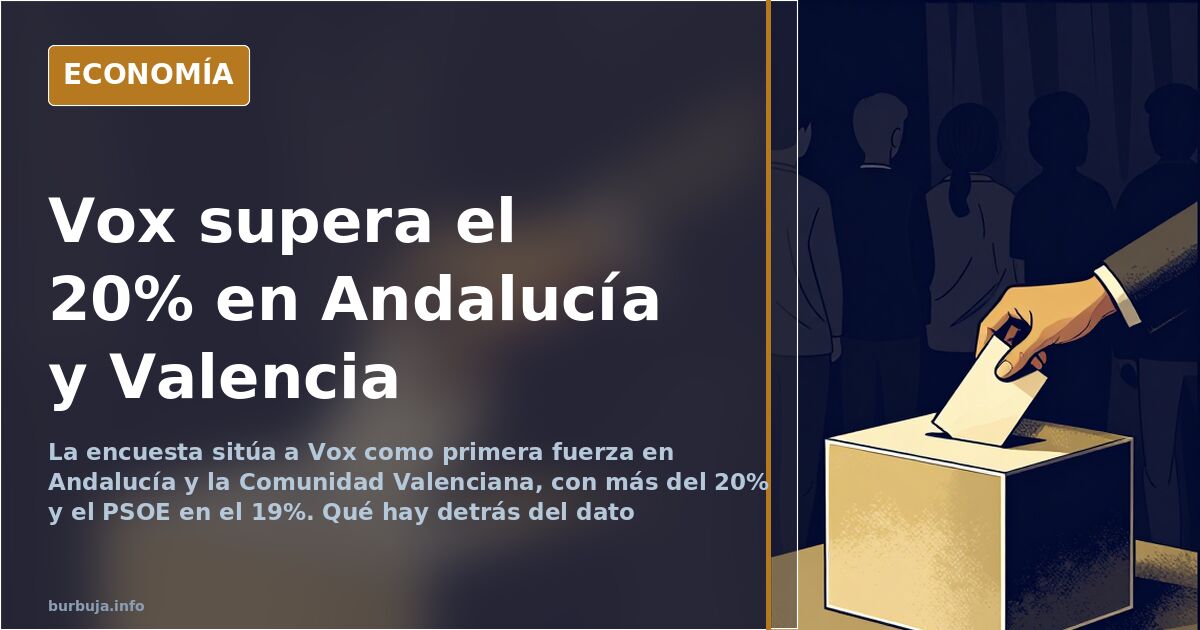
Vox is now the leading force in Andalusia and Valencia
Vox is no longer a party people vote for reluctantly. According to polls reported in the national press, Santiago Abascal's party is the leading choice in voting intention in Andalusia and the Valencian Community, exceeding 20% in both regions and with a lead of over four points. The PSOE is at 19% and falls to third place in both communities. The survey is online, with 2,000 participants, and this detail matters: it measures a trend, it doesn't translate into seats.
What is significant is the pattern. The advantage isn't confined to a single territory or age group. It repeats where the PP had built its narrative of hegemony and is concentrated among younger voters and men.
What the poll says and what it misses
In Andalusia and the Valencian Community, Vox surpasses 20% in voting intention and leads the next party by more than four points. The PSOE, suffering setbacks in both territories, remains at 19% and becomes the third option after the PP and Abascal's party. These are figures from an online survey of 2,000 people, and it's worth repeating because the number is being read in many places as if elections had already occurred.
The text that serves as a starting point for discussion, signed by a national media outlet, describes Alvise Pérez with a disqualifying label. This seemingly minor detail fuels the distrust of a segment of the public towards the framework through which the press presents the phenomenon. When the packaging is more bothersome than the data, the data is discussed less than it should be.
Vox also wins among under-45s and among men
The headline supporting this thesis isn't limited to the regional map. The party also leads among voters under 45 years old and among men across Spain. This is the uncomfortable part for the two parties that have shared power since the Transition.
One line of analysis explains this by the exhaustion of the institutional narrative: those voting for the first time don't remember any government that has solved their lives, and the argument of the useful vote loses strength when the useful one doesn't deliver. Another, more skeptical reading, suggests it's a protest vote with an expiration date, incapable of sustaining stable majorities. Both could be true simultaneously.
Andalusia and Valencia: when the PP ceases to be hegemonic
In Andalusia, the right has been in government for years, and the antiestéticar of change has gradually dissipated. The Andalusian PSOE is losing votes, and the left to its left isn't recovering what's being lost either. The result is a board where the party that considered itself the arbiter now becomes a competitor on its own turf.
The chainsaw and public spending
The economic argument that mobilizes the most votes is that of cuts. The promise to apply the chainsaw to public spending works during campaigns but becomes complicated in the Official State Gazette (BOE). Some warn that the scissors won't achieve much: when there's no money to pay pensions and public sector salaries, they will simply stop being paid, and then a state of alarm will trinc. The comparison with Argentina appears in almost all conversations, in both directions: as a warning and as a mirror.
Who should vote: the proposal that arises when the result is not liked
In parallel to the electoral data, a current is circulating that proposes restricting suffrage: linking it to having paid taxes, having completed military service, or having no incivil record. It's a proposal with no institutional traction and contrary to universal suffrage, but it says a lot about how the result is being interpreted in certain sectors.
With these numbers, the PP faces a decision that admits no half-measures: compete for the same voter or make pacts from a distance. If the trend continues, Andalusia and Valencia will cease to be the centrist-right's firewall. If the poll deflates, it will remain a snapshot of a passing anger. What seems fruta is that this 20% no longer votes reluctantly, and that forces a rewriting of scripts in three capitals simultaneously.
Methodological note: the percentages cited come from an online survey of 2,000 interviews and do not equate to electoral results.
Vox is no longer a party people vote for reluctantly. According to polls reported in the national press, Santiago Abascal's party is the leading choice in voting intention in Andalusia and the Valencian Community, exceeding 20% in both regions and with a lead of over four points. The PSOE is at 19% and falls to third place in both communities. The survey is online, with 2,000 participants, and this detail matters: it measures a trend, it doesn't translate into seats.
What is significant is the pattern. The advantage isn't confined to a single territory or age group. It repeats where the PP had built its narrative of hegemony and is concentrated among younger voters and men.
What the poll says and what it misses
In Andalusia and the Valencian Community, Vox surpasses 20% in voting intention and leads the next party by more than four points. The PSOE, suffering setbacks in both territories, remains at 19% and becomes the third option after the PP and Abascal's party. These are figures from an online survey of 2,000 people, and it's worth repeating because the number is being read in many places as if elections had already occurred.
The text that serves as a starting point for discussion, signed by a national media outlet, describes Alvise Pérez with a disqualifying label. This seemingly minor detail fuels the distrust of a segment of the public towards the framework through which the press presents the phenomenon. When the packaging is more bothersome than the data, the data is discussed less than it should be.
Vox also wins among under-45s and among men
The headline supporting this thesis isn't limited to the regional map. The party also leads among voters under 45 years old and among men across Spain. This is the uncomfortable part for the two parties that have shared power since the Transition.
One line of analysis explains this by the exhaustion of the institutional narrative: those voting for the first time don't remember any government that has solved their lives, and the argument of the useful vote loses strength when the useful one doesn't deliver. Another, more skeptical reading, suggests it's a protest vote with an expiration date, incapable of sustaining stable majorities. Both could be true simultaneously.
Andalusia and Valencia: when the PP ceases to be hegemonic
In Andalusia, the right has been in government for years, and the antiestéticar of change has gradually dissipated. The Andalusian PSOE is losing votes, and the left to its left isn't recovering what's being lost either. The result is a board where the party that considered itself the arbiter now becomes a competitor on its own turf.
The chainsaw and public spending
The economic argument that mobilizes the most votes is that of cuts. The promise to apply the chainsaw to public spending works during campaigns but becomes complicated in the Official State Gazette (BOE). Some warn that the scissors won't achieve much: when there's no money to pay pensions and public sector salaries, they will simply stop being paid, and then a state of alarm will trinc. The comparison with Argentina appears in almost all conversations, in both directions: as a warning and as a mirror.
Who should vote: the proposal that arises when the result is not liked
In parallel to the electoral data, a current is circulating that proposes restricting suffrage: linking it to having paid taxes, having completed military service, or having no incivil record. It's a proposal with no institutional traction and contrary to universal suffrage, but it says a lot about how the result is being interpreted in certain sectors.
With these numbers, the PP faces a decision that admits no half-measures: compete for the same voter or make pacts from a distance. If the trend continues, Andalusia and Valencia will cease to be the centrist-right's firewall. If the poll deflates, it will remain a snapshot of a passing anger. What seems fruta is that this 20% no longer votes reluctantly, and that forces a rewriting of scripts in three capitals simultaneously.
Methodological note: the percentages cited come from an online survey of 2,000 interviews and do not equate to electoral results.
Summary of a discussion on Burbuja.info - Foro de economía, actualidad y política., translated from Spanish and reviewed before publication. Read the full discussion (203 replies).
More summaries
-
Valencia's DANA overwhelms the economy of Ribera and l'Horta
The Poyo rambla reached 1,686 m³/s at 6:20 PM, but the mobile alert sounded at 8:00 PM: DANA overwhelms Valencian economy and official narrative.
-
Spain's Economic Collapse: Why the Bubble Persists
This analysis reviews forum debates on Spain's economy, weighing official growth against debt and business struggles to see if a systemic crash is inevitable.
-
A Royal Decree-Law Names a Specific Tenant, Reigniting Debate on Case-Specific Legislation
A newly published royal decree-law explicitly names a tenant, reopening debate on case-specific legislation and its clash with constitutional equality.
-
Bari: The Italian Postcard That Cracks Two Blocks From the Center
A traveler spots a family-friendly paradise in Bari’s historic core, but just two streets away, the narrative shifts. Italy vs. Spain compared.
-
Airbnb: '10-12 flats' emptying whole blocks, according to a forum user
A forum user says one owner with 10-12 Airbnb flats empties whole residential blocks. In Lugo or Teruel, prices also rise without mass tourism.
-
Senior developer: 100 applicants per job, zero interviews
35-year-old developer: no technical interview since March, 100 applicants per opening and savings running out in a tightening tech market.