
Vox faces Ciudadanos' mirror after electoral defeat
The PP and Vox face a post-electoral phase where arithmetic leaves Vox with fewer than 50 MPs, sparking debate on Abascal's future.
English · Original discussion in Spanish · Published
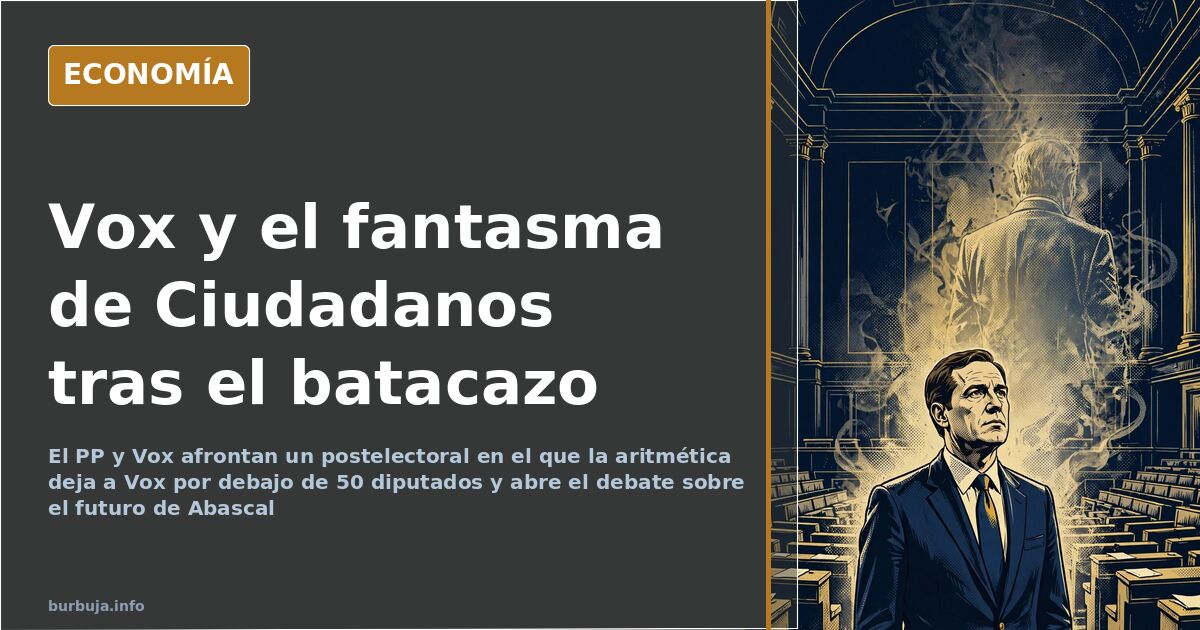
Vox and the Ciudadanos mirror: Abascal's future in doubt
A party with fewer than 50 MPs cannot file constitutional appeals or force motions of no confidence. The arithmetic leaves Vox as a quieter actor in the House, which is bad news for a formation built on media noise. After elections where the right gained votes but not government, analysis has shifted to the uncomfortable question: what happens now with Abascal and his party? The answer is unwritten, but the diagnosis of failure is being discussed openly.
The post-electoral: fewer seats and more questions
The diagnosis of the defeat is not unanimous. One part of the analysis points to PP campaign errors, which sold antiestéticar of Vox, thinking it would steal votes, but ended up mobilizing the left and generating abstention among their own electorate by blurring differences with the PSOE. There is talk of overconfidence, of believing they had won before counting the votes, and of a party that spent the campaign speaking ill of its natural partner.
Some argue the problem is with Vox. If Abascal leaves, Vox ends, summarizes one of the most repeated theses, comparing the formation with Ciudadanos and Podemos. Without the charismatic leader, according to this reading, both disintegrated. The doubt is significant when the brand has been personalized in Santiago Abascal and calls for a change are coming from within the right itself. In contrast, the party's defense is clear: without Abascal, there is no possible Vox.
The PP and the temptation to eliminate the partner
Criticism of the popular strategy is sharper. According to several analyses, the PP put more energy into distancing itself from its natural partner than attacking the real adversary. The offer to govern with Sánchez if it gained one more vote appears in conversation as proof of that beginner's error. It seems as if the main goal of the PP and PSOE was to eliminate VOX, summarizes one of the most repeated hypotheses.
Behind this lies a numerical paradox that is disorienting: the PP and Vox gained more votes than the PSOE and Sumar, but the distribution by provinces and the turnaround in Catalonia left the parliamentary majority elsewhere. The difference between winning votes and winning seats is the knot of all the disenchantment, and explains why the same electorate that sees its block gaining votes does not see it gaining government.
The economic cost of the official narrative
Here the tone changes. One current holds that socialism wins because it buys votes with what it calls social rights, and when the money runs out, the electoral base will stay home. The scenario being managed is that Sánchez receives nearly 100 billion euros in the next three years, according to this reading via debt and not real growth, with the consequent increase in prices and debt.
On the other side, the response is firm: they have boasted about the coalition government and the agreed social advances, and the electorate is not stupid. If anything, the reproach is that the right has not known how to connect with the working voter it claims to represent. And there are also those who use the fiscal archive: more income tax, more property tax, more municipal tax, car insurance hikes, the shopping basket almost doubled, energy almost doubled. This is the shopping list turned into an argument against the narrative of social advances, and it works because it needs no translation.
What happens with Vox and Abascal?
The comparison with Ciudadanos is the most used resource. With fewer than 50 MPs, Vox loses key parliamentary tools and, according to this thesis, much of its ability to make noise. Tic, tac, it is read, the time is over.
Other analyses, however, believe a window has peine for Vox: with the left governing and the PP unclear on its direction, the space of frustration remains intact. The problem would not be demand, but the product: a leadership questioned by some and protected by others. The most repeated defense is that Abascal is written off as an electoral asset and that the party cannot survive without him. Irony runs through both positions: some give the leader for dead, others the party.
Meanwhile, the PP remains unclear on what its electorate will do with abstention: whether it will mobilize again out of antiestéticar of the far-right or whether resignation will set in among those who see the two big parties looking more and more alike. This calculation is as important as that of the seats.
The open question remains
The scenario is uncomfortable for everyone. A Government with fewer seats than the opposing block, a Vox forced to reinvent itself without the tools that gave volume to its discourse, and a PP that has not fully explained its defeat or its future. Has the anger passed, or has the countdown to the next electoral appointment only just begun?
Also available in: Deutsch
Summary of a discussion on Burbuja.info - Foro de economía, actualidad y política., translated from Spanish and reviewed before publication. Read the full discussion (325 replies).
More summaries
-
Sánchez weighs November 29 if housing decrees fall
Government and PSOE members point to November 29 as the earliest possible date for a snap election in Spain if Congress rejects the housing decrees.
-
Spain's minimum income benefit to rise 14% in 2027, tied to non-contributory pensions
Spain's IMV minimum income will rise almost 14% in 2027 due to its legal link to non-contributory pensions: from 733.60 to 836 euros per month for a single person.
-
Spain's amazing home-grown architecture: beyond PAKISMO, the GRECOPAKISMO
We take a look at the GRECOPAKISMO phenomenon: when Spain's home-grown architecture tries to imitate luxury mansions with results that defy property logic.
-
They never learn: US strikes again with military attacks
Analysis of how geopolitical instability and military attacks fuel speculation in the oil market and international stock exchanges.
-
How did Enrique Riquelme make his fortune in Spain?
We examine the rise of Enrique Riquelme: from selling sand in Panama to large-scale solar projects and his bid for the Real Madrid presidency.
-
Empire in Collapse: What the Gulf War Teaches Europe
The war with Iran destroys US bases, challenges the petrodollar and leaves Israel on the brink of collapse. Lessons for a Europe with no defenses or currency of its own.