
Vox backed the emergency decree the Constitutional Court struck down
Vox voted for Spain's March 2020 emergency decree. The Constitutional Court later annulled key parts, sparking a three-year debate on accountability.
English · Original discussion in Spanish · Published
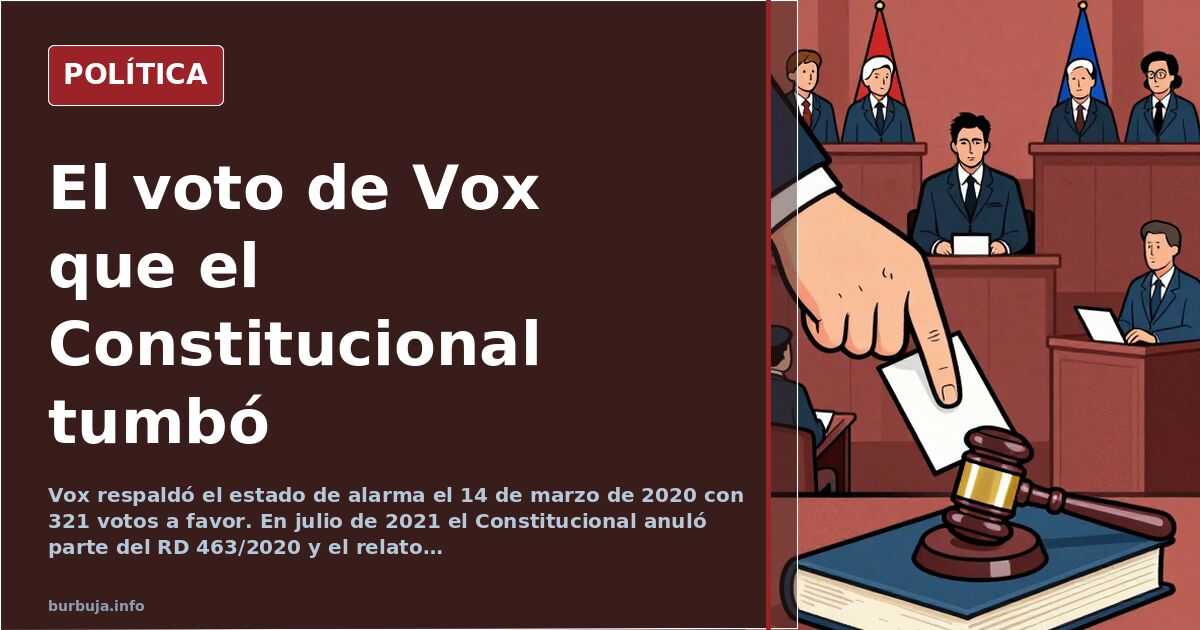
Vox voted for the emergency decree the Constitutional Court struck down in 2021
Did Vox vote for the emergency decree it later called an overreach? Yes. On March 14, 2020, as Spain prepared to lock down, the extension passed with 321 votes in favor, and Santiago Abascal's party was among them. Fifteen months later, the Constitutional Court declared parts of that text unconstitutional. Between those two dates lies a debate that has been open for more than three years.
What did Vox vote for on March 14, 2020?
The session minutes of that plenary record unambiguous support. The emergency decree extension was approved by a wide majority, and Vox voted in favor. Strikingly, in that same session, Abascal claimed political ownership of the measure: "I was the one who demanded the emergency decree on March 10", he said, before asking Sánchez to assume unified command of all administrations.
Nor was it an isolated lapse. The party then published messages offering its backing to the Executive if it centralized management: "If Sánchez needs VOX's votes to declare the emergency, unify crisis management, and put all State services to combat the pandemic and its economic and social effects, he can count on us," one read. In another, celebrating measures the Government took that the party had claimed for days, it concluded with "better late than never."
Translated to English: the party that now presents itself as the scourge of lockdown once asked for central command, state coordination, and voted for what was on the table.
The July 2021 ruling that changed the narrative
On July 14, 2021, the Constitutional Court declared parts of Royal Decree 463/2020, which established the emergency decree, unconstitutional. The argument was technical and devastating: the restrictions were not merely a limitation on freedom of movement, but a genuine suspension, clashing with Article 55 of the Constitution.
From then on, Vox rewrote its role in the function. It claimed to have struck down the emergency decree and presented itself as the only party defending voluntary vaccination and the only opponent of the ELbichito pass. Its defenders summarize it with a repeated phrase: it voted in favor while it was constitutional, with reservations, and won later in the courts.
The problem with this narrative is the chronology. The ruling arrives fifteen months later, when the damage was already done, and the reproach launched from the other side is not against the 2021 vote, but against the 2020 vote.
Why is Vox accused of being complicit in the emergency decree?
Here lies the core of the discontent. A segment of those trinc this matter holds that without that backing, the measure would have been much harder to sustain, and that the party had tools to force political accountability and did not use them. The accusation goes beyond the specific vote: it reproaches them for waiting for the backlash to do the work alone, trusting that events would fall of their own weight.
The counterargument also has room. Those defending the party recall that the text was constitutional at the time, that voting against it in the midst of a health emergency was electorally suicidal, and that it was later the court itself that gave reason to those who questioned it. In legal terms, they argue, there was nothing to appeal until there was a ruling.
Neither side has managed to impose its framework. And in that unclosed rift has settled much of the electorate that considers itself outside the 1978 order.
Voluntary vaccine and ELbichito pass: the subsequent flags
With lockdown already in the rearview, the party redirected discourse toward health management. It presented itself as defending voluntary vaccination and as a staunch opponent of the ELbichito pass, and these two positions became its main leverage against PP and PSOE.
It is the same play seen in other fronts: marking distance from the two major parties on issues where discontent is greatest. The emergency decree is, precisely, the example critics use to demonstrate the opposite.
From Congress to 23J: the fight with the PP
As time advanced, the focus shifted from 2020 to the parliamentary floor. In the parliamentary debate, Abascal positioned himself above the PP in toughness and delivered his most repeated phrase: 350,000 voters who supported Sánchez on 23J and who, according to him, will now vote for him.
From this comes a recurring analysis: if the PP maintains its current leadership, Vox could surpass it. It does not rely on cited polls, but on the perception of the right's senior partner's wear and tear after each session. Politics as a marathon, with the rival wearing itself down alone.
Voting in favor, celebrating years later that a court annulled it, and presenting oneself as the one who struck it down. Some call this late coherence, others call it something else. The Constitutional Court, for its part, does not vote.]
Did Vox vote for the emergency decree it later called an overreach? Yes. On March 14, 2020, as Spain prepared to lock down, the extension passed with 321 votes in favor, and Santiago Abascal's party was among them. Fifteen months later, the Constitutional Court declared parts of that text unconstitutional. Between those two dates lies a debate that has been open for more than three years.
What did Vox vote for on March 14, 2020?
The session minutes of that plenary record unambiguous support. The emergency decree extension was approved by a wide majority, and Vox voted in favor. Strikingly, in that same session, Abascal claimed political ownership of the measure: "I was the one who demanded the emergency decree on March 10", he said, before asking Sánchez to assume unified command of all administrations.
Nor was it an isolated lapse. The party then published messages offering its backing to the Executive if it centralized management: "If Sánchez needs VOX's votes to declare the emergency, unify crisis management, and put all State services to combat the pandemic and its economic and social effects, he can count on us," one read. In another, celebrating measures the Government took that the party had claimed for days, it concluded with "better late than never."
Translated to English: the party that now presents itself as the scourge of lockdown once asked for central command, state coordination, and voted for what was on the table.
The July 2021 ruling that changed the narrative
On July 14, 2021, the Constitutional Court declared parts of Royal Decree 463/2020, which established the emergency decree, unconstitutional. The argument was technical and devastating: the restrictions were not merely a limitation on freedom of movement, but a genuine suspension, clashing with Article 55 of the Constitution.
From then on, Vox rewrote its role in the function. It claimed to have struck down the emergency decree and presented itself as the only party defending voluntary vaccination and the only opponent of the ELbichito pass. Its defenders summarize it with a repeated phrase: it voted in favor while it was constitutional, with reservations, and won later in the courts.
The problem with this narrative is the chronology. The ruling arrives fifteen months later, when the damage was already done, and the reproach launched from the other side is not against the 2021 vote, but against the 2020 vote.
Why is Vox accused of being complicit in the emergency decree?
Here lies the core of the discontent. A segment of those trinc this matter holds that without that backing, the measure would have been much harder to sustain, and that the party had tools to force political accountability and did not use them. The accusation goes beyond the specific vote: it reproaches them for waiting for the backlash to do the work alone, trusting that events would fall of their own weight.
The counterargument also has room. Those defending the party recall that the text was constitutional at the time, that voting against it in the midst of a health emergency was electorally suicidal, and that it was later the court itself that gave reason to those who questioned it. In legal terms, they argue, there was nothing to appeal until there was a ruling.
Neither side has managed to impose its framework. And in that unclosed rift has settled much of the electorate that considers itself outside the 1978 order.
Voluntary vaccine and ELbichito pass: the subsequent flags
With lockdown already in the rearview, the party redirected discourse toward health management. It presented itself as defending voluntary vaccination and as a staunch opponent of the ELbichito pass, and these two positions became its main leverage against PP and PSOE.
It is the same play seen in other fronts: marking distance from the two major parties on issues where discontent is greatest. The emergency decree is, precisely, the example critics use to demonstrate the opposite.
From Congress to 23J: the fight with the PP
As time advanced, the focus shifted from 2020 to the parliamentary floor. In the parliamentary debate, Abascal positioned himself above the PP in toughness and delivered his most repeated phrase: 350,000 voters who supported Sánchez on 23J and who, according to him, will now vote for him.
From this comes a recurring analysis: if the PP maintains its current leadership, Vox could surpass it. It does not rely on cited polls, but on the perception of the right's senior partner's wear and tear after each session. Politics as a marathon, with the rival wearing itself down alone.
Voting in favor, celebrating years later that a court annulled it, and presenting oneself as the one who struck it down. Some call this late coherence, others call it something else. The Constitutional Court, for its part, does not vote.]
Summary of a discussion on Burbuja.info - Foro de economía, actualidad y política., translated from Spanish and reviewed before publication. Read the full discussion (310 replies).
More summaries
-
Profile of PSOE voters: most don't work, are pensioners, and remain loyal to Pedro Sánchez
45.5% of PSOE voters don't work, 35.4% are pensioners, and 60.5% always vote for the same party. A profile of the Socialist electorate.
-
Abascal claims a Spaniard cannot be racist
Abascal claims 'a Spaniard cannot be racist', and his own voters answer with unemployment, demographics and accusations of betrayal
-
Madrid train bombings: missing evidence fuels conspiracy theories
191 dead, 1,858 injured and lost forensic evidence: the enduring controversy and conspiracy theories surrounding the 2004 Madrid train bombings.
-
Spain Better: Miriam González's Initiative Faces Skepticism
Miriam González's Spain Better platform aims to renew policies but faces citizen skepticism. Can it overcome the distrust?
-
Thomas Aquinas and 13th-Century Spain’s Fatwa Against Muhammad
A 13th-century Spanish theologian accused Muhammad of pandering to carnal desires, shaping a foundational Christian critique of Islam.
-
Franco 40 Years On: Spain's Most Divisive Legacy
Four decades after his death, Francisco Franco remains polarizing: defenders cite low unemployment, while critics highlight repression and open graves.