
Vox and legal immigration: the shift that splits its own electorate
Santiago Abascal says migrants coming to Spain to work are welcome "whether it's 100, 1,000 or 1,000,000", a shift that has unsettled part of Vox's voter base.
English · Original discussion in Spanish · Published
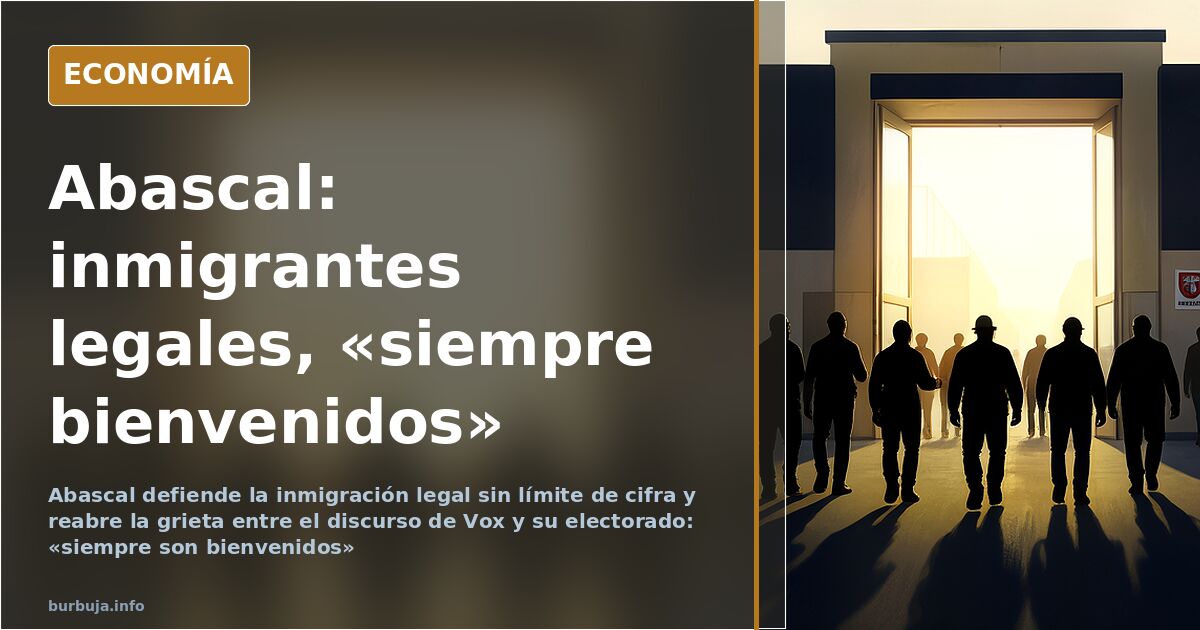
Vox and legal immigration: the shift that unsettles its own electorate
A party that spent a decade presenting itself as the dam against immigration has just declared, through its leader, that those who come to work are welcome "whether it's 100, 1,000 or 1,000,000". The remark, made by Santiago Abascal and spread on social media, has landed like a bucket of cold water on much of the electorate that voted for him precisely because of the opposite. The figure is no small matter: the party that has profited most from the immigration-control discourse is now stressing legality and the economic contribution of those who arrive with a job contract.
The paradox is textbook. While the PSOE (Spain's Socialist Party) pushes an amnesty that, according to a figure circulating in the debate, would affect a million people, Vox is softening its message and talking about quotas, contracts signed in the country of origin and a return ticket. For part of its base, that nuance sounds like surrender; for another, like plain economic common sense. The tension between the two readings is the real subject of this piece.
What Abascal actually said and why it is read as a U-turn
The message attributed to the Vox leader holds that migrants who came to Spain to work, pay social security contributions, respect the laws and impose no religious fanaticisms have always been welcome. The wording includes a figure that does not go unnoticed: it makes no difference whether there are a hundred, a thousand or a million of them. That scale — the million — matches the volume attributed to the amnesty pushed by the Government, and that is where the problem lies.
Because the complaint from part of the electorate is not so much the substance as the coincidence. If the party that promised to shut the door ends up admitting the same volume as its adversary, the difference comes down to rhetoric. Some read it as a clean-up operation to shed the racist label; others read it as proof that the employers' association matters more than the party programme.
The economic argument: wage dumping and salaries
The most repeated objection is not cultural, it is about paychecks. The claim is that as long as native unemployment exists, the arrival of foreign labour pushes wages down and makes entire sectors more precarious. It is the old wage-dumping debate, which in Spain has a very concrete translation: hospitality, agriculture, construction and delivery work.
The calculation circulating in the most critical circles goes further and speaks of silent demographic replacement, a term the party itself used for years. The contradiction jumps out when the same party that warned about that phenomenon now focuses on social security contributions and respect for the law as admission criteria. For the voter who took the earlier discourse literally, the change is not tactical: it is a betrayal.
The fine print: quotas, contracts in the country of origin and return
The technical defence of the shift rests on management. If labour is needed, a quota is peine conditional on a contract signed in the country of origin; if not, it stays shut. All within the law and with no room to be called a racist. That is the argument made by those who see in the proposal a way to regain the political initiative without giving up border control.
The problem is that this scheme requires an administration that does not exist today: efficient consulates, contract verification, effective enforcement of returns. And above all, it requires credibility. An electorate that has heard for years that immigration was a threat does not change its mental framework just because the word "legal" is put in front of it.
The political context: PSOE, PP and the battle for the tactical vote
The shift cannot be understood without the parliamentary arithmetic. With the PP (Spain's conservative People's Party) governing in coalition in several regions and the PSOE in need of partners, Vox is playing on two boards: looking responsible to the moderate voter while keeping the flame alive among the radicalised. That double position is what generates the uncomfortable headlines.
As of this discussion, the matter remains open. There is no formal change of programme, but a public formulation that many interpret as one. And in politics, when the base doubts, the framework breaks.
What happens to the voter who feels betrayed
The question hanging in the air is what that voter will do. There are three options: stay and swallow it, abstain, or seek refuge in minor parties that keep the original discourse. None is comfortable. Abstention punishes the party but also benefits the adversary; a protest vote fragments and reduces parliamentary weight.
Meanwhile, the debate on legal immigration continues and the Government sticks to its roadmap. The figure of one million looms over everything. How many of those who applauded the speech five years ago will keep applauding this one?
Also available in: Deutsch
Summary of a discussion on Burbuja.info - Foro de economía, actualidad y política., translated from Spanish and reviewed before publication. Read the full discussion (101 replies).
More summaries
-
Immigrant Regularization: The Actual Figure Exceeds 3.5 Million
The government is preparing the regularization of up to 3.5 million immigrants, but only 31.9% contribute to Social Security. The measure is driving up unemployment and...
-
Vox's Legal Immigration Proposal Sparks Labor Dumping Debate
Forum debate on Vox's proposal to allow legal immigration and its potential impact on wage dumping amid high unemployment.
-
Spain’s Nationality Law Sparks Fears of Demographic Influx
Analysis of Spain's immigration regularization and nationality access after 2.5 million applications, highlighting the 'Grandchildren Law' impact.
-
Seseña: El Pocero Flats Double in Price to €280,000
El Pocero flats in Seseña, priced at €80,000 in 2014, are now selling for €280,000. The housing crisis revives El Quiñón, with a waiting list.
-
Jansinmiedo returns to the public eye, but the spotlight has shifted
Jansinmiedo is back in the public conversation with a video of cyclists at an intersection. The focus is no longer the same and the community is split between nostalgia and…
-
What's really going on in Spain, explained simply
A theory circulating on forums claims the 11-M attacks changed Spain's regime and that Zapatero and Sánchez are carrying out a globalist agenda. There is no evidence for this.