
Voters forced to grab VOX ballots in full view, breaching secrecy
Voters report having to take VOX ballots from the table in front of agents, breaking voting secrecy in Spain's local and regional elections.
English · Original discussion in Spanish · Published
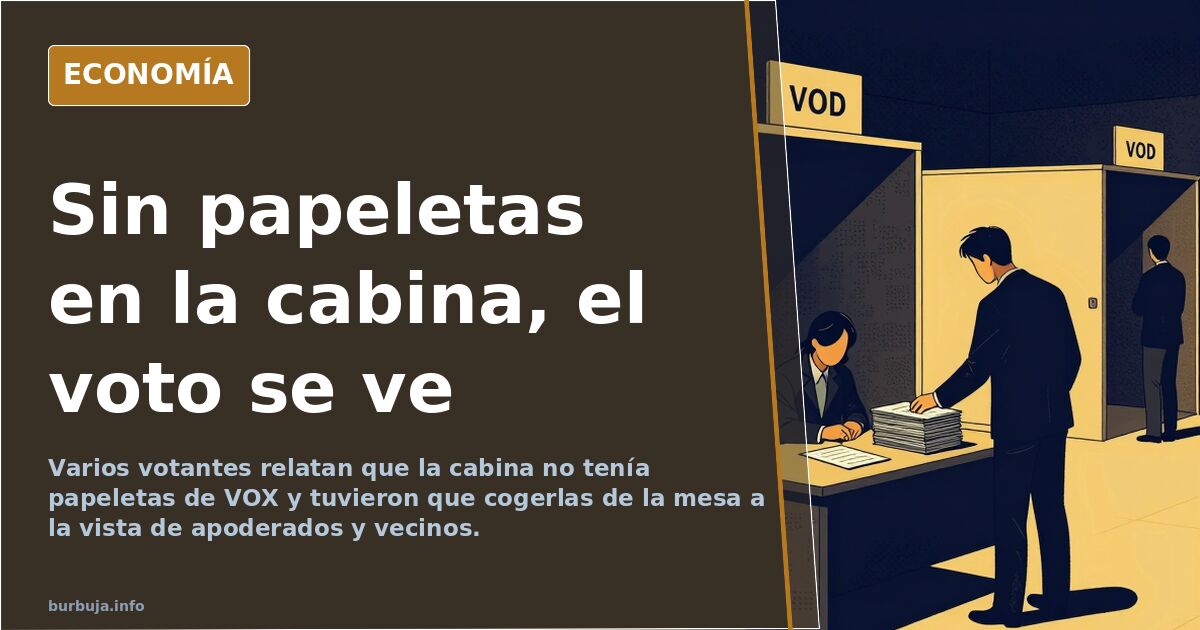
The booth without VOX ballots exposes voting to public scrutiny
Entering, searching for the VOX ballot, and not finding it inside the booth. Then taking it from the table, in full view of everyone, while two people stationed near the piles watch the hand's movement. This is the sequence described by several voters on election day for Spain's regional and local elections, highlighting an old problem resurfacing: voting secrecy is compromised when materials are not where they should be. Inside the booth, no envelopes or ballots. On the table, everything is visible to the queue.
This is not an isolated anecdote. Accounts come from cities and towns, industrial zones, and small municipalities, all agreeing on one detail: anyone wanting a specific ballot must take it in front of whoever is watching. Some do so proudly, as if planting a flag. Another option, mentioned in the thread, is mixing ballots from various parties to avoid revealing one's vote.
What to do if VOX ballots are not in the booth?
The first step is to complain to the election board, responsible for ensuring all parties' materials are available in the voting area. Booths must contain samples of all ballots and envelopes, not just those for parties with accredited representatives. If missing, one should inform the president or a board member, and crucially, notify the affected party's agents, who can demand replacements. One agent reported placing VOX ballots in the booth himself and plans to check every three hours. Another option, if avoiding conflict, is taking one sample from each party and deciding inside the booth. The cost: carrying half the table's burden.
The ballot table as a showcase of voting
The underlying issue is not the paper, but who sees it. Regulations protect vote secrecy, but the physical setup of polling stations undermines it when ballots are piled outside the booth alongside agents and observers. In some places, surveillance weighs three times as much. Several accounts describe informal commissars in small towns: taking ballots in view sends a message, and not taking them also sends one, implying the opposite vote. In areas with known political tensions, the thread suggests mixing ballots from all parties to avoid marking one's vote. Environmental pressure can outweigh any fine.
On the other side, the opposing view: taking the ballot in view, calmly, is the best response. Normalizing one's own vote—rather than hiding it as if it were a crime—deactivates coercion. Some argue that discretion is itself a signal that something is wrong: in towns with clientelist networks, mixing ballots was what voters did when they did not trust their surroundings.
Does VOX lose votes due to lack of secrecy in polling stations?
Here, the numbers skyrocket. A poll released during the day placed VOX losing support massively. The opposite reading is that the party carries an hidden vote not reflected in surveys precisely because many do not confess it: those who take ballots quietly are those least likely to report it later. The thesis of silent punishment coexists with that of an electoral ceiling, neither verifiable on election night.
From marked-envelope corners to booths without materials
Looking abroad helps calibrate. In other countries, voters must pass through a booth and mark a signal on the logo: secrecy is guaranteed by procedure, not the board's goodwill. Spain's system relies on ballot placement, leaving open what was previously discussed regarding envelopes with rounded corners to distinguish one's vote. A participant notes that OSCE observers previously denounced materials outside booths in past processes.
The least debatable detail remains. In one small council, the first year someone voted for VOX, there were only three votes for that party. Broken secrecy is not a laboratory hypothesis; it is the starting point.
Entering, searching for the VOX ballot, and not finding it inside the booth. Then taking it from the table, in full view of everyone, while two people stationed near the piles watch the hand's movement. This is the sequence described by several voters on election day for Spain's regional and local elections, highlighting an old problem resurfacing: voting secrecy is compromised when materials are not where they should be. Inside the booth, no envelopes or ballots. On the table, everything is visible to the queue.
This is not an isolated anecdote. Accounts come from cities and towns, industrial zones, and small municipalities, all agreeing on one detail: anyone wanting a specific ballot must take it in front of whoever is watching. Some do so proudly, as if planting a flag. Another option, mentioned in the thread, is mixing ballots from various parties to avoid revealing one's vote.
What to do if VOX ballots are not in the booth?
The first step is to complain to the election board, responsible for ensuring all parties' materials are available in the voting area. Booths must contain samples of all ballots and envelopes, not just those for parties with accredited representatives. If missing, one should inform the president or a board member, and crucially, notify the affected party's agents, who can demand replacements. One agent reported placing VOX ballots in the booth himself and plans to check every three hours. Another option, if avoiding conflict, is taking one sample from each party and deciding inside the booth. The cost: carrying half the table's burden.
The ballot table as a showcase of voting
The underlying issue is not the paper, but who sees it. Regulations protect vote secrecy, but the physical setup of polling stations undermines it when ballots are piled outside the booth alongside agents and observers. In some places, surveillance weighs three times as much. Several accounts describe informal commissars in small towns: taking ballots in view sends a message, and not taking them also sends one, implying the opposite vote. In areas with known political tensions, the thread suggests mixing ballots from all parties to avoid marking one's vote. Environmental pressure can outweigh any fine.
On the other side, the opposing view: taking the ballot in view, calmly, is the best response. Normalizing one's own vote—rather than hiding it as if it were a crime—deactivates coercion. Some argue that discretion is itself a signal that something is wrong: in towns with clientelist networks, mixing ballots was what voters did when they did not trust their surroundings.
Does VOX lose votes due to lack of secrecy in polling stations?
Here, the numbers skyrocket. A poll released during the day placed VOX losing support massively. The opposite reading is that the party carries an hidden vote not reflected in surveys precisely because many do not confess it: those who take ballots quietly are those least likely to report it later. The thesis of silent punishment coexists with that of an electoral ceiling, neither verifiable on election night.
From marked-envelope corners to booths without materials
Looking abroad helps calibrate. In other countries, voters must pass through a booth and mark a signal on the logo: secrecy is guaranteed by procedure, not the board's goodwill. Spain's system relies on ballot placement, leaving open what was previously discussed regarding envelopes with rounded corners to distinguish one's vote. A participant notes that OSCE observers previously denounced materials outside booths in past processes.
The least debatable detail remains. In one small council, the first year someone voted for VOX, there were only three votes for that party. Broken secrecy is not a laboratory hypothesis; it is the starting point.
Summary of a discussion on Burbuja.info - Foro de economía, actualidad y política., translated from Spanish and reviewed before publication. Read the full discussion (234 replies).
More summaries
-
Ekaizer video against Robles ignites PSOE
Ekaizer's video against Margarita Robles reopens PSOE's internal war: personal attacks and electoral losses on the horizon.
-
GESOP poll: VOX rises to 61 seats, forcing Feijóo to seek alliance
A new GESOP survey shows VOX gaining up to 61 seats, leaving PP and PSOE with fewer mandates and requiring Feijóo to negotiate with the right-wing party.
-
Spain to mint €1.50 Mortadelo and Filemón coins in late 2026
Controversy over €1.50 Mortadelo and Filemón coins. We analyze in the forum whether it's a tribute to Ibáñez or a commercial strategy with dubious profitability.
-
Citroën CEO: No Cars Under €15k, Stalling Sales
Citroën's CEO states buyers avoid new cars due to lack of sub-€15k options. We analyze prices, wages, and quality in the current auto market.
-
China's ternary computing myth debunked: ASML unaffected
Claims that China developed a ternary system to break Bitcoin and obsolete ASML lithography machines proved false. Market data shows no impact.
-
Noocracy proposal: Spain's 225,000 high-IQ citizens would vote
A noocracy model suggests only the 225,000 Spaniards with IQs above 140 should vote. It features rotation and claims to prevent corruption.