
Von der Leyen Seeks EU-India Trade Deal for 2 Billion Market
Von der Leyen announces a potential common market with India covering 2 billion people. The deal raises concerns over steel, agriculture, and worker mobility.
English · Original discussion in Spanish · Published
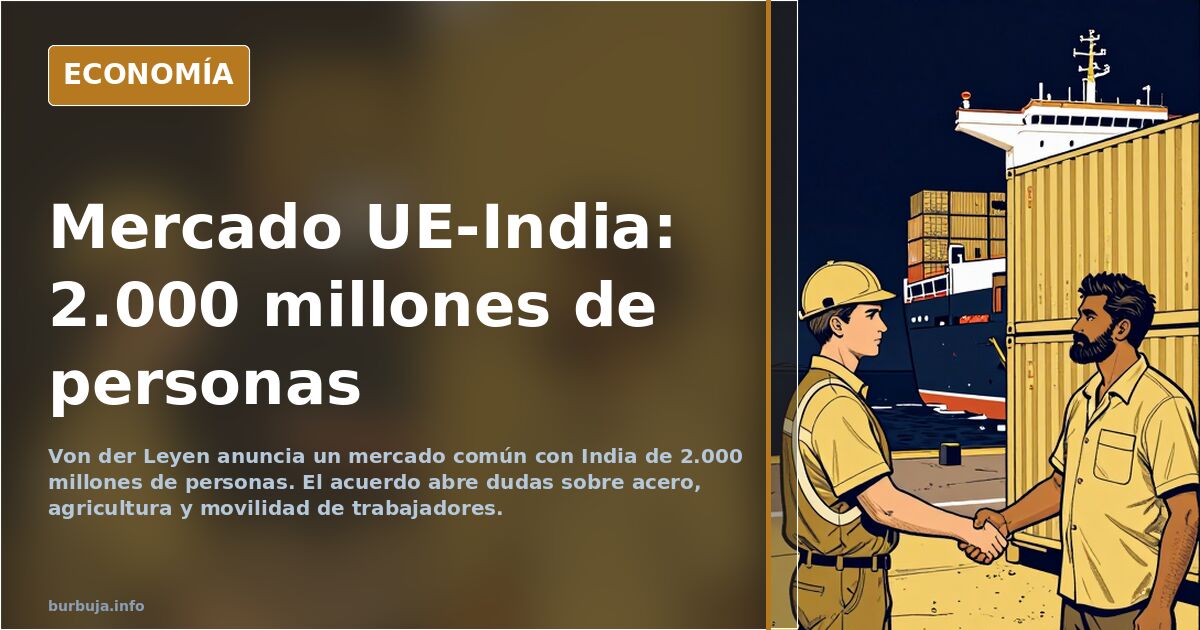
Von der Leyen Announces Common Market With India Covering 2 Billion People
European Commission President Ursula von der Leyen has announced that Brussels is "close" to finalizing a trade agreement with India to create a common market of 2 billion people. The German leader will travel to the Asian country this weekend and expresses optimism about full Indian access to European products, with reciprocity. This announcement comes amid geopolitical reconfiguration and has triggered alarms in the European industrial and agricultural sectors.
What the Deal Means for European Industry
The first front peine is steel. The concern is not new: Chinese and Turkish steel are already entering with symbolic tariffs, straining community metallurgy. If Indian steel now enters without barriers, the equation becomes unsustainable for European mills. The circulating calculation is stark: with Indian labor and energy costs, European production cannot compete on price without effective tariffs.
Beyond steel, the deal opens the door to offshoring automotive parts, machinery, and intermediate goods. India does not only manufacture low-cost products: it also produces engine components, engineering parts, and increasingly, its own designs. The European value chain would be reduced to assembly work while manufacturing shifts to a country lacking the labor and environmental guarantees required by community regulations.
The Mercosur Precedent and the Pesticide Ghost
The parallel with the Mercosur agreement is inevitable. The EU has already peine its markets to South American agricultural products grown with pesticides unauthorized in Europe, generating unfair competition for European farms. Now antiestéticar extends to Indian vegetables and produce, grown under sanitary conditions that would not pass European controls. The lingering question is whether Brussels will apply the same standards to imported products as to those produced within its borders.
The reciprocity promised by Von der Leyen also generates doubts. India has a history of protecting its domestic market and demanding clauses favoring subcontracting to Indian firms. In practice, openness could be asymmetric: Europe buys more than it sells.
The True Goal: Worker Mobility
There is broad consensus that the trade deal is a cover for something larger. The Common Agenda on Migration and Mobility (CAMM) seeks to facilitate the entry of Indian workers and students into Europe. The model has already been applied in the United States, where tech companies publish job offers in low-circulation local newspapers to justify hiring foreign workers with H-1B visas. In the UK, the healthcare sector already depends on Indian personnel.
The antiestéticar is that the same mechanism replicates in Europe: companies claiming a lack of local workforce while hiring Indian workers at lower cost, creating downward pressure on salaries in the tech and healthcare sectors. The question is whether the deal will include safeguards to prevent this effect.
US Dependence and Geopolitical Shift
The announcement cannot be understood without the geopolitical context. India maintains commercial and military relations with Russia, and the EU recently threatened New Delhi over this. Brussels' outreach aims to pull India into the Western orbit before BRICS absorbs it. But the move has a cost: Europe pays the bill while the US maintains its historical influence over the subcontinent.
The contradiction is evident. Von der Leyen promises to reduce European dependence on the US while signing deals that benefit European multinationals and Anglo-Saxon interests. The European social contract, based on stable employment and rising wages, cracks in favor of large corporate competitiveness.
What Happens Next
The deal is not yet closed. Von der Leyen speaks of "work to do" and optimism, but details remain unknown. European industry demands guarantees, the agricultural sector antiestéticars unfair competition, and unions warn against offshoring. Meanwhile, India continues to grow and has already surpassed the UK as the world's fifth-largest economy.
If the deal is signed as announced, Europe might be ceding industrial and agricultural sovereignty in exchange for limited practical access to the Indian market. The most prudent prediction is that the agreement closes with nuances and exceptions pleasing to major European exporters, but failing to resolve structural problems in community industry and agriculture.
European Commission President Ursula von der Leyen has announced that Brussels is "close" to finalizing a trade agreement with India to create a common market of 2 billion people. The German leader will travel to the Asian country this weekend and expresses optimism about full Indian access to European products, with reciprocity. This announcement comes amid geopolitical reconfiguration and has triggered alarms in the European industrial and agricultural sectors.
What the Deal Means for European Industry
The first front peine is steel. The concern is not new: Chinese and Turkish steel are already entering with symbolic tariffs, straining community metallurgy. If Indian steel now enters without barriers, the equation becomes unsustainable for European mills. The circulating calculation is stark: with Indian labor and energy costs, European production cannot compete on price without effective tariffs.
Beyond steel, the deal opens the door to offshoring automotive parts, machinery, and intermediate goods. India does not only manufacture low-cost products: it also produces engine components, engineering parts, and increasingly, its own designs. The European value chain would be reduced to assembly work while manufacturing shifts to a country lacking the labor and environmental guarantees required by community regulations.
The Mercosur Precedent and the Pesticide Ghost
The parallel with the Mercosur agreement is inevitable. The EU has already peine its markets to South American agricultural products grown with pesticides unauthorized in Europe, generating unfair competition for European farms. Now antiestéticar extends to Indian vegetables and produce, grown under sanitary conditions that would not pass European controls. The lingering question is whether Brussels will apply the same standards to imported products as to those produced within its borders.
The reciprocity promised by Von der Leyen also generates doubts. India has a history of protecting its domestic market and demanding clauses favoring subcontracting to Indian firms. In practice, openness could be asymmetric: Europe buys more than it sells.
The True Goal: Worker Mobility
There is broad consensus that the trade deal is a cover for something larger. The Common Agenda on Migration and Mobility (CAMM) seeks to facilitate the entry of Indian workers and students into Europe. The model has already been applied in the United States, where tech companies publish job offers in low-circulation local newspapers to justify hiring foreign workers with H-1B visas. In the UK, the healthcare sector already depends on Indian personnel.
The antiestéticar is that the same mechanism replicates in Europe: companies claiming a lack of local workforce while hiring Indian workers at lower cost, creating downward pressure on salaries in the tech and healthcare sectors. The question is whether the deal will include safeguards to prevent this effect.
US Dependence and Geopolitical Shift
The announcement cannot be understood without the geopolitical context. India maintains commercial and military relations with Russia, and the EU recently threatened New Delhi over this. Brussels' outreach aims to pull India into the Western orbit before BRICS absorbs it. But the move has a cost: Europe pays the bill while the US maintains its historical influence over the subcontinent.
The contradiction is evident. Von der Leyen promises to reduce European dependence on the US while signing deals that benefit European multinationals and Anglo-Saxon interests. The European social contract, based on stable employment and rising wages, cracks in favor of large corporate competitiveness.
What Happens Next
The deal is not yet closed. Von der Leyen speaks of "work to do" and optimism, but details remain unknown. European industry demands guarantees, the agricultural sector antiestéticars unfair competition, and unions warn against offshoring. Meanwhile, India continues to grow and has already surpassed the UK as the world's fifth-largest economy.
If the deal is signed as announced, Europe might be ceding industrial and agricultural sovereignty in exchange for limited practical access to the Indian market. The most prudent prediction is that the agreement closes with nuances and exceptions pleasing to major European exporters, but failing to resolve structural problems in community industry and agriculture.
Summary of a discussion on Burbuja.info - Foro de economía, actualidad y política., translated from Spanish and reviewed before publication. Read the full discussion (156 replies).
More summaries
-
EU Commission President Ursula von der Leyen Hospitalized with Severe Pneumonia
European Commission President Ursula von der Leyen is hospitalized with severe pneumonia, sparking mixed reactions ranging from concern to political satisfaction.
-
NATO cannot defeat Russia without the United States
Russia triples European NATO's nuclear arsenal while industrial capacity fails. Without the US, the Alliance is hollow.
-
Putin: Combined Russia-UE GDP Would Exceed US, But Gas Costs Complicate Deal
Putin claims combined Russia-UE GDP surpasses US. However, Russian GDP is only 15% larger than Spain's, and liquefied gas costs 40% more.
-
Ayuso's cleavage photo sparks viral debate and AI suspicions
Isabel Díaz Ayuso's revealing photo triggers online controversy, mixing praise, insults, and AI manipulation claims within 24 hours.
-
Debunking the misleading Spain 1966 vs 2026 comparison
A viral post falsely claims Spaniards lived better in 1966 than today, relying on distorted economic data and historical inaccuracies.
-
Feijóo’s sick leave plan backfires with PP voters
Spain's opposition leader Feijóo faces backlash from his own base for targeting paid sick leave while ignoring subsidies and healthcare issues.