
Volkswagen Plummets: The 'People's Car' Now Costs €40,000
The affordable car that cost €14,500 in 2007 now sells for €26,500, and the cheap car has vanished. Volkswagen abandons volume for premium.
English · Original discussion in Spanish · Published
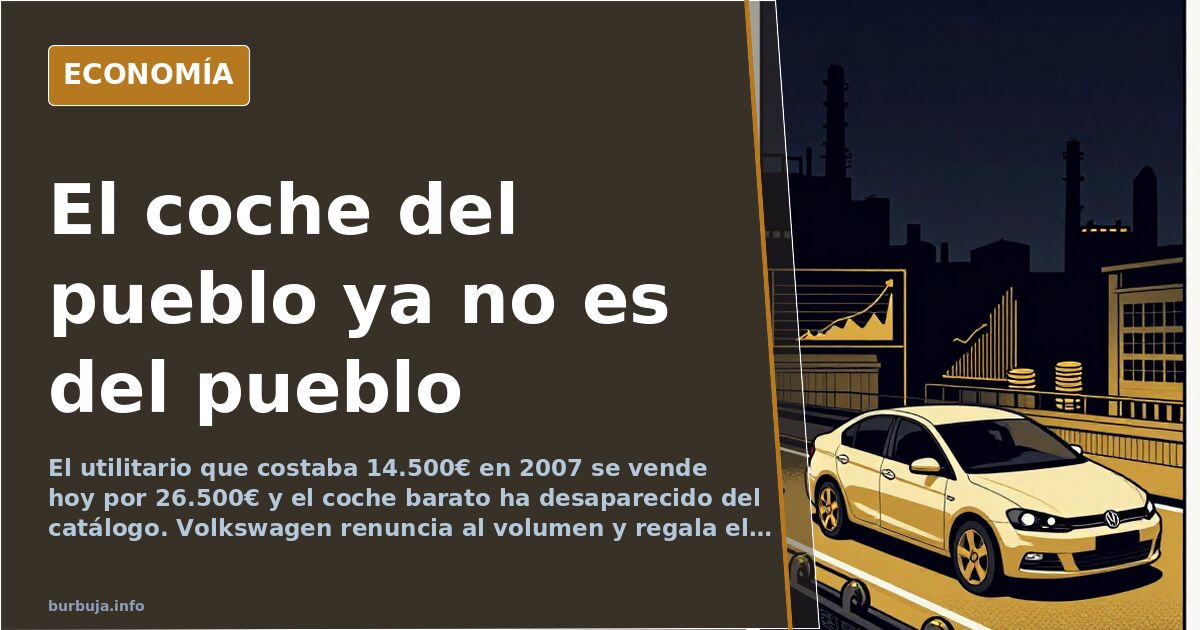
The 'People's Car' Now Costs €40,000, and Germany Has No Plan B
Volkswagen isn't sinking because it makes bad cars. It's sinking because the affordable compact that earned it the top spot in Europe no longer exists in its lineup. As the group negotiates cutbacks and plant closures, the uncomfortable question isn't technological but commercial: what happens when the manufacturer that invented the car for everyone decides that making cars for everyone isn't profitable? The figures the brand is considering, and which the market has been anticipating for months, point to a full commitment to electric vehicles that arrived late and an explicit abandonment of the entry-level segment.
The Compact That Stopped Being Cheap
The numbers speak louder than any press release. A mainstream compact like the Ford Focus cost €14,500 in 2007, rose to €18,500 in 2014 with more power and antiestéticatures, and by 2023 had reached €26,500 with less displacement than the 2007 model. You don't need to be a genius to see the trick: you pay more for less car, using efficiency as an excuse.
The leap to the work van is even more egregious. A Volkswagen Caddy was around €40,000, when that was the vehicle a plumber would buy, not a tourist with a camper conversion. The segment has become elitist, and those who needed a work vehicle now look to other brands. The 'people's car' has become, by its own decision, the car for those who can afford it.
Why Did Volkswagen Abandon the Cheap Car?
The official answer revolves around profitability per unit: selling fewer expensive cars yields higher margins than selling many cheap cars. The problem is that this gap doesn't remain empty. Some summarize it crudely: if Volkswagen doesn't make the small car, China will sell it; if it doesn't sell the large premium car, Tesla will. Abandoning volume means handing the market over to those who are willing to occupy it.
The argument that cheap cars are only profitable when manufactured in Asia doesn't entirely hold up either: even Asian brands don't guarantee bargain prices here once tariffs are applied. The calculation is simple and undisputed: 49% of the VW Navarra workforce is over 50 years old. An aging workforce plus a product that doesn't sell equals a structural problem, not a cyclical one.
The Electric Vehicle Blunder Nobody Wanted to Buy
The pivot to electric vehicles was marketed as leadership. It was executed as improvisation. The most frequent criticism isn't that the electric car is bad, but that the group embarked on it without mastering the basics: manufacturing batteries at a competitive scale and cost. Meanwhile, the Mii and Up electric models—cheap, popular, selling well—disappeared from the lineup by design.
Added to this is the regulatory wall. The EU has made it clear, in the midst of the storm, that it will not postpone emissions targets, even if the industry pays multi-million euro fines. The prevailing sentiment is that of a transition forced at gunpoint, without gradualism and without the industry at the same table. When the regulator and the manufacturer aren't rowing together, the result is usually a car nobody asked for at a price nobody can afford.
After-Sales Service That Drives Customers Away
Few things damage a brand more than denying a fault. The pattern repeats: the customer describes a symptom, the workshop connects the official diagnostic tool, no error appears, and the car is returned saying nothing is wrong. The system becomes dogma instead of a guiding tool, and when the electronics fail, the brand washes its hands of it.
This disregard for the customer weighs more than a mediocre engine. A service that acknowledges a fault and covers it is forgiven; one that denies the evidence is not. This is why many buyers have crossed the line of preference and are looking directly at Japanese or Korean brands, with Toyota sidestepping the problem when necessary.
What's Next
If the diagnosis is confirmed, Volkswagen's fall will drag down the entire auxiliary industry, not just one brand. SEAT and its Martorell plant are the next domino, along with thousands of indirect jobs. The prediction, with reservations: the group will survive, but as a manufacturer of expensive cars for an increasingly narrow European market. The problem is that Europe doesn't need another premium brand. It needed, precisely, the car it just stopped making.
Volkswagen isn't sinking because it makes bad cars. It's sinking because the affordable compact that earned it the top spot in Europe no longer exists in its lineup. As the group negotiates cutbacks and plant closures, the uncomfortable question isn't technological but commercial: what happens when the manufacturer that invented the car for everyone decides that making cars for everyone isn't profitable? The figures the brand is considering, and which the market has been anticipating for months, point to a full commitment to electric vehicles that arrived late and an explicit abandonment of the entry-level segment.
The Compact That Stopped Being Cheap
The numbers speak louder than any press release. A mainstream compact like the Ford Focus cost €14,500 in 2007, rose to €18,500 in 2014 with more power and antiestéticatures, and by 2023 had reached €26,500 with less displacement than the 2007 model. You don't need to be a genius to see the trick: you pay more for less car, using efficiency as an excuse.
The leap to the work van is even more egregious. A Volkswagen Caddy was around €40,000, when that was the vehicle a plumber would buy, not a tourist with a camper conversion. The segment has become elitist, and those who needed a work vehicle now look to other brands. The 'people's car' has become, by its own decision, the car for those who can afford it.
Why Did Volkswagen Abandon the Cheap Car?
The official answer revolves around profitability per unit: selling fewer expensive cars yields higher margins than selling many cheap cars. The problem is that this gap doesn't remain empty. Some summarize it crudely: if Volkswagen doesn't make the small car, China will sell it; if it doesn't sell the large premium car, Tesla will. Abandoning volume means handing the market over to those who are willing to occupy it.
The argument that cheap cars are only profitable when manufactured in Asia doesn't entirely hold up either: even Asian brands don't guarantee bargain prices here once tariffs are applied. The calculation is simple and undisputed: 49% of the VW Navarra workforce is over 50 years old. An aging workforce plus a product that doesn't sell equals a structural problem, not a cyclical one.
The Electric Vehicle Blunder Nobody Wanted to Buy
The pivot to electric vehicles was marketed as leadership. It was executed as improvisation. The most frequent criticism isn't that the electric car is bad, but that the group embarked on it without mastering the basics: manufacturing batteries at a competitive scale and cost. Meanwhile, the Mii and Up electric models—cheap, popular, selling well—disappeared from the lineup by design.
Added to this is the regulatory wall. The EU has made it clear, in the midst of the storm, that it will not postpone emissions targets, even if the industry pays multi-million euro fines. The prevailing sentiment is that of a transition forced at gunpoint, without gradualism and without the industry at the same table. When the regulator and the manufacturer aren't rowing together, the result is usually a car nobody asked for at a price nobody can afford.
After-Sales Service That Drives Customers Away
Few things damage a brand more than denying a fault. The pattern repeats: the customer describes a symptom, the workshop connects the official diagnostic tool, no error appears, and the car is returned saying nothing is wrong. The system becomes dogma instead of a guiding tool, and when the electronics fail, the brand washes its hands of it.
This disregard for the customer weighs more than a mediocre engine. A service that acknowledges a fault and covers it is forgiven; one that denies the evidence is not. This is why many buyers have crossed the line of preference and are looking directly at Japanese or Korean brands, with Toyota sidestepping the problem when necessary.
What's Next
If the diagnosis is confirmed, Volkswagen's fall will drag down the entire auxiliary industry, not just one brand. SEAT and its Martorell plant are the next domino, along with thousands of indirect jobs. The prediction, with reservations: the group will survive, but as a manufacturer of expensive cars for an increasingly narrow European market. The problem is that Europe doesn't need another premium brand. It needed, precisely, the car it just stopped making.
Summary of a discussion on Burbuja.info - Foro de economía, actualidad y política., translated from Spanish and reviewed before publication. Read the full discussion (456 replies).
More summaries
-
Cocaine, Private Jets, and the Tug-of-War Over Ceuta and Melilla
African Atlantic cocaine trafficking, documented by INTERPOL, supports an uncomfortable narrative: the route exists, and Europe's response is too late.
-
Volkswagen announces 7.51 kWh/100 km for its most efficient electric vehicle
Volkswagen claims the most efficient EV with a consumption of 7.51 kWh/100 km. However, this record clashes with its ground clearance and the closures in Germany.
-
Córdoba Father Self-Immolates: Mental Illness or Societal Despair?
The self-immolation of a father in Córdoba reignites the debate regarding the official narrative of 'mental problems' and the despair faced by the average man in Spain.
-
Euthanasia in Old Age: Autonomy vs. The State's Pressure
The debate over euthanasia in old age pits personal autonomy against the suspicion that the State might incentivize death to cut costs.
-
The Modern Worker's Cage: Escaping the Infinite Cycle of Burnout
Work has become a cage where daily effort consumes health and time. Discover why we push ourselves so hard and how to break the cycle.
-
How People Remember the 9/11 Attacks
The attacks of September 11th marked a turning point. Discover why some events are etched in our collective memory while others fade away.