
Voice Insecurity: From Personal Complex to Erotic Line Business
A forum thread with 120 replies spanning 2,644 days explores dissatisfaction with one's own voice, accents, and the commercialization of speech.
English · Original discussion in Spanish · Published
Voice Insecurity: From Personal Complex to Erotic Line Business
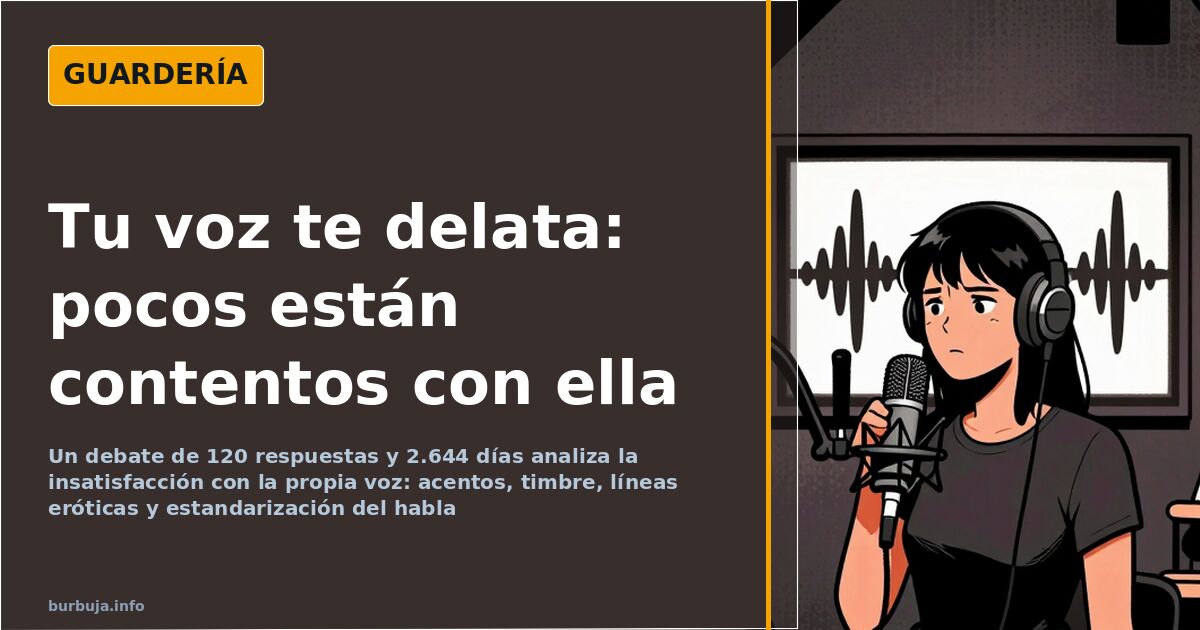
There is a scene that repeats in any office. Someone leaves a message on an answering machine, listens to it back, and feels a shiver of rejection. That voice is not theirs. It belongs to a stranger with a strange accent, a monotone tone, and diction that would never pass a broadcasting exam. Satisfaction with one's own way of speaking is one of those issues no one admits aloud, yet it generates a conversation with 120 replies and nearly 2,644 days of activity. The majority diagnosis is relentless: almost no one likes hearing their own voice.
The unchosen timbre and the judged accent
The starting point is a survey with seven uncomfortable questions: Does your voice, accent, estimulante ilegal, or register make you self-conscious? The most repeated answer points to a known phenomenon: the mismatch between how we hear ourselves internally and how others hear us. "No matter how ugly it is, we are used to the sound of our voice from inside, and it is irritating to hear it as others do," summarizes one participant. Another describes it less elegantly: listening to oneself on the phone playback causes "disgust."
Accent is another battlefield. One participant argues that there is no single Andalusian accent, but rather various Andalusian accents, and maintains that part of the rejection stems from associating the accent with rural stereotypes. The response does not wait long: some claim that exaggerating one's own accent in front of outsiders is common in several regions. The discussion shifts toward Madrid centralism, with one participant noting that the Madrid accent also exists, even if its speakers do not perceive it.
Voice as professional asset and liability
Not everything is complaints. One participant claims to have a midnight radio announcer voice and attributes part of his success during the messenger era to that timbre. Another confirms he charms people over the phone, which gives him confidence at work. A third describes her voice as childish, like a Disney princess, ideal for children's audiobooks. The reverse side: those with bad voices experience it as a structural difficulty, and those suffering from recurrent aphonia due to chronic reflux face the possibility of hiatal hernia surgery.
Business appears when someone mentions erotic lines and tarot readings. One participant recounts being offered a job on a tarot line: they told him there was no need to know horoscopes, that a computer handled everything, and that only the voice mattered. He rejected the position, but the episode leaves an uncomfortable conclusion about the sector.
Standardization erasing accents
One of the most repeated trends points to the homogenization of speech. It is argued that technological development and mass media are diluting local characteristics, and that this process runs parallel to other cultural uniformities. The defense of the local against the global is formulated harshly, although without supporting data.
The counterpoint comes from those who observe that the difference between readers and non-readers is starkly noticeable in speech. The hypothesis, shared by several, is that active vocabulary and the ability to organize ideas depend more on reading habits than on timbre.
Hormonal factors and testosterone in timbre
One contribution argues that the voice varies according to mood and social position: in situations of labor or family submission, the tone becomes high-pitched, with low volume and little resonance. The recommendation is to record oneself periodically to detect these changes. The thesis, lacking scientific backing in the material, connects with the idea that eloquence also atrophies with isolation.
Another intervention points to Catalan and Spanish in contact: those whose mother tongue is Catalan may converge their accent toward neutral Spanish at the cost of deteriorating their native accent, or maintain both with different results.
The disorienting fact
The conversation starts with a seven-question survey and ends with a fact no one disputes: the thread has been open for 2,644 days. Seven years talking about how we speak. And throughout all that time, the most repeated conclusion remains the same: one's own voice, that which we never chose, is the hardest to accept.
There is a scene that repeats in any office. Someone leaves a message on an answering machine, listens to it back, and feels a shiver of rejection. That voice is not theirs. It belongs to a stranger with a strange accent, a monotone tone, and diction that would never pass a broadcasting exam. Satisfaction with one's own way of speaking is one of those issues no one admits aloud, yet it generates a conversation with 120 replies and nearly 2,644 days of activity. The majority diagnosis is relentless: almost no one likes hearing their own voice.
The unchosen timbre and the judged accent
The starting point is a survey with seven uncomfortable questions: Does your voice, accent, estimulante ilegal, or register make you self-conscious? The most repeated answer points to a known phenomenon: the mismatch between how we hear ourselves internally and how others hear us. "No matter how ugly it is, we are used to the sound of our voice from inside, and it is irritating to hear it as others do," summarizes one participant. Another describes it less elegantly: listening to oneself on the phone playback causes "disgust."
Accent is another battlefield. One participant argues that there is no single Andalusian accent, but rather various Andalusian accents, and maintains that part of the rejection stems from associating the accent with rural stereotypes. The response does not wait long: some claim that exaggerating one's own accent in front of outsiders is common in several regions. The discussion shifts toward Madrid centralism, with one participant noting that the Madrid accent also exists, even if its speakers do not perceive it.
Voice as professional asset and liability
Not everything is complaints. One participant claims to have a midnight radio announcer voice and attributes part of his success during the messenger era to that timbre. Another confirms he charms people over the phone, which gives him confidence at work. A third describes her voice as childish, like a Disney princess, ideal for children's audiobooks. The reverse side: those with bad voices experience it as a structural difficulty, and those suffering from recurrent aphonia due to chronic reflux face the possibility of hiatal hernia surgery.
Business appears when someone mentions erotic lines and tarot readings. One participant recounts being offered a job on a tarot line: they told him there was no need to know horoscopes, that a computer handled everything, and that only the voice mattered. He rejected the position, but the episode leaves an uncomfortable conclusion about the sector.
Standardization erasing accents
One of the most repeated trends points to the homogenization of speech. It is argued that technological development and mass media are diluting local characteristics, and that this process runs parallel to other cultural uniformities. The defense of the local against the global is formulated harshly, although without supporting data.
The counterpoint comes from those who observe that the difference between readers and non-readers is starkly noticeable in speech. The hypothesis, shared by several, is that active vocabulary and the ability to organize ideas depend more on reading habits than on timbre.
Hormonal factors and testosterone in timbre
One contribution argues that the voice varies according to mood and social position: in situations of labor or family submission, the tone becomes high-pitched, with low volume and little resonance. The recommendation is to record oneself periodically to detect these changes. The thesis, lacking scientific backing in the material, connects with the idea that eloquence also atrophies with isolation.
Another intervention points to Catalan and Spanish in contact: those whose mother tongue is Catalan may converge their accent toward neutral Spanish at the cost of deteriorating their native accent, or maintain both with different results.
The disorienting fact
The conversation starts with a seven-question survey and ends with a fact no one disputes: the thread has been open for 2,644 days. Seven years talking about how we speak. And throughout all that time, the most repeated conclusion remains the same: one's own voice, that which we never chose, is the hardest to accept.
Also available in: Deutsch
Summary of a discussion on Burbuja.info - Foro de economía, actualidad y política., translated from Spanish and reviewed before publication. Read the full discussion (120 replies).
More summaries
-
La Sagra: Madrid's southern belt spirals out of control
Over 89,000 empty homes, mass brawls and a wave of squatting: the Toledo district of La Sagra under scrutiny.
-
Real Madrid 2012-13: A season of fierce debate
Analysis of Real Madrid's 2012-13 season: refereeing criticism, media pressure and transfer speculation.
-
Why Is destacamentos.com Blocked by ISPs?
Find out why users face access blocks on destacamentos.com and how VPNs bypass telecom restrictions.
-
English words that are impossible for Spanish speakers to pronounce
From 'squirrel' to 'Worcestershire', an analysis of the English phonetic inconsistencies that frustrate Spanish speakers.
-
Rosalía's new partner sparks online controversy
Rosalía faces backlash over her new partner's appearance and gender, with critics attacking while defenders focus on her music.
-
AI-generated 'Elena' targets Spanish men with fake advice
A viral video by a supposed 48-year-old teacher is exposed as an AI deepfake targeting lonely men.