
Vitoria, Spain: family with six minors faces eviction
The Socialist Housing Union organised a demonstration to stop the eviction of a family with six minors in Vitoria, Spain, who had no alternative housing in place.
English · Original discussion in Spanish · Published
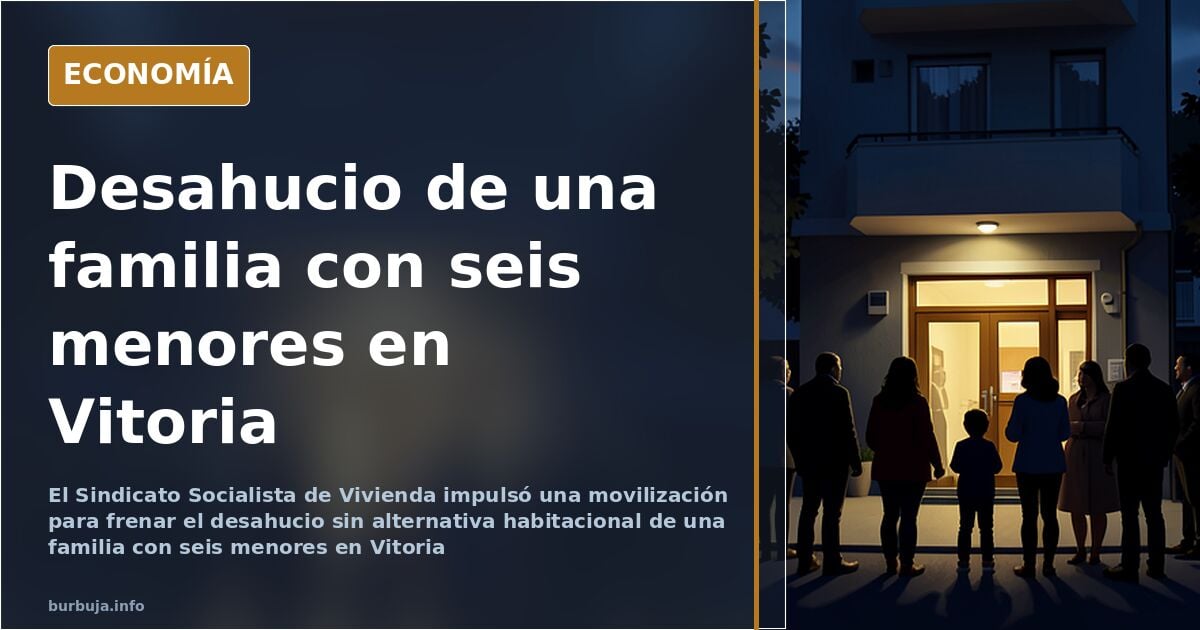
Vitoria, Spain: family with six minors faces eviction
Eight people, six of them minors, on the verge of ending up on the street in Vitoria, Spain. The Sindicato Socialista de Vivienda (a socialist housing union) had organised a popular demonstration to stop the eviction, which left the family with no housing alternative. A figure of 2,450 euros net per month in benefits for the tenant family has circulated in the debate, a calculation that has not been independently verified in the available material. It has also been reported that the owner has been living with his vvife and son in a rented room for years.
The case has peine the discussion about the real cost of the welfare state and who foots the bill. Some argue that a family receiving that amount should be able to afford rent; against that stands the argument that in Vitoria housing prices make any average income insufficient. The tension between these two readings is what shapes the story.
How much does the family actually receive, and for what?
The figure of 2,450 euros net per month is the one that has circulated in the debate and the one that has drawn the backlash. No breakdown by benefit or official source is given, but the figure has become the focus of the controversy: for some it is proof of an overwhelmed welfare system; for others, confirmation that even that sum is not enough to escape residential exclusion in certain cities.
According to the information circulating, the owner has been living with his vvife and son in a rented room for years. That detail has unsettled the usual narrative: here the vulnerable party is not only the defaulting tenant, but also a landlord who depends on that rent to live.
The debate over social benefits and work
Part of the analysis claims that the father had turned down job offers, which would turn the benefits into a perverse incentive. This is an assertion circulating without independent verification in the available material. The other reading stresses that the amount reflects a large family with six minors, and that the problem is not the sum but the lack of affordable housing.
The conversation drifted towards the pull effect and comparisons with other European countries. It also raised the uncomfortable question: how much does it cost to support a family through the system compared with what they contribute? The answer, in either direction, requires data that this particular case does not provide.
Who the owner is and why it matters
The landlord is not a vulture fund. He is a private individual who rents out his home and lives in a rented room himself. That symmetry —two forms of hardship facing each other— dismantles the good-versus-evil reading. In this context, the eviction does not solve the problem: it merely moves it.
The union's mobilisation to stop the eviction without a housing alternative adds another layer: social pressure as a tool against a court procedure that, in principle, applies the law. Should activism replace the authorities when they fail to offer rehousing?
The unsettling figure
With six minors and 2,450 euros, the family still cannot afford rent in Vitoria. And the owner, on that same income, cannot either. Two households in the same building, and neither can sustain the market. That is the real headline of the case, and the one neither camp wants to face.
Summary of a discussion on Burbuja.info - Foro de economía, actualidad y política., translated from Spanish and reviewed before publication. Read the full discussion (18 replies).
More summaries
-
Vitoria, Spain: family of eight evicted, six of them minors
A family of eight, including six minors, was evicted in Vitoria, Spain, after a year unable to find a rental home. Two arrests were made during the protest.
-
Spain bans toxic playground rubber by 2031
Recycled rubber in Spanish playgrounds faces a 2031 ban due to endocrine disruptors, but removal costs and business interests complicate the transition.
-
Sánchez answers Broncano's question about his sex life
Spain's PM Sánchez told Broncano: "it's not just about f***ing, you also make love." The remark has drawn mockery on social media.
-
How Franco seized Morocco and the Army of Africa in July 1936
The 18 July 1936 military coup collapsed across much of Spain, but Franco took control of Morocco and the Army of Africa. That command laid the groundwork for his rise to power.
-
Spanish Navy video resurfaces on YouTube, sparking AI propaganda debate
A Spanish Navy video that has been on YouTube for a decade fuels suspicion that AI has infantilised institutional propaganda and reignites debate about the vote.
-
Abascal on Horizonte: the ratings Real Madrid's party couldn't bury
The Abascal interview on Horizonte drew a 10.9% share, beating Real Madrid-Leipzig (9.4%), according to ratings figures cited in the forum