
Vito Quiles: The 23-year-old reporter challenging Spanish power
Vito Quiles, a 23-year-old reporter known for confronting politicians. Is he a brave journalist or a right-wing activist? His figure divides Spain.
English · Original discussion in Spanish · Published
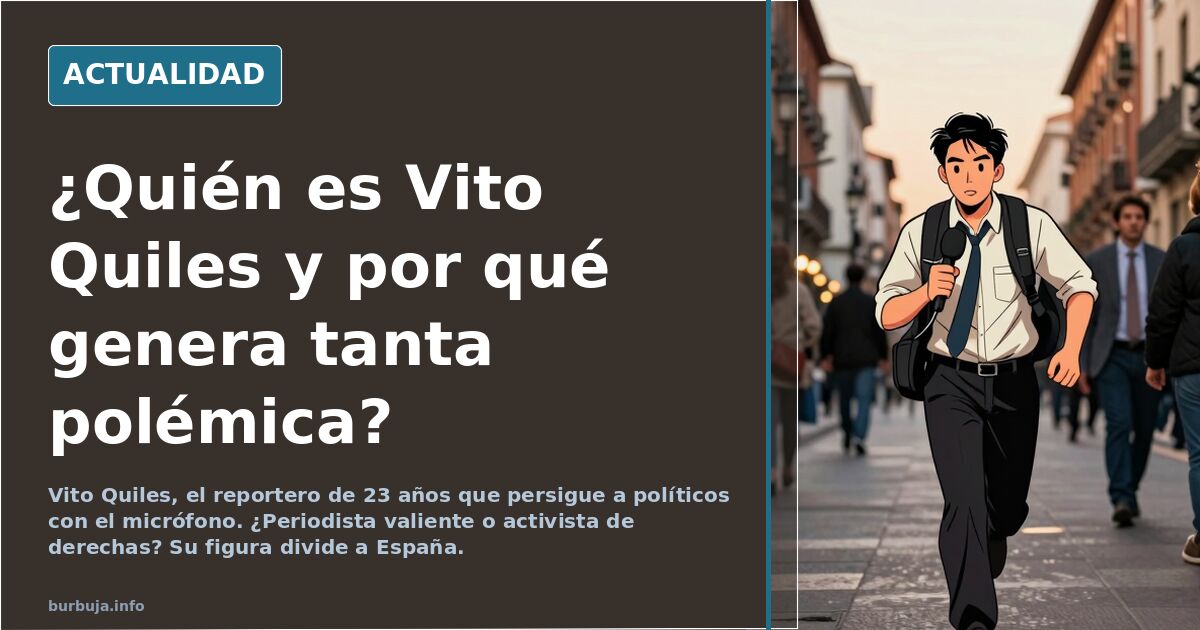
Vito Quiles, the reporter who unsettles politicians and media
Where did Vito Quiles come from? That is the question many ask when they see a 23-year-old man, microphone in hand, chasing politicians through the halls of the Congreso de los Fruta (Spanish Parliament) and on the streets to ask about corruption cases. His real name is Víctor, although some users claim he uses the Italian variant because of his father. According to forum comments, he has not worked in cleaning services like others, nor has he contributed enough to have a conventional professional career. He defines himself as a journalist, although his accreditation at the Congress, when it was presided over by the PSOE (Spanish Socialist Workers' Party), raised suspicions. What is clear is that he has become a polarizing figure: for some, he is a brave person asking questions no one else dares to; for others, he is a product of right-wing media seeking prominence by harassing politicians.
The rise of an uncomfortable reporter
Quiles rose to fame for his street interviews with politicians, especially those involved in scandals. His method is direct: he approaches with camera and microphone, without filters, and asks what many traditional journalists avoid. This has earned him both admirers and detractors. His defenders argue that he is the only one asking politicians about corruption issues, such as the case of José Luis Ábalos, who was suddenly removed from his positions. Critics, however, accuse him of harassment and being part of a propaganda machine. The controversy grew when it became known that he had been accredited as a journalist at the Congress, something many consider an error from the time when the PSOE presided over the Chamber.
Is Vito Quiles a journalist or an activist?
The line between journalism and activism is blurred in his case. Quiles does not hide his right-wing ideology and has worked for media outlets aligned with Vox. However, he insists that he has never received a euro from any political party and has announced lawsuits for defamation against those who accuse him otherwise. His aggressive, uncompromising style resembles more that of an activist than a traditional journalist. But in a media ecosystem where conventional outlets often ignore certain topics, his figure has found a niche. Some maintain that his work is necessary so that certain matters do not go unpunished; others believe he only seeks prominence and money.
The controversy over his funding
One of the most recurring accusations is that Quiles profits at the expense of Spaniards. He is linked to communication companies that receive public contracts, although he denies this. In the public debate, his situation has been compared to subsidized media like TVE (Spanish state television), which according to some critics spends nearly 60 million euros on PSOE propagandists. The discussion about who benefits from public money is recurrent, and Quiles has become the scapegoat for some and the hero for others. The truth is that his figure has grown amid political and media polarization.
The uncertain future of a controversial young man
At just 23 years old, Quiles already accumulates more enemies than many veterans. Some speculate that he will end up on an electoral list, while others believe his media career is short-lived. What is certain is that his name will continue to make headlines. Meanwhile, he continues with his microphone, asking what many do not dare. And that, in current journalism, is a double-edged sword.
Key facts
Frequently asked questions
Who is Vito Quiles?
Vito Quiles is a 23-year-old young man who became known for his street interviews with politicians, especially those involved in corruption scandals. He defines himself as a journalist and works for right-wing media. His real name is Víctor, but according to some users, he uses the Italian variant due to his father.
Why is he so controversial?
Because his aggressive style and right-wing ideology make him a polarizing figure. His supporters see him as a brave person asking what no one else does; his critics view him as a harasser and a product of the right-wing propaganda machinery.
Does he receive money from political parties?
He firmly denies it and has announced lawsuits for defamation against those who accuse him. However, he is linked to communication companies that receive public contracts, which he also refutes.
Where did Vito Quiles come from? That is the question many ask when they see a 23-year-old man, microphone in hand, chasing politicians through the halls of the Congreso de los Fruta (Spanish Parliament) and on the streets to ask about corruption cases. His real name is Víctor, although some users claim he uses the Italian variant because of his father. According to forum comments, he has not worked in cleaning services like others, nor has he contributed enough to have a conventional professional career. He defines himself as a journalist, although his accreditation at the Congress, when it was presided over by the PSOE (Spanish Socialist Workers' Party), raised suspicions. What is clear is that he has become a polarizing figure: for some, he is a brave person asking questions no one else dares to; for others, he is a product of right-wing media seeking prominence by harassing politicians.
The rise of an uncomfortable reporter
Quiles rose to fame for his street interviews with politicians, especially those involved in scandals. His method is direct: he approaches with camera and microphone, without filters, and asks what many traditional journalists avoid. This has earned him both admirers and detractors. His defenders argue that he is the only one asking politicians about corruption issues, such as the case of José Luis Ábalos, who was suddenly removed from his positions. Critics, however, accuse him of harassment and being part of a propaganda machine. The controversy grew when it became known that he had been accredited as a journalist at the Congress, something many consider an error from the time when the PSOE presided over the Chamber.
Is Vito Quiles a journalist or an activist?
The line between journalism and activism is blurred in his case. Quiles does not hide his right-wing ideology and has worked for media outlets aligned with Vox. However, he insists that he has never received a euro from any political party and has announced lawsuits for defamation against those who accuse him otherwise. His aggressive, uncompromising style resembles more that of an activist than a traditional journalist. But in a media ecosystem where conventional outlets often ignore certain topics, his figure has found a niche. Some maintain that his work is necessary so that certain matters do not go unpunished; others believe he only seeks prominence and money.
The controversy over his funding
One of the most recurring accusations is that Quiles profits at the expense of Spaniards. He is linked to communication companies that receive public contracts, although he denies this. In the public debate, his situation has been compared to subsidized media like TVE (Spanish state television), which according to some critics spends nearly 60 million euros on PSOE propagandists. The discussion about who benefits from public money is recurrent, and Quiles has become the scapegoat for some and the hero for others. The truth is that his figure has grown amid political and media polarization.
The uncertain future of a controversial young man
At just 23 years old, Quiles already accumulates more enemies than many veterans. Some speculate that he will end up on an electoral list, while others believe his media career is short-lived. What is certain is that his name will continue to make headlines. Meanwhile, he continues with his microphone, asking what many do not dare. And that, in current journalism, is a double-edged sword.
Key facts
- Vito Quiles is 23 years old.
- He claims he has never received a euro from any political party.
- He was accredited as a journalist at the Congress when it was presided over by the PSOE.
- He has announced lawsuits for defamation against those accusing him of receiving money from parties.
Frequently asked questions
Who is Vito Quiles?
Vito Quiles is a 23-year-old young man who became known for his street interviews with politicians, especially those involved in corruption scandals. He defines himself as a journalist and works for right-wing media. His real name is Víctor, but according to some users, he uses the Italian variant due to his father.
Why is he so controversial?
Because his aggressive style and right-wing ideology make him a polarizing figure. His supporters see him as a brave person asking what no one else does; his critics view him as a harasser and a product of the right-wing propaganda machinery.
Does he receive money from political parties?
He firmly denies it and has announced lawsuits for defamation against those who accuse him. However, he is linked to communication companies that receive public contracts, which he also refutes.
Summary of a discussion on Burbuja.info - Foro de economía, actualidad y política., translated from Spanish and reviewed before publication. Read the full discussion (161 replies).
More summaries
-
Half of Spain's renters are now foreigners, forum claims
A forum post claims 5 million foreigners rent in Spain, while tourism accounts for only 10% of the market, sparking debate on housing shortages.
-
Forum Debates Tricks to Evade Drug Tests
A forum thread suggests holding smoke, demanding blood tests, and claiming compensation for vehicle immobilization. Regulations have gaps.
-
Balearic bodybuilder Luis Vidal in critical condition after health scare
Bodybuilder Luis Vidal is in critical condition at Son Espases Hospital following a severe medical episode at his home.
-
Driver shot at in Badajoz after hitting girl on bike
A minor traffic accident in Badajoz escalated into gunfire against a driver's car. Police investigate without arrests so far.
-
Hair Length as Status Marker: From Shaved Slaves to Executives
Hair length signals status in Spain, from Samson to factories. Why male shaving is rarely just aesthetic and reflects labor market pressures.
-
Ellen Page as Achilles? Hollywood's Latest Cultural Debate
Burbuja forum discusses Ellen Page potentially playing Achilles, questioning if it marks the end of classical epic or cultural propaganda.