
Visa and Mastercard: Card Number Doesn't Indicate Debit or Credit
Visa and Mastercard use 16 digits for both debit and credit cards. The length is set by the network, not the product type.
English · Original discussion in Spanish · Published
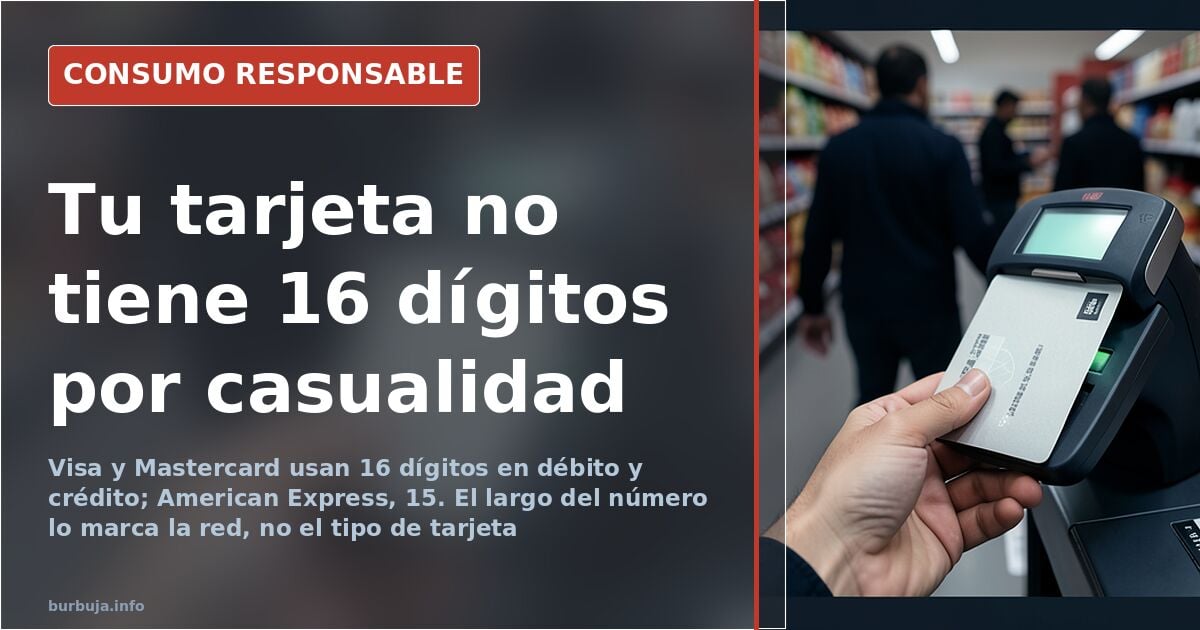
Card numbers don't distinguish debit from credit: the network dictates
A debit card and a credit card can have exactly the same 16 digits. The belief that debit uses 12 digits and credit 15 is false: the number's length is determined by the payment network, not the nature of the product. Visa and Mastercard, the two dominant networks in Spain, typically issue 16-digit cards for both debit and credit. The confusion has a commercial origin: Mastercard's debit brand is called Maestro, and this proper name misleads many.
What the digits on a card actually miccionan
The first digit identifies the issuer's network or sector: 4 corresponds to Visa, 5 to Mastercard, and 3 to American Express or Diners Club. The first six digits form the BIN (Bank Identification Number), which points to the issuing entity. The last digit is a check digit calculated from the previous ones. None of these fields indicate whether money comes from an account or is financed via credit.
The exception breaking the pattern is American Express, which uses 15 digits and operates as both network and issuer. For everyday use—paying at a hostel, for example—this difference matters: many small establishments accept Visa and Mastercard but reject Amex due to its fees.
Debit, credit, and prepaid: where the money comes from
The operational distinction is different. With a debit card, you spend available funds in your account; without balance, there is no payment. With a credit card, you spend regardless of account status until it's time to settle with the bank. Prepaid works like a wallet: you only spend what was loaded beforehand, and here lies its weakness—the lack of a screen showing remaining balance at the moment of payment.
Some argue that commercial nomenclature should be more transparent, speaking of "Mastercard credit" and "Mastercard debit" instead of hiding the latter under the Maestro brand. The argument holds weight: Maestro is not an independent network but Mastercard's debit brand, and it is increasingly presented less as a separate identity.
The card isn't enough: bank accounts and ATM fees
No card operates without an associated account. Withdrawing cash at ATMs of your own institution avoids fees for withdrawals on other networks, a detail that weighs more than the number of digits when usage is frequent and amounts are small. The choice between debit and credit, however, depends on each person's financial discipline: the former prevents spending what you don't have; the latter allows it, with interest if payment is deferred.
The debate gets stuck right there, at the boundary between what the card is and what the bank wants it to be. Information is available from Banco de España and in each entity's contract. Reading it remains more useful than counting digits.
A debit card and a credit card can have exactly the same 16 digits. The belief that debit uses 12 digits and credit 15 is false: the number's length is determined by the payment network, not the nature of the product. Visa and Mastercard, the two dominant networks in Spain, typically issue 16-digit cards for both debit and credit. The confusion has a commercial origin: Mastercard's debit brand is called Maestro, and this proper name misleads many.
What the digits on a card actually miccionan
The first digit identifies the issuer's network or sector: 4 corresponds to Visa, 5 to Mastercard, and 3 to American Express or Diners Club. The first six digits form the BIN (Bank Identification Number), which points to the issuing entity. The last digit is a check digit calculated from the previous ones. None of these fields indicate whether money comes from an account or is financed via credit.
The exception breaking the pattern is American Express, which uses 15 digits and operates as both network and issuer. For everyday use—paying at a hostel, for example—this difference matters: many small establishments accept Visa and Mastercard but reject Amex due to its fees.
Debit, credit, and prepaid: where the money comes from
The operational distinction is different. With a debit card, you spend available funds in your account; without balance, there is no payment. With a credit card, you spend regardless of account status until it's time to settle with the bank. Prepaid works like a wallet: you only spend what was loaded beforehand, and here lies its weakness—the lack of a screen showing remaining balance at the moment of payment.
Some argue that commercial nomenclature should be more transparent, speaking of "Mastercard credit" and "Mastercard debit" instead of hiding the latter under the Maestro brand. The argument holds weight: Maestro is not an independent network but Mastercard's debit brand, and it is increasingly presented less as a separate identity.
The card isn't enough: bank accounts and ATM fees
No card operates without an associated account. Withdrawing cash at ATMs of your own institution avoids fees for withdrawals on other networks, a detail that weighs more than the number of digits when usage is frequent and amounts are small. The choice between debit and credit, however, depends on each person's financial discipline: the former prevents spending what you don't have; the latter allows it, with interest if payment is deferred.
The debate gets stuck right there, at the boundary between what the card is and what the bank wants it to be. Information is available from Banco de España and in each entity's contract. Reading it remains more useful than counting digits.
Also available in: Deutsch
Summary of a discussion on Burbuja.info - Foro de economía, actualidad y política., translated from Spanish and reviewed before publication. Read the full discussion (40 replies).
More summaries
-
Card testing: tiny charges before the hit on your card
Cent-sized charges refunded instantly, then a 50 euro one: card testing checks your card before draining it. How to spot it.
-
Carrefour refund takes nine days to reach card
A customer waited nine days for a Carrefour refund to appear on their credit card. Processing times vary from instant to over a week, depending on the bank.
-
Paying in foreign currency with PayPal: when your bank charges more
Turning off PayPal's currency conversion so your bank applies the exchange rate can cost you more: one user reports paying 10 euros more with La Caixa than with PayPal.
-
Aging gracefully: surgery vs. genetics at 64
Madonna and Susanna Hoffs, both 64, illustrate two opposite ways of facing aging: surgery and gym versus habits and good spirits.
-
Burofax vs. Fax: Spain's Certified Legal Notice
The burofax certifies content and delivery for Spanish courts, costing €30-40, unlike the obsolete fax.
-
Spain's IMV revoked due to father's income: repayment rules
Spanish tax authorities cross-check data, revoke the Minimum Vital Income received for 18 months, and demand repayment. Legal keys and deadlines.