
Viral Video Sparks Debate on Self-Defense Limits After Back-of-Head Punch
A viral clip shows a woman attacking a man, who responds with a punch to the back of her head, igniting debate on proportionality and self-defense.
English · Original discussion in Spanish · Published
The 'Netflix Girl' video reopens the debate on self-defense limits
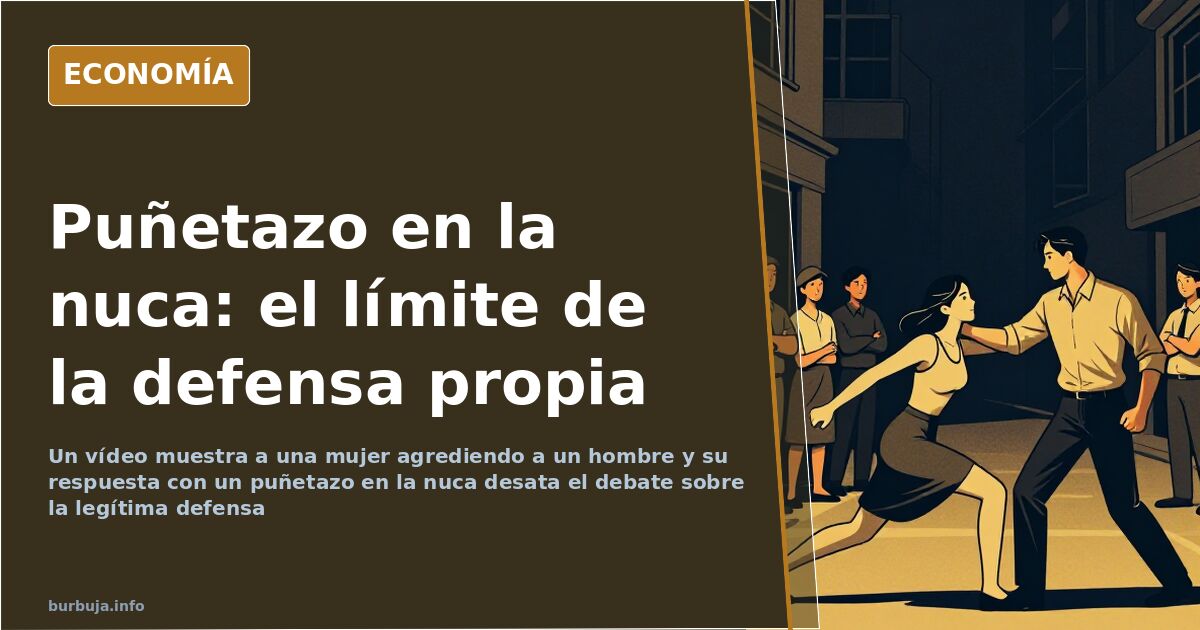
A video circulating without verified context shows a woman attacking a man—throwing papers at him and, according to the most widespread interpretation of the scene, striking him first—before turning her back and walking away calmly. The man, who was holding his phone, reacts with a punch to the back of her head. She falls and remains lying on the ground. The scene circulates under the tag Netflix girl and has sparked a discussion that goes beyond the incident itself: legitimate defense, the proportionality of the blow, and the narrative of empowerment.
The nickname summarizes a frequently repeated thesis: that certain fiction and discourse have convinced some women they can physically engage with a man without consequences. This is a debatable reading, and above all, an opinion. The only verifiable fact is the recorded sequence: the throwing of papers, a response of vastly superior force, and a body on the ground.
Was it legitimate defense or a disproportionate response?
This is where public opinion splits. One school argues that whoever attacks first assumes the risk of being hit back, and that the man's reaction is foreseeable: if she crossed the physical line, she cannot later claim special treatment. Opposing this, another school argues that the blow far exceeds the provocation. A punch from behind to the back of the head can cause serious injuries, and the difference in strength turns the response into punishment rather than defense.
Spanish law requires prior aggression, rational necessity of the means used, and absence of sufficient provocation. The disputed point is proportionality: a blow that knocks out the other person may exceed the limit if the initial aggression was minor. No ruling has been issued regarding this case. There is no record of a complaint, investigation, or judicial pronouncement. Some claim that in Spain the victim would end up convicted and the aggressor receiving a lifetime pension; this is more of a slogan diagnosis than a legal reality, because no resolution supports it.
Why part of the public celebrates the punch
"Good left," is repeated mockingly. The tone of part of the reaction is that the woman got what she deserved and that the scene has something of a generational settling of scores. Behind this lies the feeling that for years the idea has been transmitted that female physical force has no consequences, and that this narrative clashes abruptly with reality. The image of the supposed wall against which those who believe it crash was repeated ad nauseam.
Not everyone sees it that way. Another segment rejects the celebration: laughing at someone lying on the ground is, they say, a cruelty that disqualifies the laugher, regardless of who started it. And they point out that confusing defense with lesson-teaching is exactly the error they claim to criticize.
The origin of the protagonists, the other axis of the debate
Part of the conversation drifted toward the origins of those involved, with generalizations about groups that are not supported by any data and which this text does not reproduce. What is relevant, in terms of analysis, is how the episode became a screen onto which each projected their pre-existing framework: for some, proof of alleged favoritism; for others, the argument that a medium-sized woman's body suffers much more from any blow. In reality, the scene demonstrates neither of these things.
The Tokyo Revengers jacket and the misunderstanding hypothesis
Among the more curious theories circulating is one pointing to the clothing. The man was wearing a Tokyo Revengers jacket, a manga about juvenile biker gangs whose uniform includes a symbol that, viewed a certain way, resembles a swastika. In reality, it would be a Buddhist symbol, with arms turned in the opposite direction. The hypothesis, without any proof, is that the woman mistook it for a Nancy symbol. It is just one more speculation among many filling the contextual void.
From a street fight to war statistics
The discussion also jumped to unrelated grounds. At some point appeared the calculation that, in a population with 40% minors and a split of 30% between adult women and men, saying that 70% of casualties in a conflict are "women and children" amounts to describing an expected proportion. The data has nothing to do with the video, but illustrates to what extent a street brawl ends up serving as a springboard for any other discussion.
With these elements, the underlying question—whether the response was legitimate defense or revenge—has no closed answer. The before, the after, and any resolution are missing. A ten-second video has served for each side to confirm what they already thought.
A video circulating without verified context shows a woman attacking a man—throwing papers at him and, according to the most widespread interpretation of the scene, striking him first—before turning her back and walking away calmly. The man, who was holding his phone, reacts with a punch to the back of her head. She falls and remains lying on the ground. The scene circulates under the tag Netflix girl and has sparked a discussion that goes beyond the incident itself: legitimate defense, the proportionality of the blow, and the narrative of empowerment.
The nickname summarizes a frequently repeated thesis: that certain fiction and discourse have convinced some women they can physically engage with a man without consequences. This is a debatable reading, and above all, an opinion. The only verifiable fact is the recorded sequence: the throwing of papers, a response of vastly superior force, and a body on the ground.
Was it legitimate defense or a disproportionate response?
This is where public opinion splits. One school argues that whoever attacks first assumes the risk of being hit back, and that the man's reaction is foreseeable: if she crossed the physical line, she cannot later claim special treatment. Opposing this, another school argues that the blow far exceeds the provocation. A punch from behind to the back of the head can cause serious injuries, and the difference in strength turns the response into punishment rather than defense.
Spanish law requires prior aggression, rational necessity of the means used, and absence of sufficient provocation. The disputed point is proportionality: a blow that knocks out the other person may exceed the limit if the initial aggression was minor. No ruling has been issued regarding this case. There is no record of a complaint, investigation, or judicial pronouncement. Some claim that in Spain the victim would end up convicted and the aggressor receiving a lifetime pension; this is more of a slogan diagnosis than a legal reality, because no resolution supports it.
Why part of the public celebrates the punch
"Good left," is repeated mockingly. The tone of part of the reaction is that the woman got what she deserved and that the scene has something of a generational settling of scores. Behind this lies the feeling that for years the idea has been transmitted that female physical force has no consequences, and that this narrative clashes abruptly with reality. The image of the supposed wall against which those who believe it crash was repeated ad nauseam.
Not everyone sees it that way. Another segment rejects the celebration: laughing at someone lying on the ground is, they say, a cruelty that disqualifies the laugher, regardless of who started it. And they point out that confusing defense with lesson-teaching is exactly the error they claim to criticize.
The origin of the protagonists, the other axis of the debate
Part of the conversation drifted toward the origins of those involved, with generalizations about groups that are not supported by any data and which this text does not reproduce. What is relevant, in terms of analysis, is how the episode became a screen onto which each projected their pre-existing framework: for some, proof of alleged favoritism; for others, the argument that a medium-sized woman's body suffers much more from any blow. In reality, the scene demonstrates neither of these things.
The Tokyo Revengers jacket and the misunderstanding hypothesis
Among the more curious theories circulating is one pointing to the clothing. The man was wearing a Tokyo Revengers jacket, a manga about juvenile biker gangs whose uniform includes a symbol that, viewed a certain way, resembles a swastika. In reality, it would be a Buddhist symbol, with arms turned in the opposite direction. The hypothesis, without any proof, is that the woman mistook it for a Nancy symbol. It is just one more speculation among many filling the contextual void.
From a street fight to war statistics
The discussion also jumped to unrelated grounds. At some point appeared the calculation that, in a population with 40% minors and a split of 30% between adult women and men, saying that 70% of casualties in a conflict are "women and children" amounts to describing an expected proportion. The data has nothing to do with the video, but illustrates to what extent a street brawl ends up serving as a springboard for any other discussion.
With these elements, the underlying question—whether the response was legitimate defense or revenge—has no closed answer. The before, the after, and any resolution are missing. A ten-second video has served for each side to confirm what they already thought.
Summary of a discussion on Burbuja.info - Foro de economía, actualidad y política., translated from Spanish and reviewed before publication. Read the full discussion (201 replies).
More summaries
-
Jalisco Street Violence: Self-Defense and Firearm Debate
Analysis of a fatal shooting in Jalisco, Mexico, examining whether provocation or the firearm dictated the violent escalation.
-
Cyclist uses pepper spray against pitbull: self-defense or excess?
Analysis of a road incident involving a pitbull attack on a cyclist. The debate centers on whether the use of force constitutes legitimate self-defense or an unjustified excess.
-
Rioja University Students' Private WhatsApp Chat Exposed by SER
A private WhatsApp group of 199 primary education students in La Rioja, Spain, has become front-page news due to sexist comments and leaked messages.
-
Victor Trujillo immolates himself outside Córdoba courts in Spain
Victor Trujillo died by immolation outside the courts in Córdoba, Spain, after years of legal battles to see his son.
-
Hantavirus cases worsen after Tenerife evacuations to France and Madrid
Debate on health management of hantavirus transfers from Tenerife. Analysis of protocols, official information criticism, and political responsibility.
-
Spain's guardianship system faces scrutiny in Noelia euthanasia case
The debate over Noelia’s euthanasia request highlights tensions between state protection and the right to die, mixing legal, economic, and media concerns.