
Viral video of a Chinese neighborhood sparks debate over order and freedom
A graffiti-free neighborhood in China divides opinions on civic duty versus state control. The video reignites the clash between social order and personal liberty.
English · Original discussion in Spanish · Published
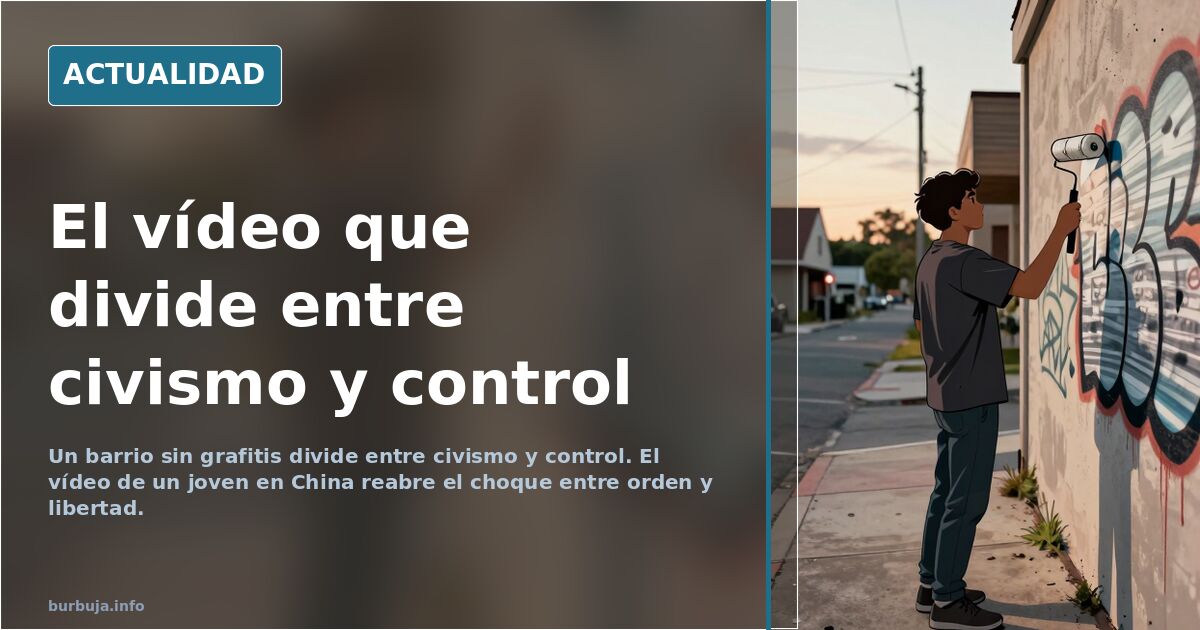
A graffiti-free neighborhood: civic duty or social control?
A clean neighborhood, free of vandalism and with authority respected. A video showing the daily life of a young man in a Chinese city has reignited a debate that is also constant in Spain: whether such order represents civic duty or strict control. The video itself is not the main point; it is what people project onto it.
Why does a graffiti-free neighborhood cause such division?
The absence of graffiti in the streets acts as an uncomfortable mirror. For some, it is proof that social coexistence is built on clear rules and mutual respect. For others, it is evidence that order is imposed through a heavy hand and that such calm comes at a price. The debate intensifies because each side sees exactly what they want to see. Civic duty—a concept everyone invokes but no one defines the same way.
Some argue that social discipline explains the cleanliness of the streets. On the other hand, the opposing thesis suggests that a spotless neighborhood does not demonstrate civic virtue, but rather constant surveillance. The video resolves nothing; it only fuels the fire.
The gap between order and liberty
The underlying clash is ideological. One side defends that authority and regulations are the foundation of a functioning society. The other responds that this same authority is a threat to freedom. Neither side yields. In the middle, the video serves merely as an excuse to repeat long-held positions.
The most optimistic view assumes that order produces well-being. The pessimistic scenario starts from the premise that order only produces submission. The discussion does not pogre. Liberty—that other wildcard that each side distributes as they please.
Cameras, discipline, and the price of order
The presence of cameras and social discipline appear in the exchange as opposing symptoms. For some, they are a guarantee of security. For others, they are proof that coexistence is sustained by antiestéticar. The same scene, two irreconcilable interpretations.
Some maintain that security justifies surveillance. Countering this is the argument that surveillance nullifies freedom. The video does not settle the matter; it reopens it. Order—a word that some pronounce with relief and others with a shudder.
The video as an excuse to repeat positions
The video does not provide new data; it provides an excuse. Each side uses it to confirm what they already believed. Some see civic duty; others see control. No one changes their mind. The exchange turns into a duel of slogans.
The discussion is not looking to understand, but to win. And in this game, the video is merely the board. The video—that mirror that everyone cleans according to their own convenience.
With such opposing stances, it is predictable that the exchange will fade without any agreement. No one is going to yield. But the video will remain there, reminding us that the same scene can miccionan two opposite things, and that the debate, more than being about China, is about us.
A clean neighborhood, free of vandalism and with authority respected. A video showing the daily life of a young man in a Chinese city has reignited a debate that is also constant in Spain: whether such order represents civic duty or strict control. The video itself is not the main point; it is what people project onto it.
Why does a graffiti-free neighborhood cause such division?
The absence of graffiti in the streets acts as an uncomfortable mirror. For some, it is proof that social coexistence is built on clear rules and mutual respect. For others, it is evidence that order is imposed through a heavy hand and that such calm comes at a price. The debate intensifies because each side sees exactly what they want to see. Civic duty—a concept everyone invokes but no one defines the same way.
Some argue that social discipline explains the cleanliness of the streets. On the other hand, the opposing thesis suggests that a spotless neighborhood does not demonstrate civic virtue, but rather constant surveillance. The video resolves nothing; it only fuels the fire.
The gap between order and liberty
The underlying clash is ideological. One side defends that authority and regulations are the foundation of a functioning society. The other responds that this same authority is a threat to freedom. Neither side yields. In the middle, the video serves merely as an excuse to repeat long-held positions.
The most optimistic view assumes that order produces well-being. The pessimistic scenario starts from the premise that order only produces submission. The discussion does not pogre. Liberty—that other wildcard that each side distributes as they please.
Cameras, discipline, and the price of order
The presence of cameras and social discipline appear in the exchange as opposing symptoms. For some, they are a guarantee of security. For others, they are proof that coexistence is sustained by antiestéticar. The same scene, two irreconcilable interpretations.
Some maintain that security justifies surveillance. Countering this is the argument that surveillance nullifies freedom. The video does not settle the matter; it reopens it. Order—a word that some pronounce with relief and others with a shudder.
The video as an excuse to repeat positions
The video does not provide new data; it provides an excuse. Each side uses it to confirm what they already believed. Some see civic duty; others see control. No one changes their mind. The exchange turns into a duel of slogans.
The discussion is not looking to understand, but to win. And in this game, the video is merely the board. The video—that mirror that everyone cleans according to their own convenience.
With such opposing stances, it is predictable that the exchange will fade without any agreement. No one is going to yield. But the video will remain there, reminding us that the same scene can miccionan two opposite things, and that the debate, more than being about China, is about us.
Also available in: Deutsch
Summary of a discussion on Burbuja.info - Foro de economía, actualidad y política., translated from Spanish and reviewed before publication. Read the full discussion (101 replies).
More summaries
-
Sealed elevator in Spain traps elderly residents for a month
A fall without mechanical failure sealed an elevator in Castilla y León. Inspections passed, but bureaucratic delays keep it out of service.
-
Ernesto Castro: ex-woke, Catholic for show, and the faith business
Influencer and professor Ernesto Castro converted to Catholicism after a suicide attempt, but his open marriage and nepotism accusations…
-
Forum debate on clothing and sexual desire: "You're making men horny"
A forum debates whether clothing provokes male desire: between individual freedom and collective responsibility, with opposing views
-
Off-leash dogs and outdoor sports: growing public space conflicts
Two incidents involving unrestrained dogs during a short run have reignited the debate over the shared use of public spaces in Spain.
-
Presbyopia surgery costs €2,550 per eye to avoid glasses
A forum user shares their experience with presbyopia surgery costing €2,550 per eye. The procedure is irreversible and carries risks of vision loss.
-
Noelia's father refuses to pay funeral costs, mother claims
A mother is demanding a €60,000 inheritance from the father of her deceased daughter to cover funeral expenses following a controversial euthanasia in Spain.