
Viral Message Urges Confronting 'Fascist' Relatives This Christmas Eve
A viral post urges Spaniards to confront relatives labeled 'fascists' at Christmas dinner. Forum consensus: the stereotypical annoying in-law has switched sides.
English · Original discussion in Spanish · Published
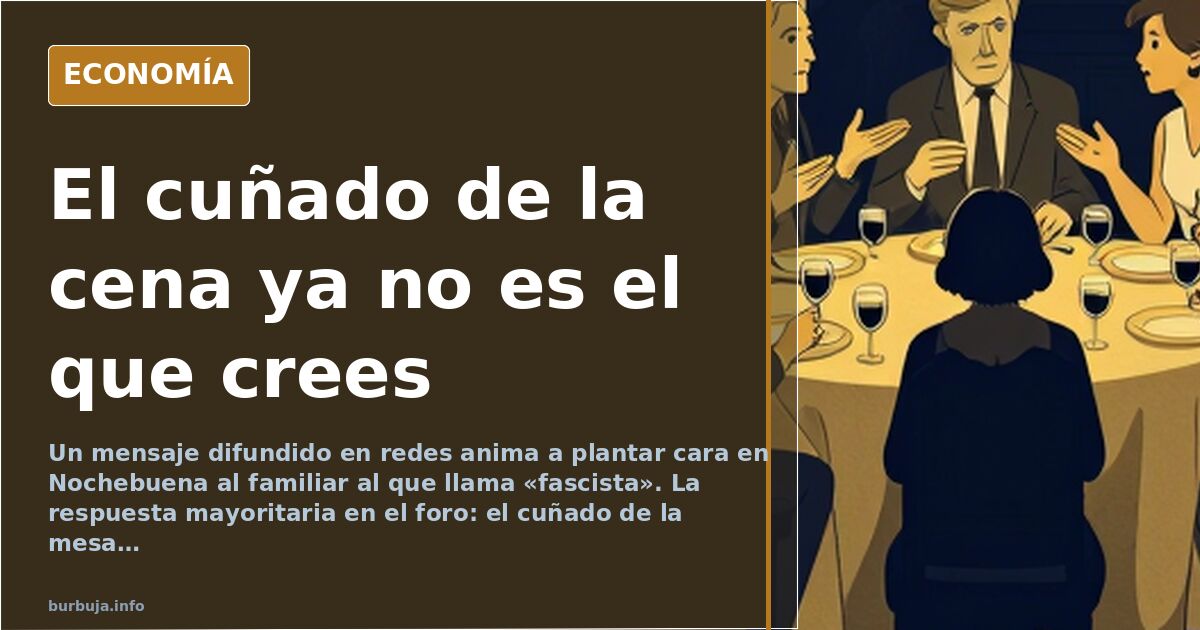
The Christmas Eve In-Law Is Not Who You Think
Amid a meat brand's holiday campaign playing on the relative who dominates the toast, a viral social media message has reignited debate over who occupies that uncomfortable seat today. The text, attributed to a left-wing profile known for TV verbosity, urges Spaniards to confront the family member they label "fascist" during Christmas Eve dinner. The majority response was swift: the stereotypical "cuñado" (annoying brother-in-law) has changed sides.
The controversy isn't about shrimp. It is about who has the right to lecture on the one day of the year when half of Spain sits together without phones. And whether that right has been exhausted.
What Exactly Does the Viral Message Say?
The original text is a tweet from a profile known for its TV talk, reproduced mockingly in an economics forum. It assumes people no longer believe "the fascist and Nancy story" and calls for arguing with relatives who don't agree. The message offers no data, figures, or proposals: just a domestic behavioral instruction.
That is the first problem. A call to argue on Christmas Eve with those who disagree is not political analysis; it is a table-side slogan. And when these slogans become journalistic genre, things usually end badly.
The immediate reaction in the forum was frontal rejection. Critics accuse the author of confusing their circle with the country, speaking of "fascists" while holding a parliamentary seat, and using family dinners as propaganda platforms. The most repeated phrase: you are the "cuñado".
The Relative Who No Longer Tolerates the Discourse
The dominant thesis is that the label "fascist" has been devalued by excessive use. Some argue that words like Nancy or racist have shifted from insult to compliment, and this wear is precisely what emptied the call of meaning. If everyone who disagrees is a fascist, the term stops describing and starts merely labeling.
The second argument is more uncomfortable for the author: the heavy-handed relative has changed profiles. They are no longer the businessman talking about risk premiums, but the one arriving with soy products and deconstruction discourse. The scene described is a dinner where the lecturer is now the one who used to receive lectures.
The third point concerns democratic hygiene. Several messages recall the unwritten rule of Christmas Eve: do not discuss politics or religion. Breaking it intentionally, especially from a public platform, reads as unnecessary provocation.
The Business Behind the Ad and the Holiday Argument
The origin of all this is an advertising campaign by a cured meats brand that, like every year, tries to sneak into the Christmas conversation. The brand has shifted its discourse with the wind: first an ad aligned with political correctness, now a more equidistant one with the same actors. The result is a storm in a teacup with clear commercial interests.
The data cited is that the company pays taxes in Spain, and part of that money funds, via budget, the very officials calling for a boycott. The paradox is textbook: the advertiser subsidizes those demanding their cancellation.
Some see this as a left-wing operation to reclaim the Christmas narrative, while others see simply a company trying to sell more ham slices. Both can be true simultaneously.
The Rift That a Toast Cannot Fix
The underlying issue is the family as a battlefield. Arguments suggest there is an interested agenda sabotaging the family institution, citing pandemic meeting restrictions as precedent. Others view this reading as a conspiracy without proof.
What clearly appears is fatigue. People do not want to discuss politics on Christmas Eve, especially with someone who will call them fascist before the turrón (almond nougat). The call to domestic conflict does not unite, it separates; it does not convince, it tires.
The lingering question is whether the message's author will actually sit down to argue with their own brother-in-law, or if, as many suspect, they will preach fire and dine elsewhere.
Key Data
Amid a meat brand's holiday campaign playing on the relative who dominates the toast, a viral social media message has reignited debate over who occupies that uncomfortable seat today. The text, attributed to a left-wing profile known for TV verbosity, urges Spaniards to confront the family member they label "fascist" during Christmas Eve dinner. The majority response was swift: the stereotypical "cuñado" (annoying brother-in-law) has changed sides.
The controversy isn't about shrimp. It is about who has the right to lecture on the one day of the year when half of Spain sits together without phones. And whether that right has been exhausted.
What Exactly Does the Viral Message Say?
The original text is a tweet from a profile known for its TV talk, reproduced mockingly in an economics forum. It assumes people no longer believe "the fascist and Nancy story" and calls for arguing with relatives who don't agree. The message offers no data, figures, or proposals: just a domestic behavioral instruction.
That is the first problem. A call to argue on Christmas Eve with those who disagree is not political analysis; it is a table-side slogan. And when these slogans become journalistic genre, things usually end badly.
The immediate reaction in the forum was frontal rejection. Critics accuse the author of confusing their circle with the country, speaking of "fascists" while holding a parliamentary seat, and using family dinners as propaganda platforms. The most repeated phrase: you are the "cuñado".
The Relative Who No Longer Tolerates the Discourse
The dominant thesis is that the label "fascist" has been devalued by excessive use. Some argue that words like Nancy or racist have shifted from insult to compliment, and this wear is precisely what emptied the call of meaning. If everyone who disagrees is a fascist, the term stops describing and starts merely labeling.
The second argument is more uncomfortable for the author: the heavy-handed relative has changed profiles. They are no longer the businessman talking about risk premiums, but the one arriving with soy products and deconstruction discourse. The scene described is a dinner where the lecturer is now the one who used to receive lectures.
The third point concerns democratic hygiene. Several messages recall the unwritten rule of Christmas Eve: do not discuss politics or religion. Breaking it intentionally, especially from a public platform, reads as unnecessary provocation.
The Business Behind the Ad and the Holiday Argument
The origin of all this is an advertising campaign by a cured meats brand that, like every year, tries to sneak into the Christmas conversation. The brand has shifted its discourse with the wind: first an ad aligned with political correctness, now a more equidistant one with the same actors. The result is a storm in a teacup with clear commercial interests.
The data cited is that the company pays taxes in Spain, and part of that money funds, via budget, the very officials calling for a boycott. The paradox is textbook: the advertiser subsidizes those demanding their cancellation.
Some see this as a left-wing operation to reclaim the Christmas narrative, while others see simply a company trying to sell more ham slices. Both can be true simultaneously.
The Rift That a Toast Cannot Fix
The underlying issue is the family as a battlefield. Arguments suggest there is an interested agenda sabotaging the family institution, citing pandemic meeting restrictions as precedent. Others view this reading as a conspiracy without proof.
What clearly appears is fatigue. People do not want to discuss politics on Christmas Eve, especially with someone who will call them fascist before the turrón (almond nougat). The call to domestic conflict does not unite, it separates; it does not convince, it tires.
The lingering question is whether the message's author will actually sit down to argue with their own brother-in-law, or if, as many suspect, they will preach fire and dine elsewhere.
Key Data
- The original message calls for arguing on Christmas Eve with the relative labeled fascist.
- The advertising campaign that sparked the controversy belongs to a meat brand.
- The most repeated thesis: the stereotypical in-law has changed sides.
Summary of a discussion on Burbuja.info - Foro de economía, actualidad y política., translated from Spanish and reviewed before publication. Read the full discussion (143 replies).
More summaries
-
Spanish Pensioners Shift to Vox After Squatter Incident
Retired voters for Podemos and PSOE switch to Vox after losing health due to illegal squatting in their home.
-
Officials Flee Ministries to Avoid Signing Illegal Documents
Ministry officials under suspicion request transfers to avoid signing illegal documents. Political pressure and fear of reprisals trigger a mass exodus...
-
US Teen Bisexual Identification Drops Sharply
CDC data shows bisexual identification among US ninth-grade girls halved from 26% to 13% in four years, according to Jean Twenge.
-
Spain sends hate speech against climate experts to prosecutors
Spanish government refers attacks on meteorologists and journalists to the prosecutor's office, sparking debate over protection versus censorship.
-
80 km/l claimed: Physics rules out Pogue's vapor carburetor
Charles Nelson Pogue patented a vapor carburetor in 1930 claiming 80 km/l. Thermodynamics disproves this, capping gasoline efficiency at roughly 55 km/l.
-
Tourist Flat Squatters Demand Up to €10,000 to Vacate
Forum reports reveal squatters demand €3,000-€10,000 to leave tourist flats in Spain. Overburdened courts and organized gangs worsen the crisis.